Combining parenting and economic strengthening programmes to reduce violence against children: a cluster randomised controlled trial with predominantly male caregivers in rural Tanzania
- PMID: 32641291
- PMCID: PMC7348478
- DOI: 10.1136/bmjgh-2020-002349
Combining parenting and economic strengthening programmes to reduce violence against children: a cluster randomised controlled trial with predominantly male caregivers in rural Tanzania
Abstract
Introduction: Parenting programmes may reduce the risk of violence against children and improve child well-being. However, additional economic support may be necessary in highly deprived rural communities in sub-Saharan Africa. Furthermore, delivering programmes within farmer groups may increase male caregiver recruitment and engagement.
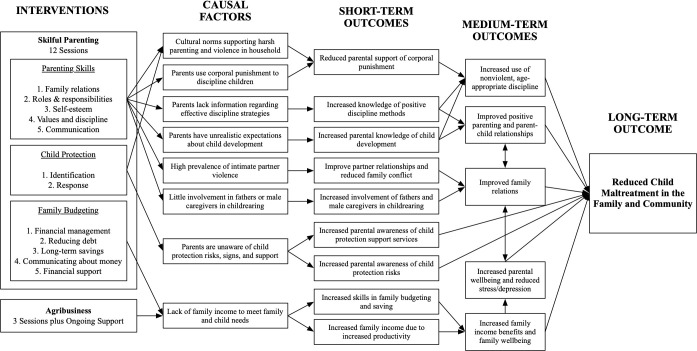
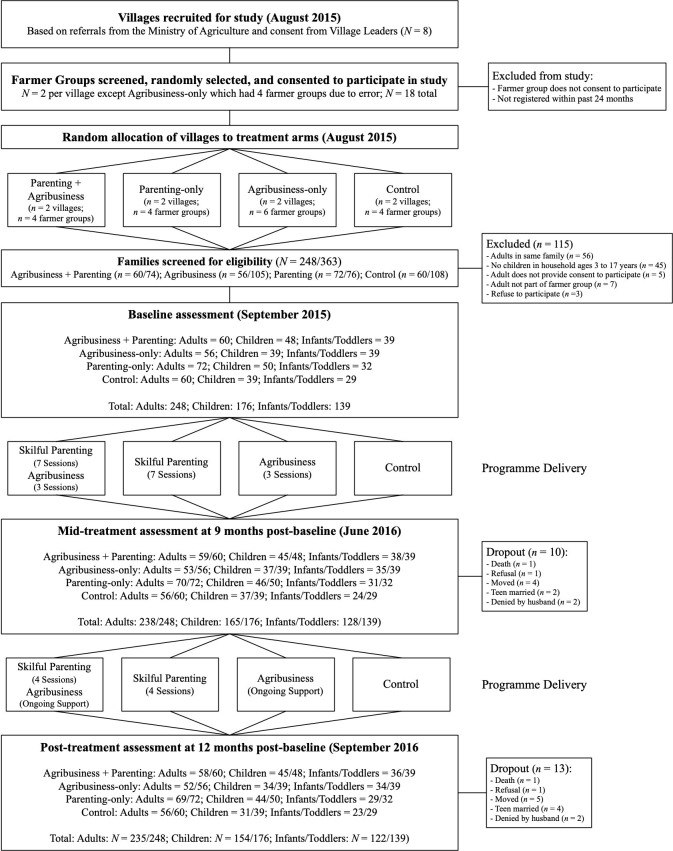
Methods: A parallel cluster randomised controlled trial examined the combined and separate effects of parenting and economic strengthening programmes on reducing violence against children aged 0-18 years in farming communities in Tanzania (n=248 families; 63% male caregivers). Eight villages were randomly assigned to four conditions (2:2:2:2): (1) 12-session parenting programme (n=60); (2) agribusiness training (n=56); (3) parenting and agribusiness combined (n=72); (4) control (n=60). Parent-report, child-report and early childhood observation assessments were conducted at baseline, mid-treatment and post-treatment. Primary outcomes were child maltreatment and parenting behaviour. Secondary outcomes included corporal punishment endorsement, parenting stress, parent/child depression, child behaviour, economic well-being and child development.
Results: At post-treatment, parents and children receiving the combined interventions reported less maltreatment (parents: incidence rate ratio (IRR=0.40, 95% CI 0.24 to 0.65; children: IRR=0.40, 95% CI 0.17 to 0.92). Parents reported reduced endorsement of corporal punishment (Dw =-0.43, 95% CI -0.79 to 0.07) and fewer child behaviour problems (Dw =-0.41, 95% CI -0.77 to 0.05). Parents in parenting-only villages reported less abuse (IRR=0.36, 95% CI 0.21 to 0.63) and fewer child behaviour problems (Dw =-0.47, 95% CI -0.84 to 0.11). Parents in agribusiness-only villages reported fewer child behaviour problems (Dw =-0.43, 95% CI -0.77 to 0.08) and greater household wealth (Dw =0.57, 95% CI 0.08 to 1.06). However, children in agribusiness-only villages reported increased physical abuse (IRR=2.26, 95% CI 1.00 to 5.12) and less positive parenting (Dw =-0.50, 95% CI -0.91 to 0.10). There were no other adverse effects.
Conclusion: Parent training may be the active ingredient in reducing maltreatment in farmer groups with majority male caregivers, while agribusiness training programmes may have unintended negative consequences on children when delivered alone. Locating parenting support in existing farmer groups can engage much higher proportions of fathers than stand-alone programmes.ClinicalTrials.gov: NCT02633319.
Keywords: cCluster randomised trial; child health; prevention strategies.
© Author(s) (or their employer(s)) 2020. Re-use permitted under CC BY. Published by BMJ.
Conflict of interest statement
Competing interests: The authors declare the following competing interests: JL reports grants from UBS Optimus Foundation, grants from Netherlands Ministry of Foreign Affairs, grants from Complexity in Health Improvement Programme of the Medical Research Council MRC UK, during the conduct of the study; grants from UNICEF Thailand, grants from UNICEF Philippines, personal fees from Maestral International, grants from EU Horizon 2020, personal fees from Oxford Policy Management, personal fees from Clowns Without Borders South Africa, grants from Oak Foundation, outside the submitted work; and JL is the codeveloper of a non-profit parenting program with the WHO ‘Parenting for Lifelong Health’, under a creative commons license, and receives fees as a trainer for this. JW reports grants from UBS Optimus foundation during the conduct of the study. TS reports personal fees from International Catholic Relief Services, personal fees from Department of Education, University of Oxford, personal fees and other from Journal of Child and Adolescent Mental Health outside the submitted work. JM reports grants from UBS Optimus Foundation, grants from Netherlands Ministry of Foreign Affairs, from Complexity in Health Improvement Programme of the Medical Research Council MRC UK during the conduct of the study. DW reports grants from UBS Optimus Foundation, grants from Netherlands Ministry of Foreign Affairs, from Complexity in Health Improvement Programme of the Medical Research Council MRC UK, during the conduct of the study; and DW has devoted considerable time to developing a parenting programme in Uganda (Parenting for Respectability) which might be perceived to create a bias towards interpreting parenting interventions as effective. FG reports grants from NIHR, during the conduct of the study; grants from UNICEF, grants from EU Horizon 2020, grants from UBS Optimus Foundation, grants from John Fell Oxford University Press Research Fund, personal fees from Blueprints for Health Youth Development, University of Colorado, Boulder, personal fees from Trygfonden Foundation, Denmark, outside the submitted work. FG is also a codeveloper of a non-profit parenting programme with WHO, ‘Parenting for Lifelong Health’, and receives no fees for this.
Figures
References
-
- UNICEF Violence against children in Tanzania: findings from a national survey, 2009. Dar es Salaam, Tanzania: UNICEF Tanzania, Division of Violence Prevention, National Center for Injury Prevention and Control, Centers for Disease Control and Prevention, and Muhimbili University of Health and Allied Sciences, 2011.
Publication types
MeSH terms
Associated data
Grants and funding
LinkOut - more resources
Full Text Sources
Medical