


Mixed-methods study on pharmacies as contraception providers to Kenyan young people: who uses them and why?
- PMID: 32641322
- PMCID: PMC7348460
- DOI: 10.1136/bmjopen-2019-034769
Mixed-methods study on pharmacies as contraception providers to Kenyan young people: who uses them and why?
Abstract
Objectives: This study sought to answer two questions: (1) what are the characteristics of young Kenyans aged 18-24 who use contraception obtained at pharmacies, and (2) why are pharmacies appealing sources of contraception?
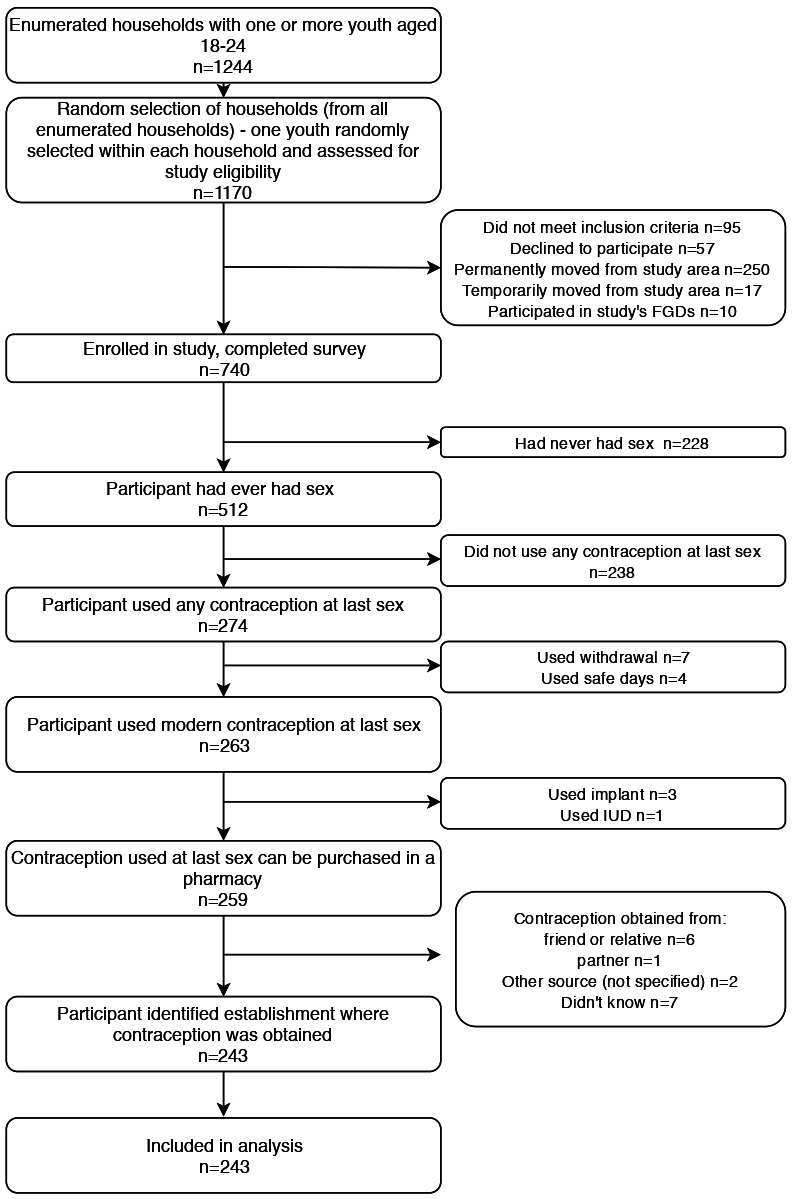
Design and setting: This was a mixed-methods study in one peri-urban part of Kwale County, Kenya. Methods included cross-sectional survey (n=740), six focus group discussions, 18 in-depth interviews and 25 key-informant interviews. Quantitative data analysis identified factors pushing young people to pharmacies for modern contraception versus other sources. Qualitative data analysis identified reasons pharmacies were perceived to be appealing to young clients.
Participants: Participants were (1) young people aged 18-24 from the study area, including a subset who had recently purchased contraception from a pharmacy; or (2) pharmacy personnel and pharmacy stakeholders.
Results: Among surveyed participants who had ever had sexual intercourse and had used modern contraception at last sexual intercourse, 59% obtained it from a pharmacy. In multivariable analysis, participants who used a condom or emergency contraception as well as those living alone were significantly more likely to get contraception from pharmacies. Pharmacies were valued for their convenience, privacy, non-judgmental and personable staff, service speed, as well as predictable and affordable prices.
Conclusions: Our findings indicate a high percentage of young people in Coastal Kenya use pharmacies for contraception. Our inclusion of emergency contraception users partially explains this. Pharmacies were perceived to be everything that health facilities are not: fast, private and non-limiting. Policy-makers should recognise the role of pharmacies as contraception providers and look for opportunities to link pharmacies to the public health system. This would create a network of accessible and appealing contraception services for young people.
Keywords: community child health; public health; qualitative research; reproductive medicine.
©World Health Organization 2020. Licensee BMJ.
Conflict of interest statement
Competing interests: None declared.
Figures
References
-
- MacQuarrie KLD. Unmet need for family planning among young women: levels and trends. Rockville, MD: ICF International, 2014.
-
- High-Impact Practices in Family Planning (HIPs) . Adolescent-friendly contraceptive services: mainstreaming adolescent-friendly elements into existing contraceptive services. USAID, 2015.
-
- JSI . Private shops and pharmacies as providers of family planning, 2016.
Publication types
MeSH terms
Grants and funding
LinkOut - more resources
Full Text Sources
