


Hierarchical Order of Distinct Autoantibody Spreading and Progression to Type 1 Diabetes in the TEDDY Study
- PMID: 32641373
- PMCID: PMC7440899
- DOI: 10.2337/dc19-2547
Hierarchical Order of Distinct Autoantibody Spreading and Progression to Type 1 Diabetes in the TEDDY Study
Abstract
Objective: The first-appearing β-cell autoantibody has been shown to influence risk of type 1 diabetes (T1D). Here, we assessed the risk of autoantibody spreading to the second-appearing autoantibody and further progression to clinical disease in The Environmental Determinants of Diabetes in the Young (TEDDY) study.
Research design and methods: Eligible children with increased HLA-DR-DQ genetic risk for T1D were followed quarterly from age 3 months up to 15 years for development of a single first-appearing autoantibody (GAD antibody [GADA], insulin autoantibody [IAA], or insulinoma antigen-2 autoantibody [IA-2A]) and subsequent development of a single second-appearing autoantibody and progression to T1D. Autoantibody positivity was defined as positivity for a specific autoantibody at two consecutive visits confirmed in two laboratories. Zinc transporter 8 autoantibody (ZnT8A) was measured in children who developed another autoantibody.
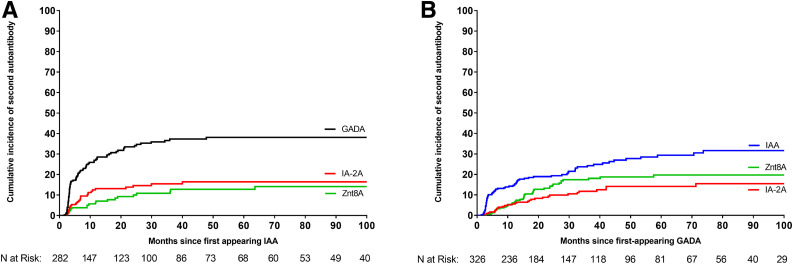
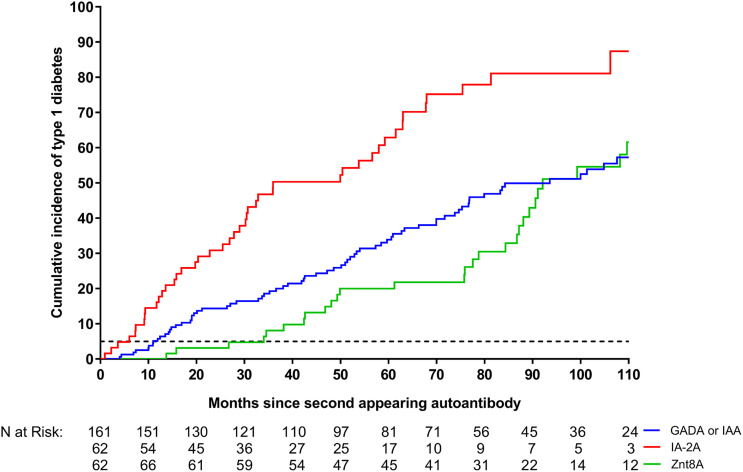
Results: There were 608 children who developed a single first-appearing autoantibody (IAA, n = 282, or GADA, n = 326) with a median follow-up of 12.5 years from birth. The risk of a second-appearing autoantibody was independent of GADA versus IAA as a first-appearing autoantibody (adjusted hazard ratio [HR] 1.12; 95% CI 0.88-1.42; P = 0.36). Second-appearing GADA, IAA, IA-2A, or ZnT8A conferred an increased risk of T1D compared with children who remained positive for a single autoantibody, e.g., IAA or GADA second (adjusted HR 6.44; 95% CI 3.78-10.98), IA-2A second (adjusted HR 16.33; 95% CI 9.10-29.29; P < 0.0001), or ZnT8A second (adjusted HR 5.35; 95% CI 2.61-10.95; P < 0.0001). In children who developed a distinct second autoantibody, IA-2A (adjusted HR 3.08; 95% CI 2.04-4.65; P < 0.0001) conferred a greater risk of progression to T1D as compared with GADA or IAA. Additionally, both a younger initial age at seroconversion and shorter time to the development of the second-appearing autoantibody increased the risk for T1D.
Conclusions: The hierarchical order of distinct autoantibody spreading was independent of the first-appearing autoantibody type and was age-dependent and augmented the risk of progression to T1D.
© 2020 by the American Diabetes Association.
Figures
References
-
- Bingley PJ, Bonifacio E, Williams AJ, Genovese S, Bottazzo GF, Gale EA. Prediction of IDDM in the general population: strategies based on combinations of autoantibody markers. Diabetes 1997;46:1701–1710 - PubMed
-
- Bonifacio E, Bingley PJ. Islet autoantibodies and their use in predicting insulin-dependent diabetes. Acta Diabetol 1997;34:185–193 - PubMed
Publication types
MeSH terms
Substances
Associated data
Grants and funding
- U01 DK063821/DK/NIDDK NIH HHS/United States
- UC4 DK063863/DK/NIDDK NIH HHS/United States
- HHSN267200700014C/DK/NIDDK NIH HHS/United States
- U01 DK063790/DK/NIDDK NIH HHS/United States
- UL1 TR001082/TR/NCATS NIH HHS/United States
- UL1 TR000064/TR/NCATS NIH HHS/United States
- U01 DK063836/DK/NIDDK NIH HHS/United States
- U01 DK063829/DK/NIDDK NIH HHS/United States
- U01 DK063865/DK/NIDDK NIH HHS/United States
- UC4 DK095300/DK/NIDDK NIH HHS/United States
- UC4 DK063861/DK/NIDDK NIH HHS/United States
- UC4 DK063829/DK/NIDDK NIH HHS/United States
- UC4 DK063821/DK/NIDDK NIH HHS/United States
- UC4 DK117483/DK/NIDDK NIH HHS/United States
- UC4 DK063836/DK/NIDDK NIH HHS/United States
- UC4 DK112243/DK/NIDDK NIH HHS/United States
- U01 DK124166/DK/NIDDK NIH HHS/United States
- U01 DK063861/DK/NIDDK NIH HHS/United States
- UC4 DK063865/DK/NIDDK NIH HHS/United States
- U01 DK063863/DK/NIDDK NIH HHS/United States
- UC4 DK106955/DK/NIDDK NIH HHS/United States
- UC4 DK100238/DK/NIDDK NIH HHS/United States
LinkOut - more resources
Full Text Sources
Medical
Research Materials
