Brain Metastasis Cell Lines Panel: A Public Resource of Organotropic Cell Lines
- PMID: 32641416
- PMCID: PMC7572582
- DOI: 10.1158/0008-5472.CAN-20-0291
Brain Metastasis Cell Lines Panel: A Public Resource of Organotropic Cell Lines
Abstract
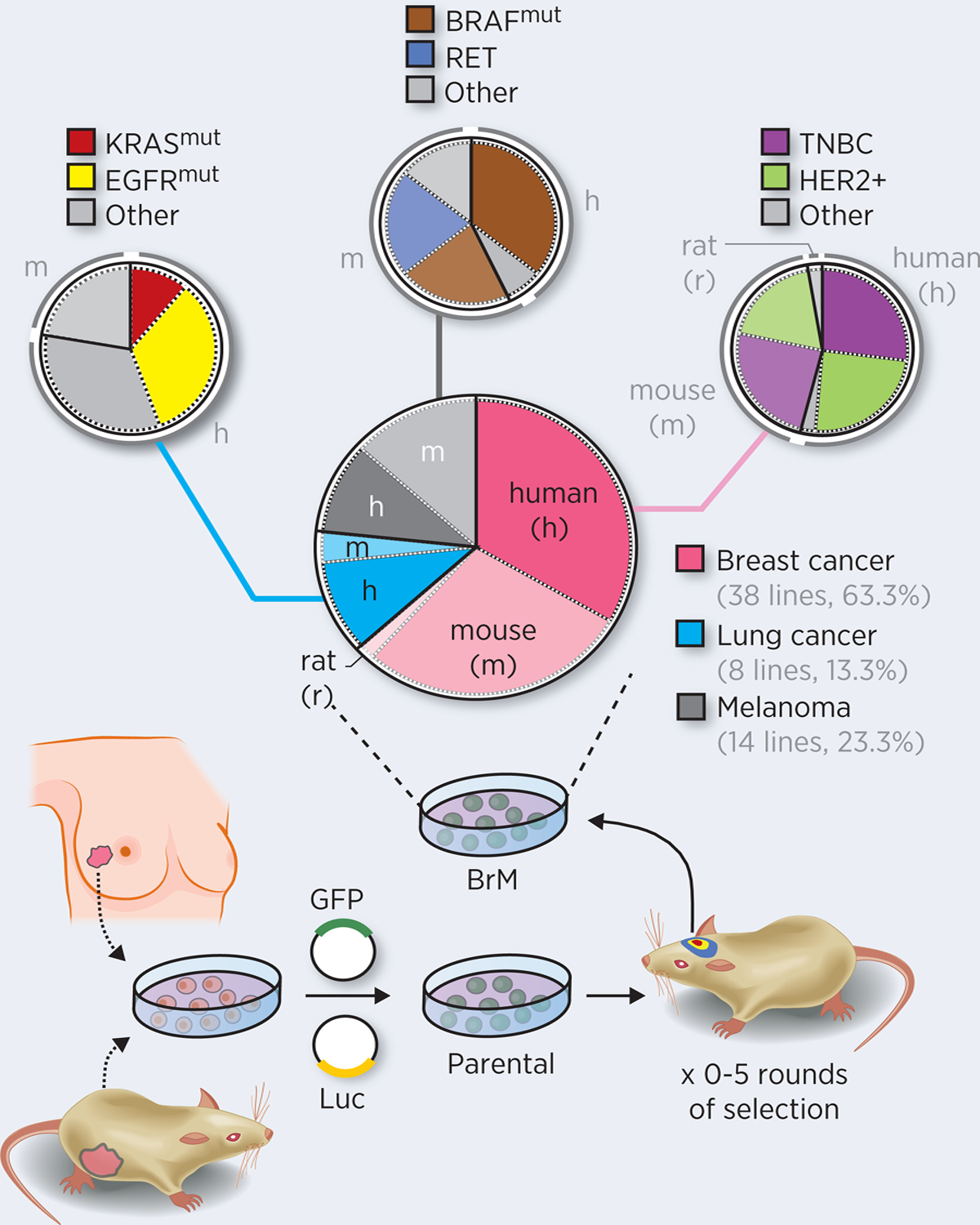
Spread of cancer to the brain remains an unmet clinical need in spite of the increasing number of cases among patients with lung, breast cancer, and melanoma most notably. Although research on brain metastasis was considered a minor aspect in the past due to its untreatable nature and invariable lethality, nowadays, limited but encouraging examples have questioned this statement, making it more attractive for basic and clinical researchers. Evidences of its own biological identity (i.e., specific microenvironment) and particular therapeutic requirements (i.e., presence of blood-brain barrier, blood-tumor barrier, molecular differences with the primary tumor) are thought to be critical aspects that must be functionally exploited using preclinical models. We present the coordinated effort of 19 laboratories to compile comprehensive information related to brain metastasis experimental models. Each laboratory has provided details on the cancer cell lines they have generated or characterized as being capable of forming metastatic colonies in the brain, as well as principle methodologies of brain metastasis research. The Brain Metastasis Cell Lines Panel (BrMPanel) represents the first of its class and includes information about the cell line, how tropism to the brain was established, and the behavior of each model in vivo. These and other aspects described are intended to assist investigators in choosing the most suitable cell line for research on brain metastasis. The main goal of this effort is to facilitate research on this unmet clinical need, to improve models through a collaborative environment, and to promote the exchange of information on these valuable resources.
©2020 American Association for Cancer Research.
Conflict of interest statement
Conflict of interest statement
The authors declare no potential conflict of interest
Figures
References
Publication types
MeSH terms
Grants and funding
- MR/S002057/1/MRC_/Medical Research Council/United Kingdom
- 16945/CRUK_/Cancer Research UK/United Kingdom
- R01 CA223544/CA/NCI NIH HHS/United States
- P30 CA010815/CA/NCI NIH HHS/United States
- L30 CA242554/CA/NCI NIH HHS/United States
- P30 CA008748/CA/NCI NIH HHS/United States
- R37 CA227984/CA/NCI NIH HHS/United States
- R01 CA208205/CA/NCI NIH HHS/United States
- R01 CA121118/CA/NCI NIH HHS/United States
- C5255/A15935 /CRUK_/Cancer Research UK/United Kingdom
- P01 CA114046/CA/NCI NIH HHS/United States
- 16466/CRUK_/Cancer Research UK/United Kingdom
- R35 CA197743/CA/NCI NIH HHS/United States
LinkOut - more resources
Full Text Sources
Medical
Miscellaneous