Sub-solid lung adenocarcinoma in Asian versus Caucasian patients: different biology but similar outcomes
- PMID: 32642121
- PMCID: PMC7330405
- DOI: 10.21037/jtd.2020.04.37
Sub-solid lung adenocarcinoma in Asian versus Caucasian patients: different biology but similar outcomes
Abstract
Background: Asian and Caucasian patients with lung cancer have been compared in several database studies, with conflicting findings regarding survival. However, these studies did not include proportion of ground-glass opacity or mutational status in their analyses. Asian patients commonly develop sub-solid lung adenocarcinomas that harbor EGFR mutations, which have a better prognosis. We hypothesized that among patients undergoing surgery for sub-solid lung adenocarcinomas, Asian patients have better survival compared to Caucasian patients.
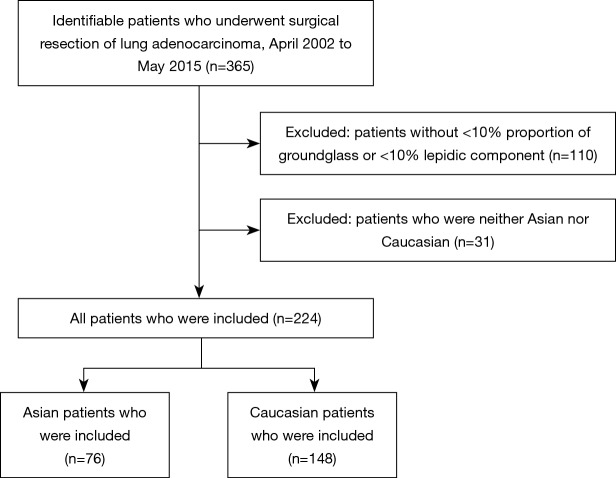
Methods: We identified Asian and Caucasian patients who underwent surgical resection for a sub-solid lung adenocarcinoma from 2002 to 2015 at our institution. Sub-solid was defined as ≥10% ground-glass opacity on preoperative CT scan or ≥10% lepidic component on surgical pathology. Time-to-event multivariable analysis was performed to determine which characteristics were associated with recurrence and survival.
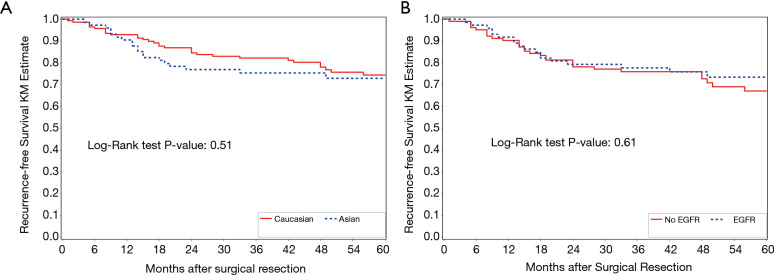
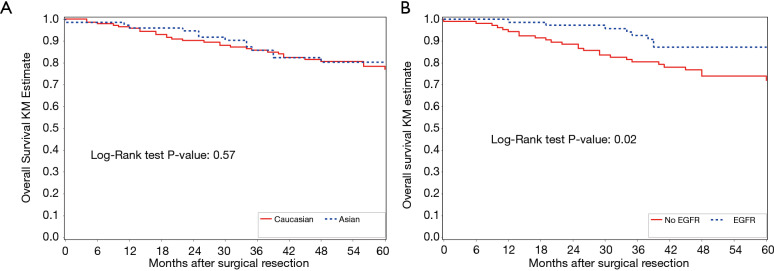
Results: Two hundred twenty-four patients were included with median follow up 48 months. Asian patients were more likely to be never smokers (76.3% vs. 29.0%, P<0.01) and have an EGFR mutation (69.4% vs. 25.6% of those tested, P<0.01), while Caucasian patients were more likely to have a KRAS mutation (23.5% vs. 4.9% of those tested, P<0.01). There was a trend towards Asian patients having a higher proportion of ground-glass opacity (38.8% vs. 30.5%, P=0.11). Time-to-event multivariable analysis showed that higher proportion of ground-glass opacity was significantly associated with better recurrence-free survival (HR 0.76 per 20% increase, P=0.02). However, mutational status and race did not have a significant impact on recurrence-free or overall survival.
Conclusions: Asian and Caucasian patients with sub-solid lung adenocarcinoma have different tumor biology, but recurrence-free and overall survival after surgical resection is similar.
Keywords: Lung adenocarcinoma; ground-glass opacity; sub-solid lung nodule.
2020 Journal of Thoracic Disease. All rights reserved.
Conflict of interest statement
Conflicts of Interest: All authors have completed the ICMJE uniform disclosure form (available at http://dx.doi.org/10.21037/jtd.2020.04.37). JBS reports grants and personal fees from Becton-Dickinson, outside the submitted work; In addition, JBS has a patent CRISPR/Cas-mediated Genome Editing to Treat EGFR-mutant Lung Cancer issued. NSL reports other from Auspex, outside the submitted work and serves as an unpaid editorial board member of Journal of Thoracic Disease from Sep 2019 to Aug 2021. MFB serves as an unpaid editorial board member of Journal of Thoracic Disease from Sep 2018 to Aug 2020. The other authors have no conflicts of interest to declare.
Figures
References
LinkOut - more resources
Full Text Sources
Research Materials
Miscellaneous