


Development of non-nucleoside reverse transcriptase inhibitors (NNRTIs): our past twenty years
- PMID: 32642405
- PMCID: PMC7332669
- DOI: 10.1016/j.apsb.2019.11.010
Development of non-nucleoside reverse transcriptase inhibitors (NNRTIs): our past twenty years
Abstract
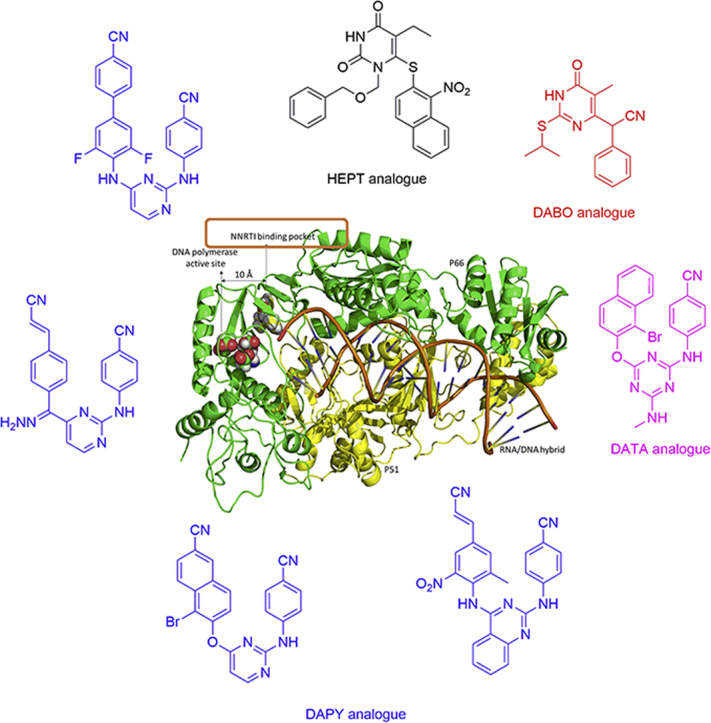
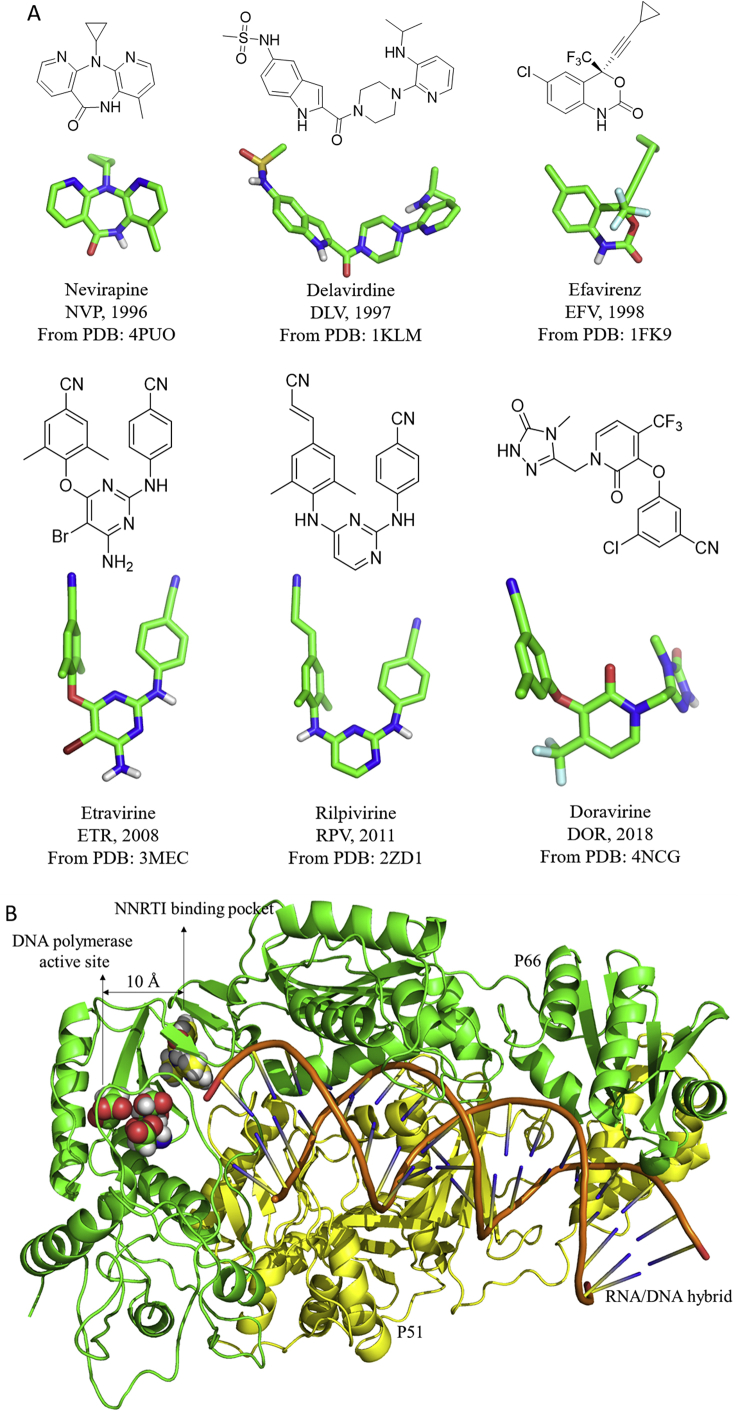
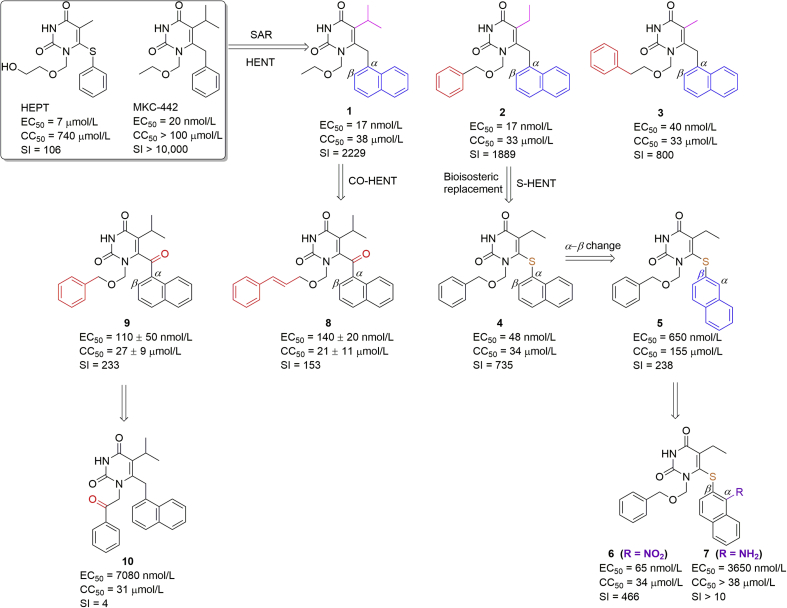
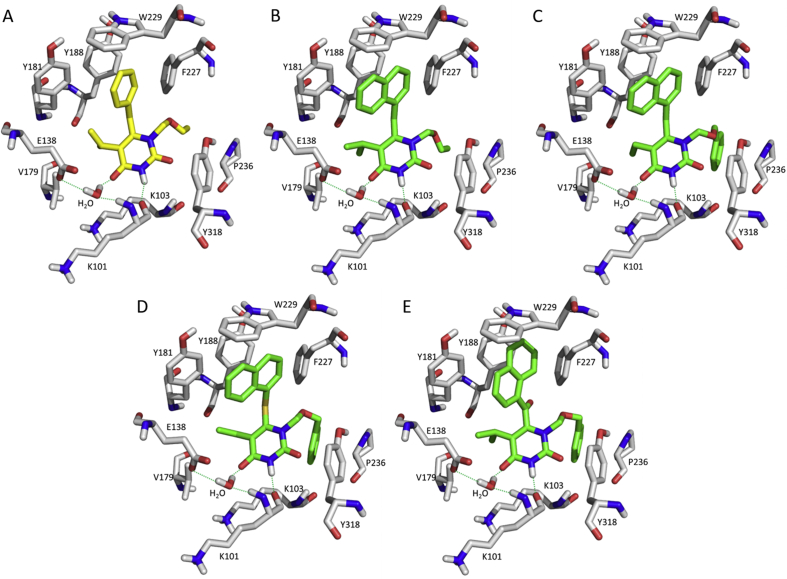
Human immunodeficiency virus (HIV) is the primary infectious agent of acquired immunodeficiency syndrome (AIDS), and non-nucleoside reverse transcriptase inhibitors (NNRTIs) are the cornerstone of HIV treatment. In the last 20 years, our medicinal chemistry group has made great strides in developing several distinct novel NNRTIs, including 1-[(2-hydroxyethoxy)methyl]-6-(phenylthio)thymine (HEPT), thio-dihydro-alkoxy-benzyl-oxopyrimidine (S-DABO), diaryltriazine (DATA), diarylpyrimidine (DAPY) analogues, and their hybrid derivatives. Application of integrated modern medicinal strategies, including structure-based drug design, fragment-based optimization, scaffold/fragment hopping, molecular/fragment hybridization, and bioisosterism, led to the development of several highly potent analogues for further evaluations. In this paper, we review the development of NNRTIs in the last two decades using the above optimization strategies, including their structure-activity relationships, molecular modeling, and their binding modes with HIV-1 reverse transcriptase (RT). Future directions and perspectives on the design and associated challenges are also discussed.
Keywords: AIDS, acquired immunodeficiency syndrome; Bioisosterism; DAPY, diarylpyrimidine; DAPYs; DATA, diaryltriazine; DATAs; DLV, delavirdine; DOR, doravirine; ECD, electronic circular dichroism; EFV, efavirenz; ETR, etravirine; FDA, U.S. Food and Drug Administration; Fragment-based drug design; HAART, highly active antiretroviral therapy; HENT, napthyl-HEPT; HENTs; HEPT, 1-[(2-hydroxyethoxy)methyl]-6-(phenylthio)thymine; HIV, human immunodeficiency virus; HIV-1; INSTI, integrase inhibitor; Molecular hybridization; NNIBP, NNRTI binding pocket; NNRTI, non-nucleoside reverse transcriptase inhibitor; NNRTIs; NRTI, nucleoside reverse transcriptase inhibitor; NVP, nevirapine; PI, protease inhibitor; PK, pharmacokinetic; PROTAC, proteolysis targeting chimera; RPV, rilpivirine; RT, reverse transcriptase; S-DABO, thio-dihydro-alkoxy-benzyl-oxopyrimidine; S-DABOs; SAR, structure–activity relationship; SBDD, structure-based drug design; SFC, supercritical fluid chromatography; SI, selectivity index; Structure-based optimization; UNAIDS, the Joint United Nations Programme on HIV/AIDS; ee, enantiomeric excess.
© 2020 Chinese Pharmaceutical Association and Institute of Materia Medica, Chinese Academy of Medical Sciences. Production and hosting by Elsevier B.V.
Figures
References
-
- UNAIDS global HIV & AIDS statistics—2019 fact sheet. http://www.unaids.org/en/resources/fact-sheet Available from:
-
- Brechtl J.R., Breitbart W., Galietta M., Krivo S., Rosenfeld B. The use of highly active antiretroviral therapy (HAART) in patients with advanced HIV infection: impact on medical, palliative care, and quality of life outcomes. J Pain Symptom Manag. 2001;21:41–51. - PubMed
-
- Shafer R.W., Vuitton D.A. Highly active antiretroviral therapy (HAART) for the treatment of infection with human immunodeficiency virus type 1. Biomed Pharmacother. 1999;53:73–86. - PubMed
-
- de Clercq E. The design of drugs for HIV and HCV. Nat Rev Drug Discov. 2007;6:1001–1018. - PubMed
Publication types
LinkOut - more resources
Full Text Sources
Research Materials
Miscellaneous
