


The impact of financial hardship in childhood on depression and anxiety in adult life: Testing the accumulation, critical period and social mobility hypotheses
- PMID: 32642546
- PMCID: PMC7334602
- DOI: 10.1016/j.ssmph.2020.100592
The impact of financial hardship in childhood on depression and anxiety in adult life: Testing the accumulation, critical period and social mobility hypotheses
Erratum in
-
Erratum regarding missing Declaration of Competing Interest statements in previously published articles.SSM Popul Health. 2020 Dec 17;12:100709. doi: 10.1016/j.ssmph.2020.100709. eCollection 2020 Dec. SSM Popul Health. 2020. PMID: 33381632 Free PMC article.
Abstract
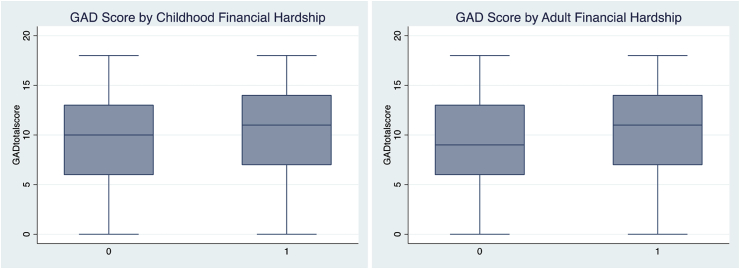
This paper examines the association between financial hardship in childhood and adulthood, and depression and anxiety in adulthood with reference to the accumulation, critical period and social mobility hypotheses in lifecourse epidemiology. Using the BBC Stress test, linear regression models were used to investigate the associations for the whole population and stratifying by gender and adjusting for age and highest education attainment. The critical period hypothesis was not confirmed. The accumulation hypothesis was confirmed and stratifying by gender women had a higher estimated mean GAD score if they were poor in both childhood and adulthood compared to men. Our findings do not support the social mobility hypothesis. However, stratifying by gender, a clear difference emerged with upward mobility having a favourable impact (lower) on women's mean GAD scores, while upward social mobility in adulthood did not attenuate the impact of financial hardship in childhood or men. The impact of financial hardship in childhood on later mental health outcomes is particularly concerning for future health outcomes as current levels of child poverty increases in the UK.
Keywords: Adult health; Childhood; Depression and anxiety; Financial hardship; Lifecourse epidemiology.
© 2020 Published by Elsevier Ltd.
Figures
References
-
- Bambra C., Netuveli G., Eikemo T.A. Welfare state regime life courses: The development of western European welfare state regimes and age-related patterns of educational inequalities in self-reported health. International Journal of Health Services. 2010;40(3):399–420. - PubMed
-
- Barker D.J.P. Churchill Livingstone; Edinburgh: 1998. Mothers, babies and health in later life.
-
- Ben-Schlomo Y., Kuh D. A lifecourse approach to chronic disease epidemiology: Conceptual models, empirical challenges and interdisciplinary perspectives. International Journal of Epidemiology. 2002;31:285–293. - PubMed
LinkOut - more resources
Full Text Sources
