. 2021 Sep;39(15):5831-5842.
doi: 10.1080/07391102.2020.1790426. Epub 2020 Jul 9.

On the potential role of exosomes in the COVID-19 reinfection/reactivation opportunity

Affiliations

On the potential role of exosomes in the COVID-19 reinfection/reactivation opportunity

Fatma Elrashdy et al. J Biomol Struct Dyn. 2021 Sep.

Abstract

We propose here that one of the potential mechanisms for the relapse of the COVID-19 infection could be a cellular transport pathway associated with the release of the SARS-CoV-2-loaded exosomes and other extracellular vesicles. It is possible that this "Trojan horse" strategy represents possible explanation for the re-appearance of the viral RNA in the recovered COVID-19 patients 7-14 day post discharge, suggesting that viral material was hidden within such exosomes or extracellular vesicles during this "silence" time period and then started to re-spread again.Communicated by Ramaswamy H. Sarma.

Keywords: COVID-19; SARS-CoV-2; exosome; extracellular vesicle; reinfection.


Conflict of interest statement

No potential conflict of interest was reported by the author(s).

Figures
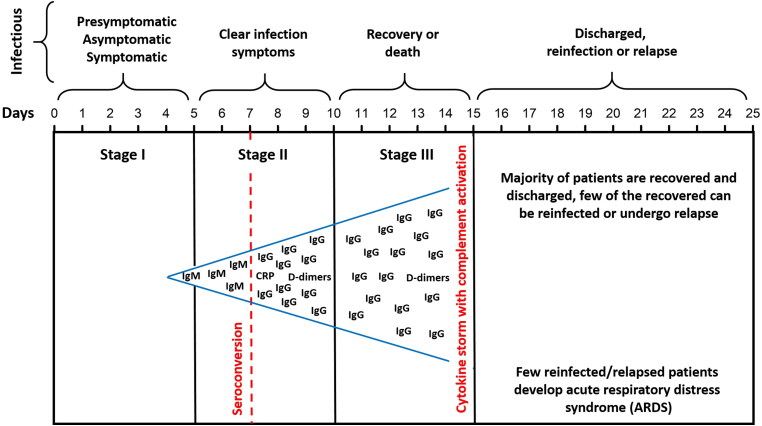
Figure 1.
Figure 1.
Schematic representation of stages of the COVID-19 infection and infectivity of corresponding patients. Here, seroconversion corresponds to the transition from the initial (primary infection) phase of the infection, where immunoglobulin M (IgM) antibodies are produced to the phase, where IgM levels drop (and become undetectable) and the immunoglobulin G (IgG) levels rise and remain detectable. C-reactive protein (CRP) is an acute inflammatory protein that increases up to 1,000-fold at sites of infection or inflammation. D-dimer is a degradation product of the cross-linked fibrin resulting from plasmin cleavage. In the blood of most healthy individuals, D-dimer is present in negligible amounts, whereas the elevated blood levels of D-dimer are the reflection of the intravascular coagulation and venous thromboembolism (VTE), which can present as either deep vein thrombosis (DVT) or pulmonary embolism (PE). Elevated D-dimer levels in COVID-19 patients are associated with the severity of COVID-19 infection and correlate with higher mortality.
Figure 2.
Figure 2.
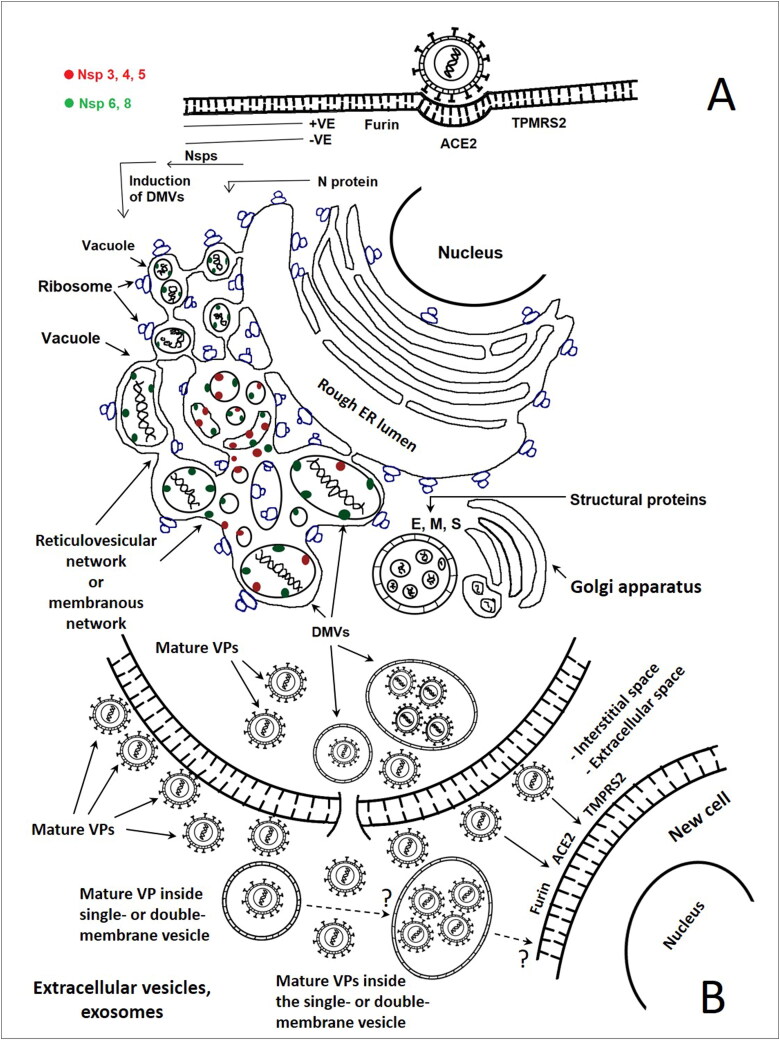
A. Putative life cycle of the SARS-CoV and SARS-CoV-2 in the human host cell (in vivo) and/or in Vero E6 cell (in vitro). Virus-induced double membrane vesicles in the cytoplasm of infected cells represent platforms for coronaviruses replication, assembling, trafficking, extrusion, and shedding the mature viral particles (free and/or inside vesicles). Cell infected with the virus demonstrated the formation of a reticulovesicular network of modified membranes, which included single/multiple double-membrane vesicles, representing the site where the virus replicate. All are and contiguous with the rough endoplasmic reticulum. The viral + RNA is released into the cytoplasm and primarily translated into viral polyproteins encoding the Nsps, which stimulate/induce the DMVs to proceed and complete the virus life cycle in association with the Golgi stacks to produce the virus particles in the vesicles, which eventually fuse with the plasma membrane. The DMV may contain the mature or immature viral particle, or the non-assembled viral apparatus. The Nsp 3–8 are present on the CM, while some of Nsp8 can be detected inside the DMVs. The histological and ultrastructural analysis of the appearance of the samples from the SARS-CoV-2 infected patients demonstrated the presence of mature viral particles as well as the immature viral particles or non-assembled viral apparatus inside DMVs. The illustration depends on the data from (Alsaad et al., ; Angelini et al., ; Bulfamante et al., ; Goldsmith & Miller, ; Knoops et al., ; Menter et al., ; Oudshoorn et al., ; Perlman & Netland, ; Qinfen et al., ; Shieh et al., ; Sims et al., ; Su et al., 2020). B. The mature and immature viral particles spread/disseminated into new neighbouring cells as documented in the text for SARS-CoV-2, while the extracellular vesicles (exosomes) introduce the SARS-CoV-2 virus particles into the cells still needs to be documented.

References

    1. Ahlquist, P. (2006). Parallels among positive-strand RNA viruses, reverse-transcribing viruses and double-stranded RNA viruses. Nature Reviews. Microbiology, 4(5), 371–382. 10.1038/nrmicro1389 - DOI - PMC - PubMed
    1. Al-Mulla, H. M. N., Turrell, L., Smith, N. M., Payne, L., Baliji, S., Züst, R., Thiel, V., Baker, S. C., Siddell, S. G., & Neuman, B. W. (2014). Competitive fitness in coronaviruses is not correlated with size or number of double-membrane vesicles under reduced-temperature growth conditions. mBio, 5(2), e01107–e01113. 10.1128/mBio.01107-13 - DOI - PMC - PubMed
    1. Alsaad, K. O., Hajeer, A. H., Al Balwi, M., Al Moaiqel, M., Al Oudah, N., Al Ajlan, A., AlJohani, S., Alsolamy, S., Gmati, G. E., Balkhy, H., Al-Jahdali, H. H., Baharoon, S. A., & Arabi, Y. M. (2018). Histopathology of Middle East respiratory syndrome coronovirus (MERS-CoV) infection - clinicopathological and ultrastructural study. Histopathology, 72(3), 516–524. 10.1111/his.13379 - DOI - PMC - PubMed
    1. Angelini, M. M., Akhlaghpour, M., Neuman, B. W., & Buchmeier, M. J. (2013). Severe acute respiratory syndrome coronavirus nonstructural proteins 3, 4, and 6 induce double-membrane vesicles. mBio, 4(4), e00524–e0013. 10.1128/mBio.00524-13 - DOI - PMC - PubMed
    1. Arons, M. M., Hatfield, K. M., Reddy, S. C., Kimball, A., James, A., Jacobs, J. R., Taylor, J., Spicer, K., Bardossy, A. C., Oakley, L. P., Tanwar, S., Dyal, J. W., Harney, J., Chisty, Z., Bell, J. M., Methner, M., Paul, P., Carlson, C. M., McLaughlin, H. P., … Jernigan, J. A. (2020). Presymptomatic SARS-CoV-2 infections and transmission in a skilled nursing facility. New England Journal of Medicine, 382(22), 2081–2090. 10.1056/NEJMoa2008457 - DOI - PMC - PubMed