. 2020 Sep 4;48(15):8740-8754.
doi: 10.1093/nar/gkaa569.

3-Dimensional architecture of the human multi-tRNA synthetase complex

Affiliations

3-Dimensional architecture of the human multi-tRNA synthetase complex

Krishnendu Khan et al. Nucleic Acids Res. .

Abstract

In mammalian cells, eight cytoplasmic aminoacyl-tRNA synthetases (AARS), and three non-synthetase proteins, reside in a large multi-tRNA synthetase complex (MSC). AARSs have critical roles in interpretation of the genetic code during protein synthesis, and in non-canonical functions unrelated to translation. Nonetheless, the structure and function of the MSC remain unclear. Partial or complete crystal structures of all MSC constituents have been reported; however, the structure of the holo-MSC has not been resolved. We have taken advantage of cross-linking mass spectrometry (XL-MS) and molecular docking to interrogate the three-dimensional architecture of the MSC in human HEK293T cells. The XL-MS approach uniquely provides structural information on flexibly appended domains, characteristic of nearly all MSC constituents. Using the MS-cleavable cross-linker, disuccinimidyl sulfoxide, inter-protein cross-links spanning all MSC constituents were observed, including cross-links between eight protein pairs not previously known to interact. Intra-protein cross-links defined new structural relationships between domains in several constituents. Unexpectedly, an asymmetric AARS distribution was observed featuring a clustering of tRNA anti-codon binding domains on one MSC face. Possibly, the non-uniform localization improves efficiency of delivery of charged tRNA's to an interacting ribosome during translation. In summary, we show a highly compact, 3D structural model of the human holo-MSC.


Figures

Figure 1.
Figure 1.
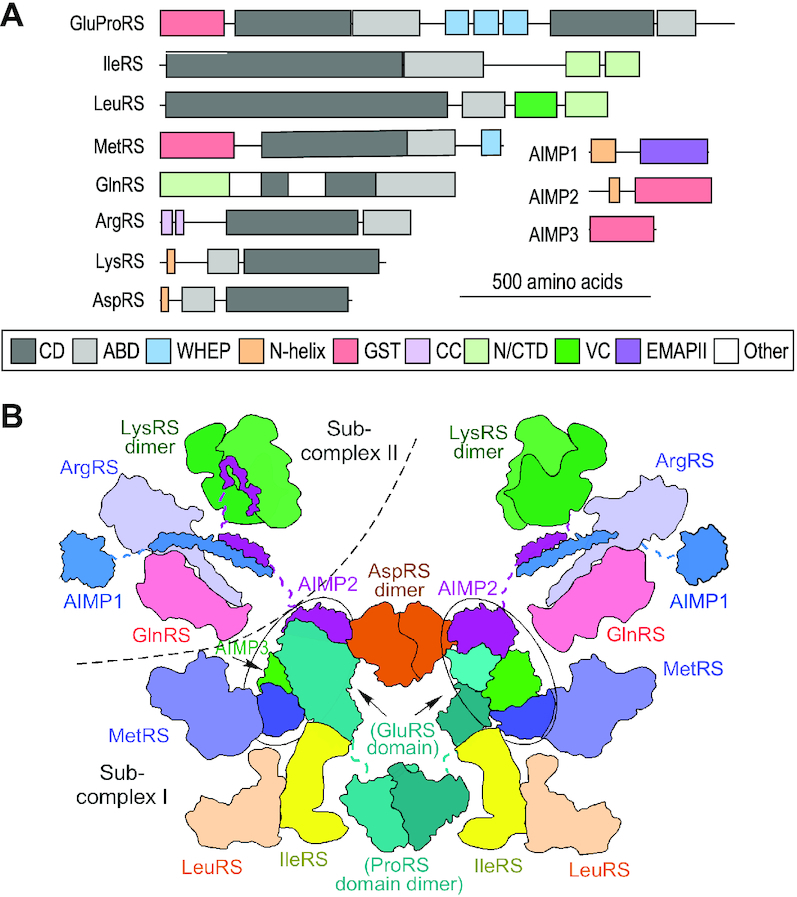
Constituents and proposed architecture of mammalian MSC. (A) Schematic of protein domain arrangements of the nine AARSs and three AIMPs in the MSC. The highly conserved catalytic (dark gray) and anticodon (light gray) binding domains are highlighted. Likewise, the vertebrate-specific appended domains, including GST-like domains (pink), WHEP domains (cyan), lysine-rich N-helical domains (orange), among others, are indicated in box at bottom. Constituents and domains are drawn to scale (scale indicated). (B) Proposed bisymmetrical model of the MSC. Each symmetrical side is a monomeric complex consisting of one copy of each of the eleven proteins with the exception of LysRS, which is present as a dimer. Each unit is sub-divided into sub-complexes I and II (dashed curve). Hubs containing four GST-like domains are highlighted in ovals.
Figure 2.
Figure 2.
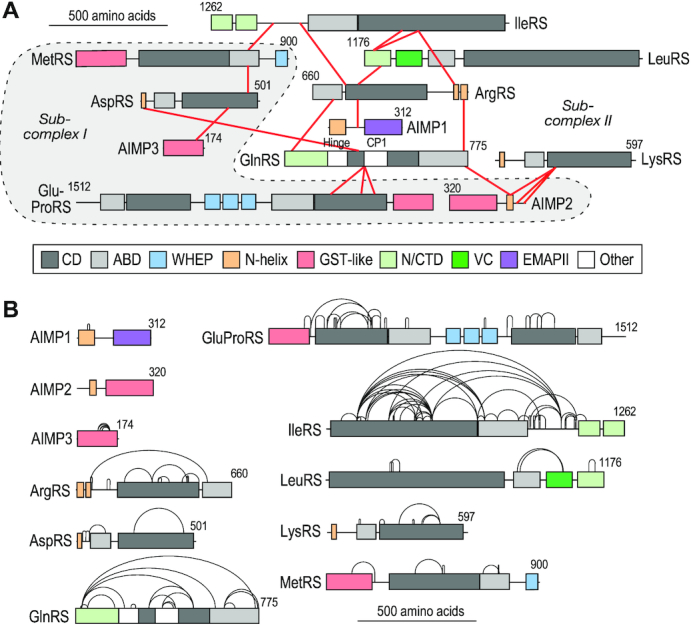
XL-MS-derived cross-links in the MSC. (A) Linkage map generated by xiView depicting inter-protein cross-links determined by XL-MS analysis of HEK293T cells (49). Subcomplex I constituents are highlighted (gray regions surrounded by dashed outline). (B) Linkage map showing intra-protein cross-links obtained by XL-MS.
Figure 3.
Figure 3.
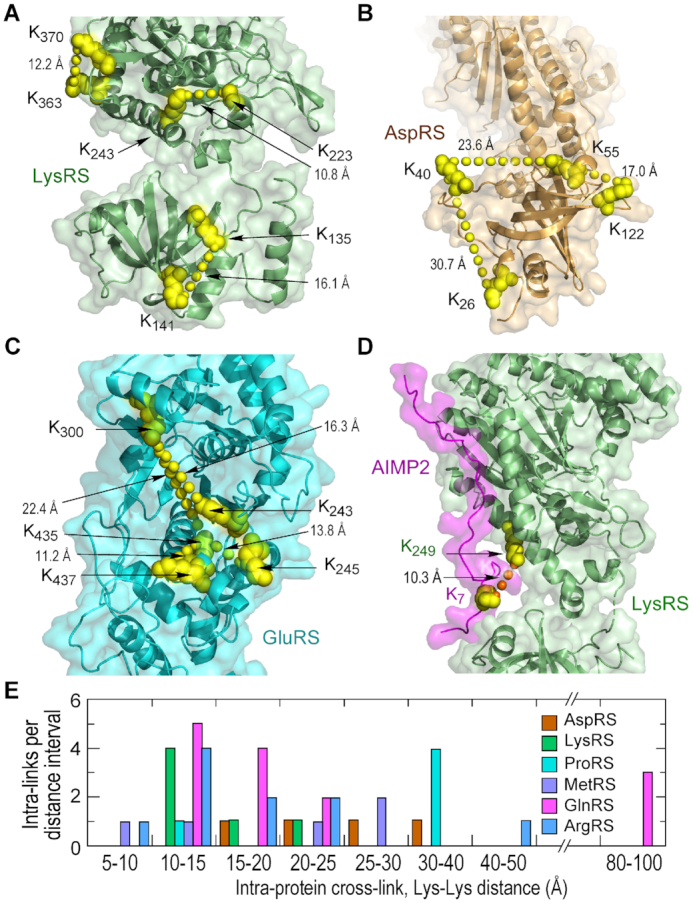
Validation of XL-MS-derived cross-links. (A, B) XL-MS-derived cross-links shown in X-ray structure of (A) LysRS (PDB ID: 6ILD) and (B) AspRS (PDB ID: 4J15). Cross-linked Lys residues are shown as atom-level structures (yellow), and intra-protein cross-links shown as connecting line of yellow spheres. (C) The structure of human GluRS was modeled based on homology to the archaebacterium Methanothermobacter thermautotrophicus GluRS (PDB ID: 3AII). (D) XL-MS-derived crosslinks between LysRS and AIMP2 are shown in the X-ray structure (PDB ID: 6ILD). Inter-protein cross-links are indicated by connecting line of orange spheres. (E) Number of cross-links as a function of cross-link distance within the reported structures.
Figure 4.
Figure 4.
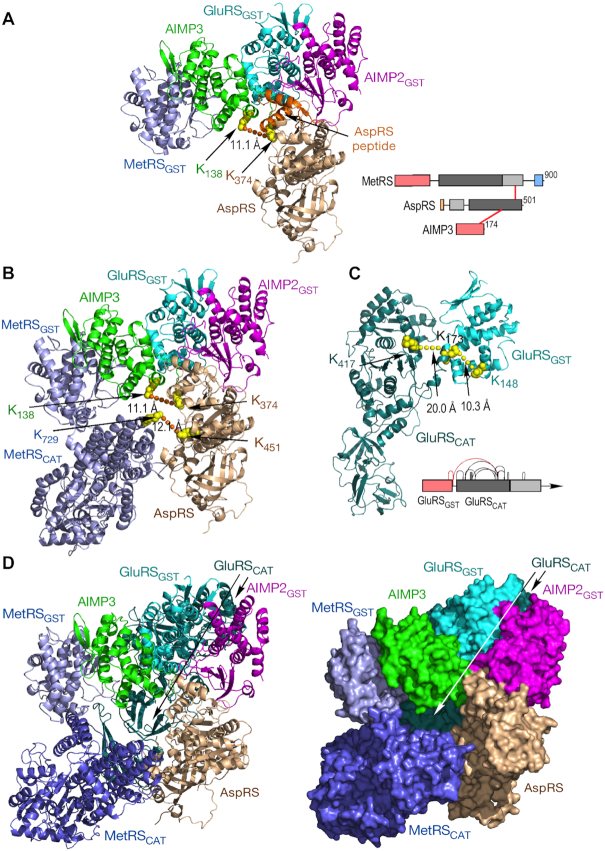
Assembly of the sub-complex I pentamer. (A) Schematic of inter-protein cross-links between MetRS, AspRS and AIMP3 (right). Reported crystal structure (PDB ID: 5Y6L REF) of the four GST-like domains with the AspRS peptide (orange). The crystal structure (PDB ID: 4J15) of human AspRS (brown) was used to model and dock full-length AspRS on the GST tetramer. (B) The MetRS catalytic domain (PDB ID: 5GL7) was docked on the pentameric structure using inter-protein distance constraints given by XL-MS. (C) Schematic of intra-protein cross-links in GluRS with cross-links between GST-like and catalytic domains highlighted (red, right). Structure of human catalytic domain determined by homology modeling with archael GluRS (PDB ID: 3AII). (D) Ribbon (left) and space-filled (right) structures of the pentameric complex comprising sub-complex I.
Figure 5.
Figure 5.
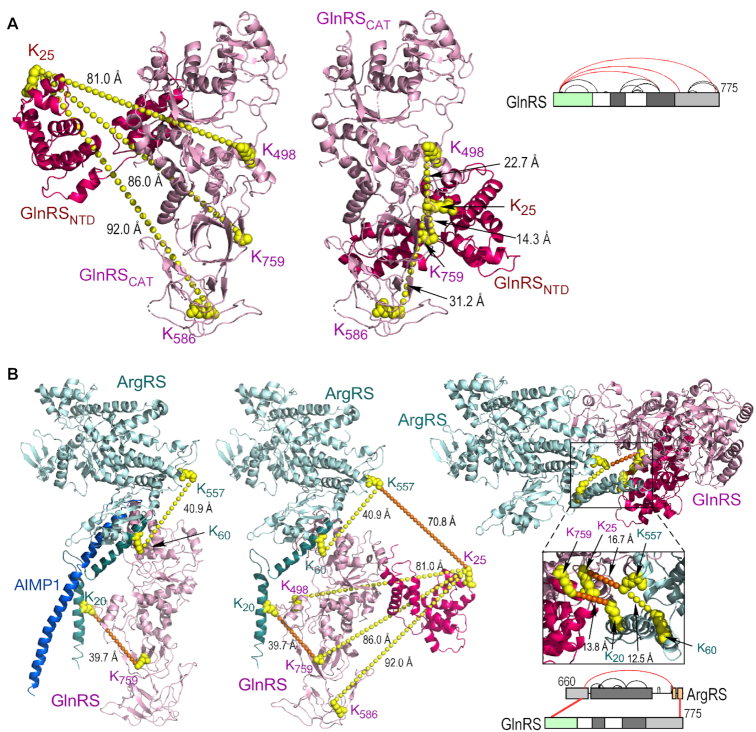
Application of XL-MS-derived cross-links to amend GlnRS monomer and GlnRS-ArgRS dimer structures. (A) Schematic (right) of XL-MS-derived intra-links in GlnRS; cross-links between N-terminal domain (NTD) and catalytic domain are highlighted (red). Crystal structure (PDB ID: 4YE6) of the NTD (red) and catalytic domain (pink) of GlnRS (left). Position of K586 is estimated from A584, the nearest neighbor in the crystal structure. Amended model of GlnRS obtained by conformance with XL-MS-derived intra-protein distance constraints (middle). (B) Schematic of inter-links between GlnRS and ArgRS obtained by XL-MS (right, bottom). Crystal structure (PDB ID: 4R3Z) of ArgRS-GlnRS-AIMP1 trimer (left). Structure of ArgRS complexed with GlnRS containing the N-terminus (PDB ID: 4YE6) (middle). Improved model of ArgRS-GlnRS satisfying ArgRS intra-protein and ArgRS-GlnRS inter-protein cross-links (right, top).
Figure 6.
Figure 6.
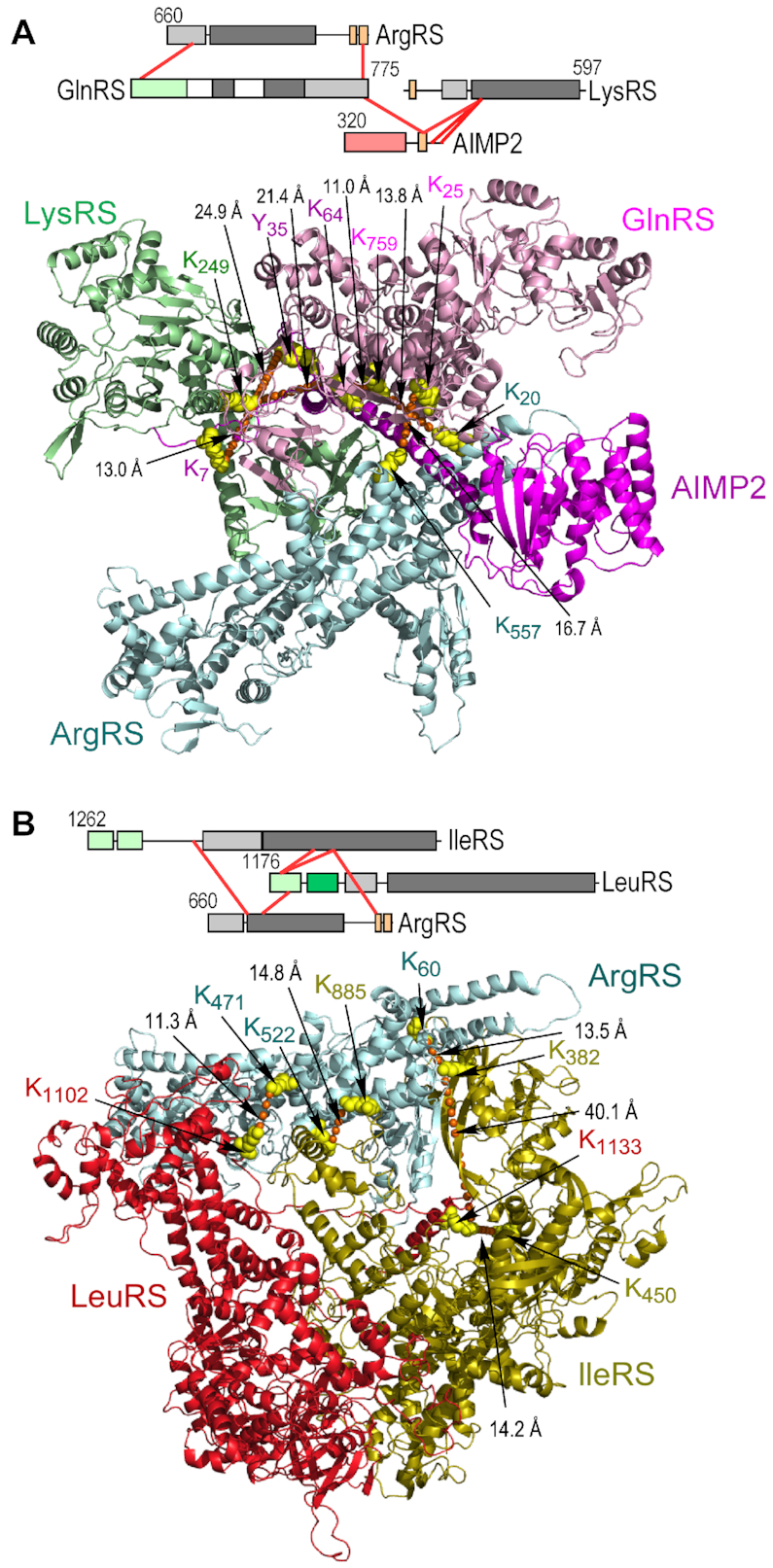
Modeling of protein-protein interactions within sub-complex II. (A) Schematic of inter-protein cross-links between ArgRS, GlnRS, LysRS and AIMP2 (top). Ribbon model of tetrameric complex satisfying distance constraints of all inter-protein cross-links (bottom). (B) Schematic of inter-protein cross-links between ArgRS, IleRS and LeuRS (top). Ribbon model of trimeric ArgRS–IleRS–LeuRS complex satisfying distance constraints of all inter-protein cross-links (bottom).
Figure 7.
Figure 7.
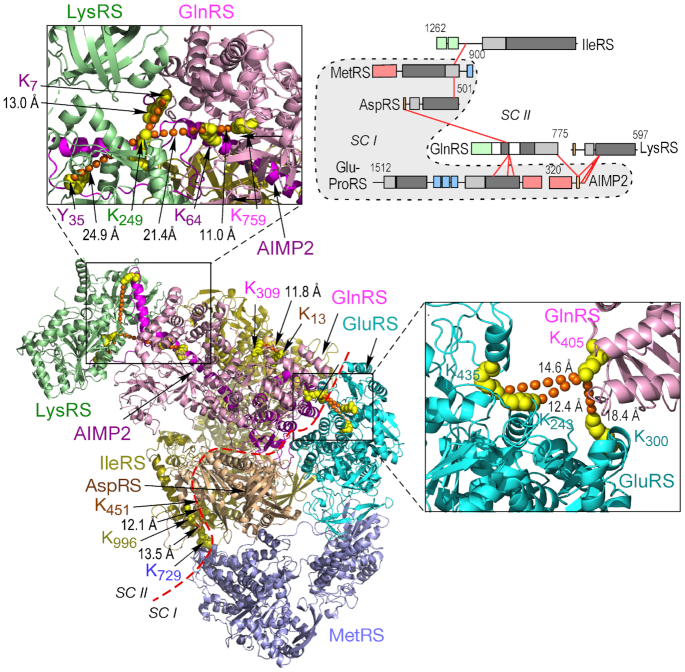
Connections between sub-complexes I and II. Schematic of inter-protein cross-links between five protein pairs joining sub-complexes I and II (top, right). Structural model comprising LysRS, GlnRS, GluRS, MetRS, AspRS, IleRS and AIMP2 satisfying XL-MS-derived inter-protein distance constraints (bottom, left). Red dashed line delineates sub-complexes (SC) I and II; AIMP2 spans both sub-complexes. Expanded outsets show details of GlnRS–GluRS (bottom, right) and AIMP2–GlnRS–LysRS interactions (top, left).
Figure 8.
Figure 8.
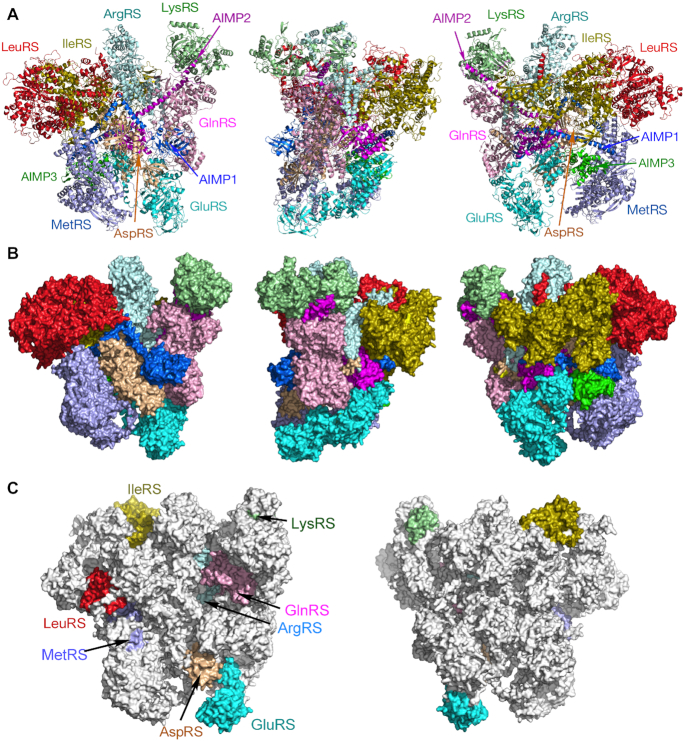
Three-dimensional models of human holo-MSC. Ribbon (A) and space-filled (B) models of front (left), side (middle) and rear (right) views of the MSC. (C) Space-filled model showing front (left) and back (right) views of the MSC with anticodon binding domains highlighted.
Figure 9.
Figure 9.
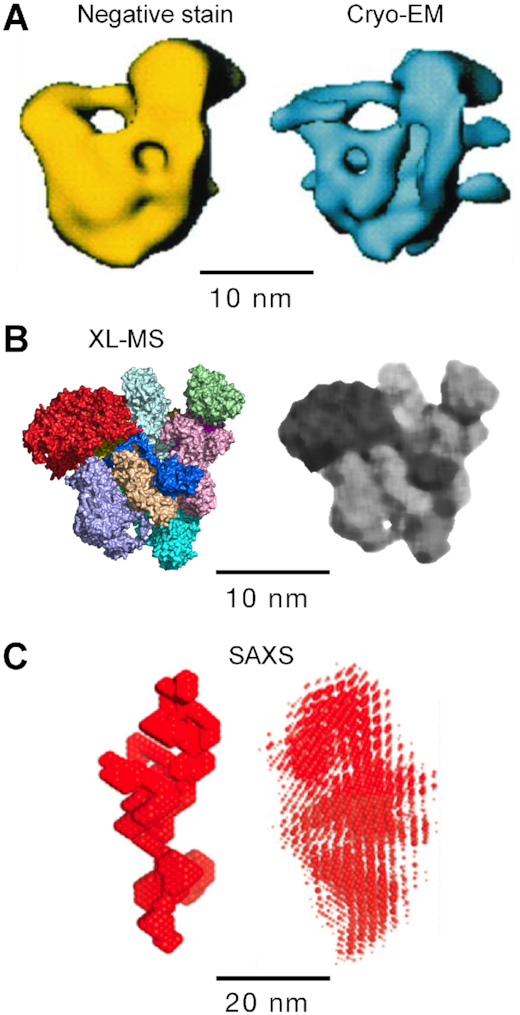
Volumetric comparison of MSC structures. Structures derived from (A) negative stain (left) and cryo-EM (right), (B) XL-MS, before (left) and after (right) application of median low-pass filter (Canvas Draw 4, median filter setting = 5) and (C) low-resolution SAXS bead model (left) and superposition of SAXS bead models (right).

References

    1. Guo M., Schimmel P.. Essential nontranslational functions of tRNA synthetases. Nat. Chem. Biol. 2013; 9:145–153. - PMC - PubMed
    1. Yao P., Fox P.L.. Aminoacyl-tRNA synthetases in medicine and disease. EMBO Mol. Med. 2013; 5:332–343. - PMC - PubMed
    1. Kim S., You S., Hwang D.. Aminoacyl-tRNA synthetases and tumorigenesis: more than housekeeping. Nat. Rev. Cancer. 2011; 11:708–718. - PubMed
    1. Guo M., Yang X.L., Schimmel P.. New functions of aminoacyl-tRNA synthetases beyond translation. Nat. Rev. Mol. Cell Biol. 2010; 11:668–674. - PMC - PubMed
    1. Wei N., Zhang Q., Yang X.L.. Neurodegenerative Charcot-Marie-Tooth disease as a case study to decipher novel functions of aminoacyl-tRNA synthetases. J. Biol. Chem. 2019; 294:5321–5339. - PMC - PubMed

Publication types

Substances