


Effects of Extended-Release Methylphenidate Treatment on Cognitive Task Performance in Children with Autism Spectrum Disorder and Attention-Deficit/Hyperactivity Disorder
- PMID: 32644833
- PMCID: PMC7475091
- DOI: 10.1089/cap.2020.0004
Effects of Extended-Release Methylphenidate Treatment on Cognitive Task Performance in Children with Autism Spectrum Disorder and Attention-Deficit/Hyperactivity Disorder
Abstract
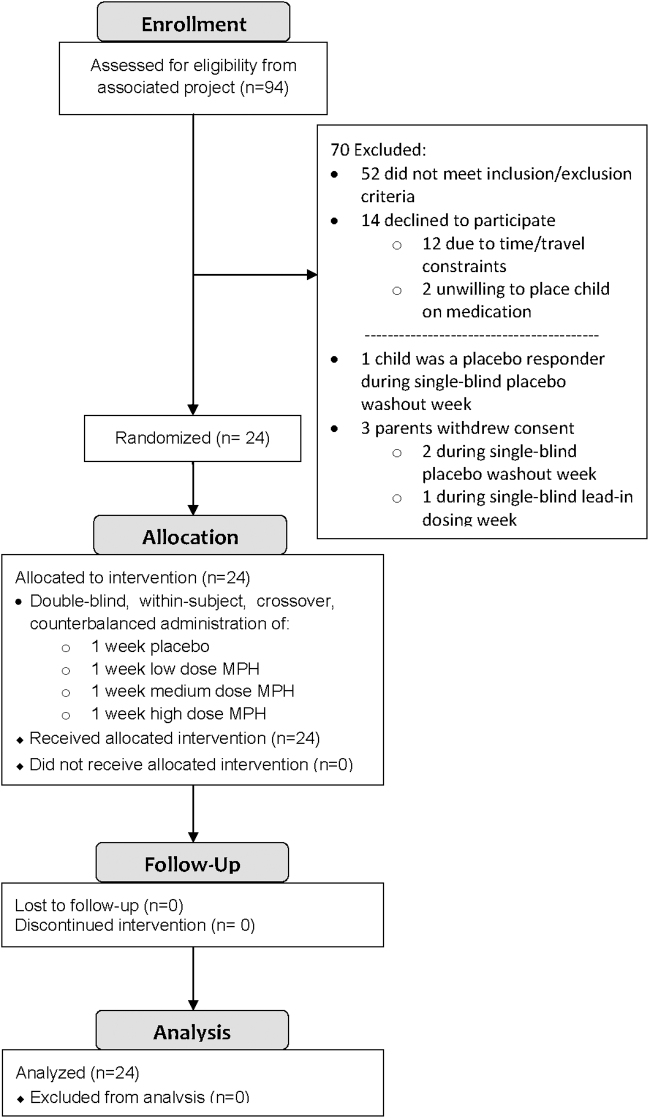
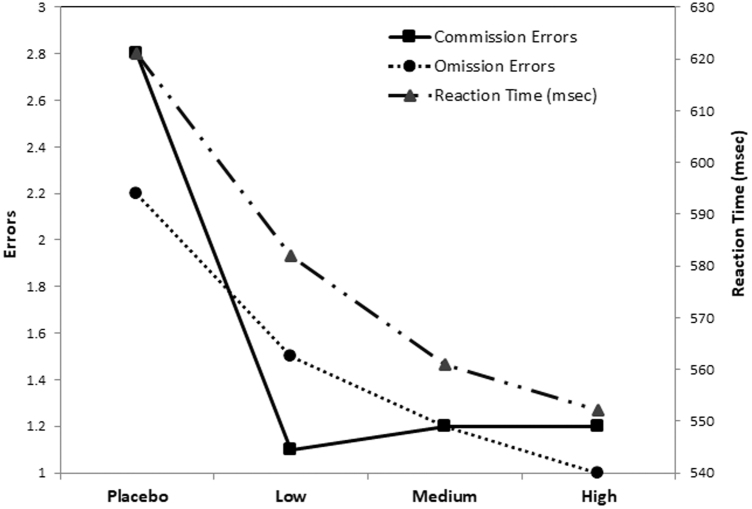
Objective: To examine the effectiveness of four doses of psychostimulant medication, combining extended-release methylphenidate (ER-MPH) in the morning with immediate-release MPH (IR-MPH) in the afternoon, on cognitive task performance. Method: The sample comprised 24 children (19 boys and 5 girls) who met the Diagnostic and Statistical Manual of Mental Disorders, 4th Edition Text Revision (DSM-IV-TR) criteria for an autism spectrum disorder (ASD) on the Autism Diagnostic Interview-R and the Autism Diagnostic Observation Schedule, and had significant symptoms of attention-deficit/hyperactivity disorder (ADHD). This sample consisted of elementary school-age, community-based children (mean chronological age = 8.8 years, SD = 1.7; mean intelligence quotient = 85; SD = 16.8). Effects of placebo and three dose levels of ER-MPH (containing 0.21, 0.35, and 0.48 mg/kg equivalent of IR-MPH) on cognitive task performance were compared using a within-subject, crossover, placebo-controlled design. Each of the four MPH dosing regimens (placebo, low-dose MPH, medium-dose MPH, and high-dose MPH) was administered for 1 week; the dosing order was counterbalanced across children. Results: MPH treatment was associated with significant performance gains on cognitive tasks tapping sustained attention, selective attention, and impulsivity/inhibition. Dose/response was generally linear in the dose range studied, with no evidence of deterioration in performance at higher MPH doses in the dose range studied. Conclusion: The results of this study suggest that MPH formulations are associated with significant improvements on cognitive task performance in children with ASD and ADHD.
Keywords: ADHD; ASD; cognitive tasks; stimulants.
Figures
References
-
- Aman MG: Stimulant drugs in the developmental disabilities revisited. J Dev Phys Disabil 8:347–365, 1996
-
- Aman MG, Kern RA, McGhee DE, Arnold LE: Fenfluramine and methylphenidate in children with mental retardation and attention deficit hyperactivity disorder: Laboratory effects. J Autism Dev Disord 23:491–506, 1993 - PubMed
-
- Aman MG, Lam KSL, Van Bourgondien ME: Medication patterns in patients with autism: Temporal, regional, and demographic influences. J Child Adolesc Psychopharmacol 15:116–126, 2005 - PubMed
-
- Aman MG, Marks RE, Turbott SH, Wilsher CP, Merry SN: Clinical effects of methylphenidate and thioridazine in intellectually subaverage children. J Am Acad Child Adolesc Psychiatry 30:246–256, 1991a - PubMed
-
- Aman MG, Marks RE, Turbott SH, Wilsher CP, Merry SN: Methylphenidate and thioridazine in the treatment of intellectually subaverage children: Effects on cognitive-motor performance. J Am Acad Child Adolesc Psychiatry 30:816–824, 1991b - PubMed
Publication types
MeSH terms
Substances
LinkOut - more resources
Full Text Sources
Medical
Miscellaneous
