


Initial and Repeated Point Prevalence Surveys to Inform SARS-CoV-2 Infection Prevention in 26 Skilled Nursing Facilities - Detroit, Michigan, March-May 2020
- PMID: 32644985
- PMCID: PMC7732365
- DOI: 10.15585/mmwr.mm6927e1
Initial and Repeated Point Prevalence Surveys to Inform SARS-CoV-2 Infection Prevention in 26 Skilled Nursing Facilities - Detroit, Michigan, March-May 2020
Abstract
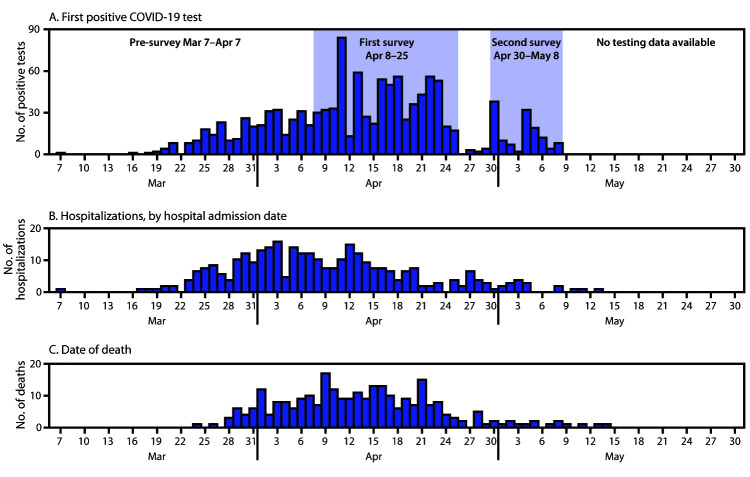
Skilled nursing facilities (SNFs) are focal points of the coronavirus disease 2019 (COVID-19) pandemic, and asymptomatic infections with SARS-CoV-2, the virus that causes COVID-19, among SNF residents and health care personnel have been described (1-3). Repeated point prevalence surveys (serial testing of all residents and health care personnel at a health care facility irrespective of symptoms) have been used to identify asymptomatic infections and have reduced SARS-CoV-2 transmission during SNF outbreaks (1,3). During March 2020, the Detroit Health Department and area hospitals detected a sharp increase in COVID-19 diagnoses, hospitalizations, and associated deaths among SNF residents. The Detroit Health Department collaborated with local government, academic, and health care system partners and a CDC field team to rapidly expand SARS-CoV-2 testing and implement infection prevention and control (IPC) activities in all Detroit-area SNFs. During March 7-May 8, among 2,773 residents of 26 Detroit SNFs, 1,207 laboratory-confirmed cases of COVID-19 were identified during three periods: before (March 7-April 7) and after two point prevalence surveys (April 8-25 and April 30-May 8): the overall attack rate was 44%. Within 21 days of receiving their first positive test results, 446 (37%) of 1,207 COVID-19 patients were hospitalized, and 287 (24%) died. Among facilities participating in both surveys (n = 12), the percentage of positive test results declined from 35% to 18%. Repeated point prevalence surveys in SNFs identified asymptomatic COVID-19 cases, informed cohorting and IPC practices aimed at reducing transmission, and guided prioritization of health department resources for facilities experiencing high levels of SARS-CoV-2 transmission. With the increased availability of SARS-CoV-2 testing, repeated point prevalence surveys and enhanced and expanded IPC support should be standard tools for interrupting and preventing COVID-19 outbreaks in SNFs.
Conflict of interest statement
All authors have completed and submitted the International Committee of Medical Journal Editors form for disclosure of potential conflicts of interest. John Zervos and Tyler Prentiss report grants from the United Way of Southeastern Michigan, Vattikuti Foundation, and Abbott Laboratories during the conduct of the study. Marcus J. Zervos reports grants from Pfizer, Merck, and Serono, outside the submitted work. No other potential conflicts of interest were disclosed.
Figures
References
-
- Kimball A, Hatfield KM, Arons M, et al. ; Public Health – Seattle & King County; CDC COVID-19 Investigation Team. Asymptomatic and presymptomatic SARS-CoV-2 infections in residents of a long-term care skilled nursing facility—King County, Washington, March 2020. MMWR Morb Mortal Wkly Rep 2020;69:377–81. 10.15585/mmwr.mm6913e1 - DOI - PMC - PubMed
-
- Food and Drug Administration. Emergency use authorizations. Silver Spring, MD: US Department of Health and Human Services, Food and Drug Administration; 2020. https://www.fda.gov/medical-devices/emergency-situations-medical-devices...
-
- CDC. Interim clinical guidance for management of patients with confirmed coronavirus disease (COVID-19). Atlanta, GA: US Department of Health and Human Services, CDC; 2020. https://www.cdc.gov/coronavirus/2019-ncov/hcp/clinical-guidance-manageme...
MeSH terms
LinkOut - more resources
Full Text Sources
Medical
Miscellaneous
