The association of the serum levels of myostatin, follistatin, and interleukin-6 with sarcopenia, and their impacts on survival in patients with hepatocellular carcinoma
- PMID: 32646201
- PMCID: PMC7641544
- DOI: 10.3350/cmh.2020.0005
The association of the serum levels of myostatin, follistatin, and interleukin-6 with sarcopenia, and their impacts on survival in patients with hepatocellular carcinoma
Abstract
Background/aims: The role of serum myokine levels in sarcopenia and the outcome of hepatocellular carcinoma (HCC) patients are not clear. This study investigated the serum levels of myostatin, follistatin, and interleukin-6 (IL-6) in HCC patients and their association with sarcopenia and survival.
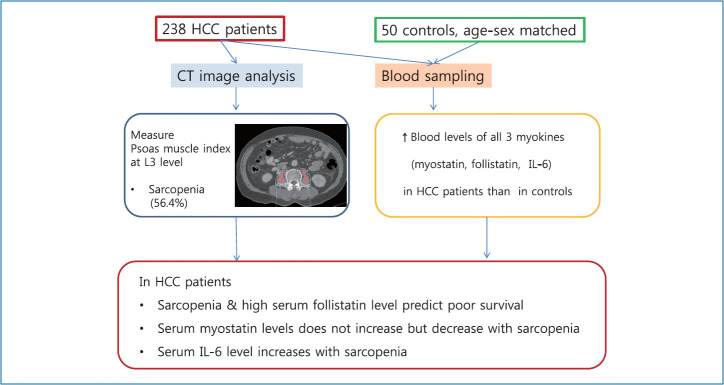
Methods: Using prospectively collected pretreatment samples from 238 HCC patients in a hospital from 2012 to 2015, the serum levels of 3 myokines were determined and compared to 50 samples from age and sex-matched healthy controls. Sarcopenia was evaluated using the psoas muscle index (PMI) measured at the third lumbar level in the computed tomography, and clinical data were collected until 2017.
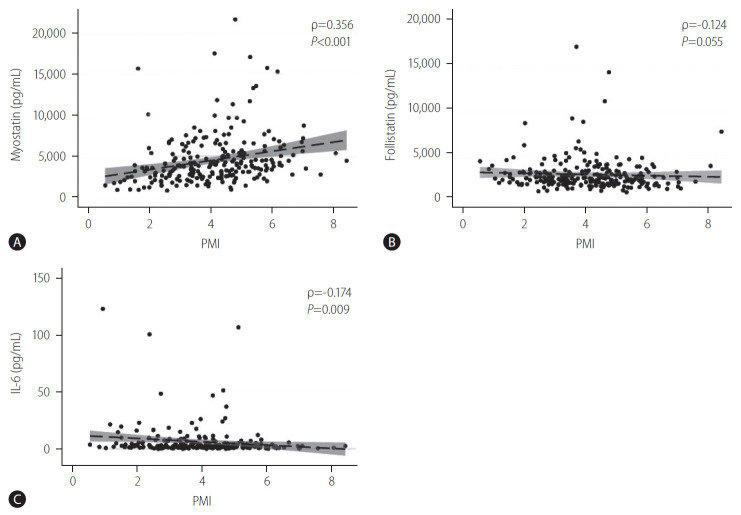
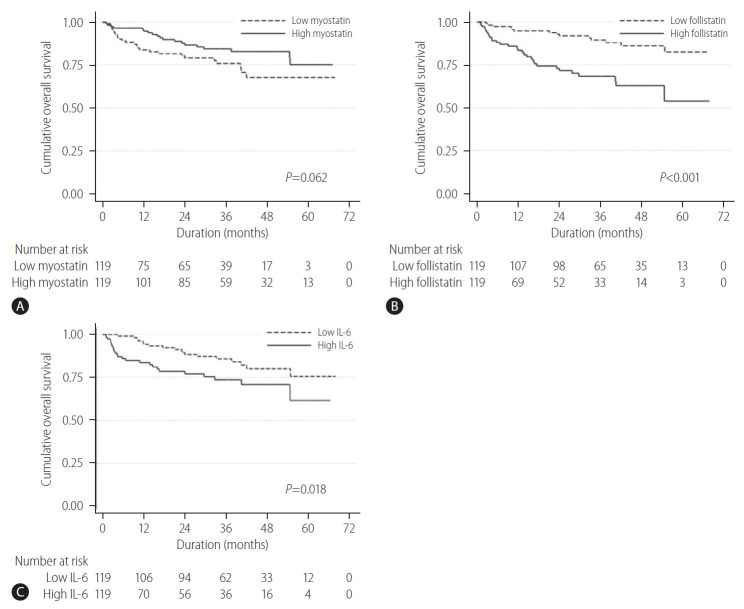
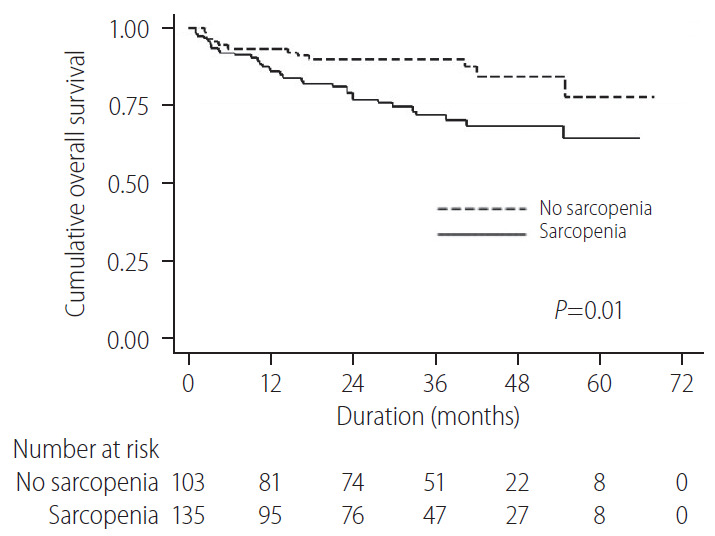
Results: The median levels of the 3 myokines for the male and female HCC patients were as follow: myostatin (3,979.3 and 2,976.3 pg/mL), follistatin (2,118.5 and 2,174.6 pg/mL), and IL-6 (2.5 and 2.7 pg/mL), respectively. Those in the HCC patients were all significantly higher than in the healthy controls. In the HCC patient, the median PMI was 4.43 (males) and 2.17 cm2/m2 (females) with a sarcopenic prevalence of 56.4%. The serum levels of myostatin, IL-6 and follistatin in the HCC patients showed a positive, negative, and no correlation with PMI, respectively. The serum follistatin level was an independent factor for poor survival in HCC patients.
Conclusion: The serum levels of myostatin, follistatin, and IL-6 and their correlation with sarcopenia and survival were presented in HCC patients for the first time. The role of the serum follistatin level as a poor prognostic biomarker warrants further study.
Keywords: Follistatin; Hepatocellular carcinoma; Interleukin 6; Myostatin; Sarcopenia.
Conflict of interest statement
Figures

Comment in
-
Sarcopenia and blood myokine levels as prognostic biomarkers in patients with liver cirrhosis or hepatocellular carcinoma.Clin Mol Hepatol. 2020 Oct;26(4):476-479. doi: 10.3350/cmh.2020.0192. Epub 2020 Oct 1. Clin Mol Hepatol. 2020. PMID: 33053929 Free PMC article. No abstract available.
References
-
- Landi F, Onder G, Russo A, Liperoti R, Tosato M, Martone AM, et al. Calf circumference, frailty and physical performance among older adults living in the community. Clin Nutr. 2014;33:539–544. - PubMed
-
- Mijnarends DM, Meijers JM, Halfens RJ, ter Borg S, Luiking YC, Verlaan S, et al. Validity and reliability of tools to measure muscle mass, strength, and physical performance in community-dwelling older people: a systematic review. J Am Med Dir Assoc. 2013;14:170–178. - PubMed
-
- Beaudart C, Reginster JY, Slomian J, Buckinx F, Locquet M, Bruyère O. Prevalence of sarcopenia: the impact of different diagnostic cut-off limits. J Musculoskelet Neuronal Interact. 2014;14:425–431. - PubMed
-
- Zillikens MC, van den Berg JW, Wilson JH, Swart GR. Whole-body and segmental bioelectrical-impedance analysis in patients with cirrhosis of the liver: changes after treatment of ascites. Am J Clin Nutr. 1992;55:621–625. - PubMed
Publication types
MeSH terms
Substances
LinkOut - more resources
Full Text Sources
Medical