


Risk and Secondary Prevention of Stroke Recurrence: A Population-Base Cohort Study
- PMID: 32646337
- PMCID: PMC7382537
- DOI: 10.1161/STROKEAHA.120.028992
Risk and Secondary Prevention of Stroke Recurrence: A Population-Base Cohort Study
Abstract
Background and purpose: With recent advances in secondary prevention management, stroke recurrence rates may have changed substantially. We aim to estimate risks and trends of stroke recurrence over the past 2 decades in a population-based cohort of patients with stroke.
Methods: Patients with a first-ever stroke between 1995 and 2018 in South London, United Kingdom (n=6052) were collected and analyzed. Rates of recurrent stroke with 95% CIs were stratified by 5-year period of index stroke and etiologic TOAST (Trial of ORG 10172 in Acute Stroke Treatment) subtype. Cumulative incidences were estimated and multivariate Cox models applied to examine associations of recurrence and recurrence-free survival.
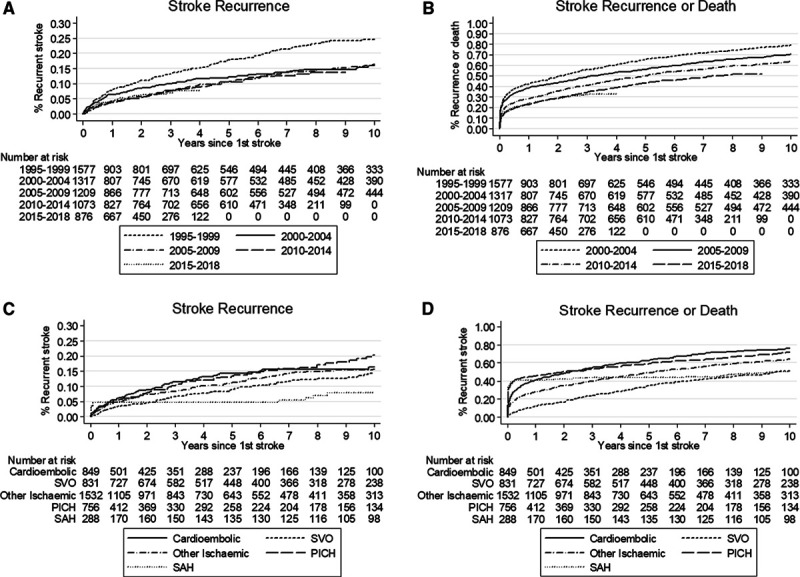
Results: The rate of stroke recurrence at 5 years reduced from 18% (95% CI, 15%-21%) in those who had their stroke in 1995 to 1999 to 12% (10%-15%) in 2000 to 2005, and no improvement since. Recurrence-free survival has improved (35%, 1995-1999; 67%, 2010-2015). Risk of recurrence or death is lowest for small-vessel occlusion strokes and other ischemic causes (36% and 27% at 5 years, respectively). For cardioembolic and hemorrhagic index strokes around half of first recurrences are of the same type (54% and 51%, respectively). Over the whole study period a 54% increased risk of recurrence was observed among those who had atrial fibrillation before the index stroke (hazard ratio, 1.54 [1.09-2.17]).
Conclusions: The rate of recurrence reduced until mid-2000s but has not changed over the last decade. The majority of cardioembolic or hemorrhagic strokes that have a recurrence are stroke of the same type indicating that the implementation of effective preventive strategies is still suboptimal in these stroke subtypes.
Keywords: atrial fibrillation; prevalence; risk factors; secondary prevention.
Figures
References
-
- Mohan KM, Wolfe CD, Rudd AG, Heuschmann PU, Kolominsky-Rabas PL, Grieve AP. Risk and cumulative risk of stroke recurrence: a systematic review and meta-analysis. Stroke 2011421489–1494doi: 10.1161/STROKEAHA.110.602615 - PubMed
-
- Chróinín DN, Asplund K, Åsberg S, Callaly E, Cuadrado-Godia E, Díez-Tejedor E, Di Napoli M, Engelter ST, Furie KL, Giannopoulos S, et al. Statin therapy and outcome after ischemic stroke. Stroke 201344448–456doi: 10.1161/STROKEAHA.112.668277 - PubMed
Publication types
MeSH terms
LinkOut - more resources
Full Text Sources
Medical
Miscellaneous
