


Return to Sport After Anterior Cruciate Ligament Injury: Panther Symposium ACL Injury Return to Sport Consensus Group
- PMID: 32647735
- PMCID: PMC7328222
- DOI: 10.1177/2325967120930829
Return to Sport After Anterior Cruciate Ligament Injury: Panther Symposium ACL Injury Return to Sport Consensus Group
Abstract
Background: A precise and consistent definition of return to sport (RTS) after anterior cruciate ligament (ACL) injury is lacking, and there is controversy surrounding the process of returning patients to sport and their previous activity level.
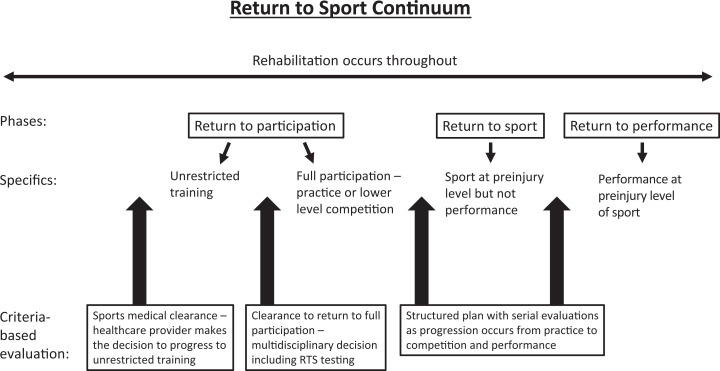
Purpose: The aim of the Panther Symposium ACL Injury Return to Sport Consensus Group was to provide a clear definition of RTS after ACL injury and a description of the RTS continuum as well as provide clinical guidance on RTS testing and decision-making.
Study design: Consensus statement.
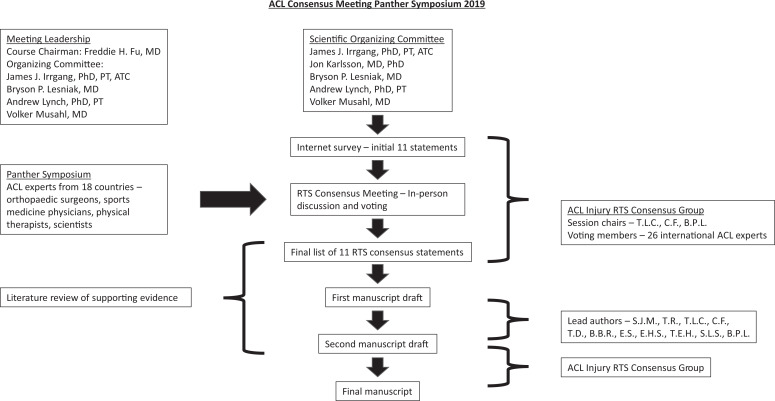
Methods: An international, multidisciplinary group of ACL experts convened as part of a consensus meeting. Consensus statements were developed using a modified Delphi method. Literature review was performed to report the supporting evidence.
Results: Key points include that RTS is characterized by achievement of the preinjury level of sport and involves a criteria-based progression from return to participation to RTS and, ultimately, return to performance. Purely time-based RTS decision-making should be abandoned. Progression occurs along an RTS continuum, with decision-making by a multidisciplinary group that incorporates objective physical examination data and validated and peer-reviewed RTS tests, which should involve functional assessment as well as psychological readiness. Consideration should be given to biological healing, contextual factors, and concomitant injuries.
Conclusion: The resultant consensus statements and scientific rationale aim to inform the reader of the complex process of RTS after ACL injury that occurs along a dynamic continuum. Research is needed to determine the ideal RTS test battery, the best implementation of psychological readiness testing, and methods for the biological assessment of healing and recovery.
Keywords: anterior cruciate ligament; rehabilitation; return to sport; sports medicine.
© The Author(s) 2020.
Conflict of interest statement
One or more of the authors has declared the following potential conflict of interest or source of funding: C.F. has received research support from Zimmer Biomet, consulting fees from Karl Storz and Medacta, speaking fees from Medacta, and royalties from Karl Storz. S.L.S. has received research support from Zimmer Biomet and consulting fees from Arthrex, Conmed, Flexion Therapeutics, JRF Ortho, Olympus, Smith & Nephew, and Vericel. B.P.L. has received royalties from Wolters Kluwer Health–Lippincott Williams & Wilkins. Contributing authors have the following disclosures: L.E. has received grants from Smith & Nephew. C.C.K. has received grant support from DJO, educational support from CDC Medical, consulting fees from Zimmer Biomet, and nonconsulting fees from Arthrex. R.K. has received grants from Smith & Nephew, Zimmer Biomet, Stryker, and Johnson & Johnson; consulting fees from Medacta International, Arthrex, Japan Tissue Engineering, and Hirosaki Life Science Innovation; and speaking fees from Arthrex, Smith & Nephew, Zimmer Biomet, Johnson & Johnson, and Japan Tissue Engineering. V.M. has received educational support from Arthrex and Smith & Nephew. S.J.R. has received educational support from Mid-Atlantic Surgical. R.S. has received personal fees from Medacta International. C.v.E. has received educational support from Arthrex, Mid-Atlantic Surgical, and Smith & Nephew and grant support from DJO and Zimmer Biomet. D.V. has received educational support from Mid-Atlantic Surgical and hospitality payments from Arthrex. AOSSM checks author disclosures against the Open Payments Database (OPD). AOSSM has not conducted an independent investigation on the OPD and disclaims any liability or responsibility relating thereto.
Figures
References
-
- Ardern CL, Bizzini M, Bahr R. It is time for consensus on return to play after injury: five key questions. Br J Sports Med. 2016;50(9):506–508. - PubMed
-
- Ardern CL, Glasgow P, Schneiders A, et al. 2016. consensus statement on return to sport from the First World Congress in Sports Physical Therapy, Bern. Br J Sports Med. 2016;50(14):853–864. - PubMed
LinkOut - more resources
Full Text Sources
