


Editorial
doi: 10.1097/HS9.0000000000000407.
eCollection 2020 Jun.
Cytokine Profiling as a Novel Complementary Tool to Predict Prognosis in MPNs?
Affiliations
- PMID: 32647805
- PMCID: PMC7306306
- DOI: 10.1097/HS9.0000000000000407
Item in Clipboard
Editorial
Cytokine Profiling as a Novel Complementary Tool to Predict Prognosis in MPNs?
Hemasphere.
.
Erratum in
-
Correction Notice: Cytokine Profiling as a Novel Complementary Tool to Predict Prognosis in MPNs?Hemasphere. 2020 Aug 21;4(5):e482. doi: 10.1097/HS9.0000000000000482. eCollection 2020 Oct. Hemasphere. 2020. PMID: 33688623 Free PMC article.
No abstract available
Figures
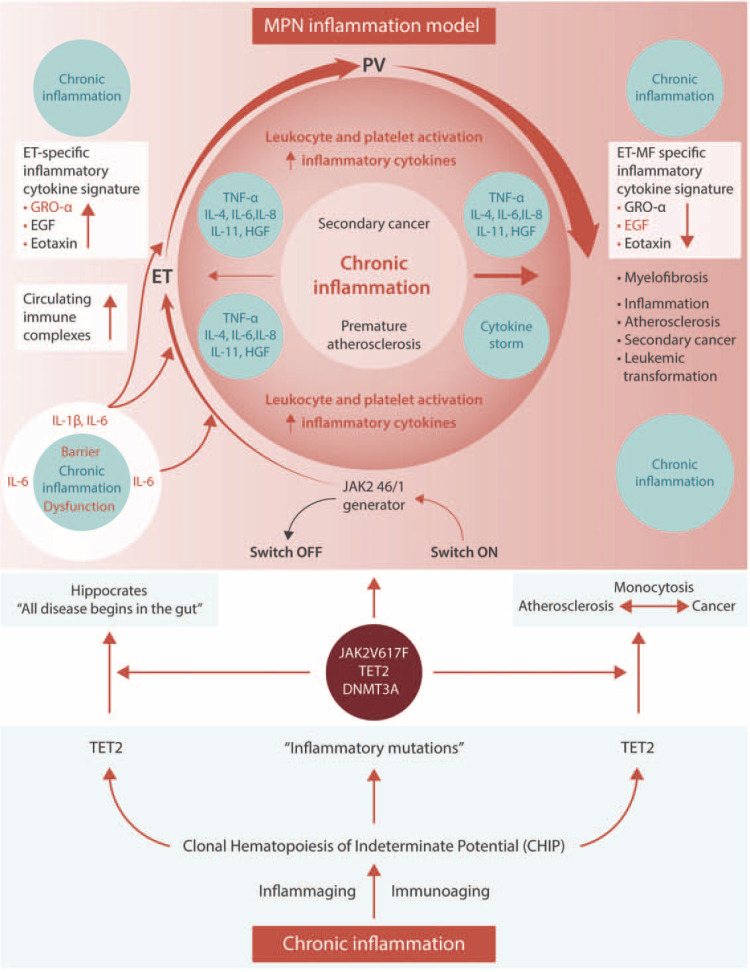
Clonal hematopoiesis of indeterminate potential (CHIP) is common and increases in prevalence with age. Somatic mutations in JAK2, TET2, DNMT3A are among the most common and are associated with an increased risk of hematological and non-hematological malignancies as well as an increased risk of cardiovascular diseases. It is increasingly being recognized that the common denominator for development of cancer and cardiovascular diseases is chronic inflammation. The Philadelphia-negative chronic myeloproliferative neoplasms (MPNs) are “inflammatory” diseases, which have been described as “A Human Inflammation Model”, since chronic inflammation is likely both a trigger and driver of clonal evolution and determinant for disease progression, cardiovascular disease burden (early inflamma-aging and immune-aging) and the increased risk of second cancers. Small-intestinal barrier dysfunction may be highly important for MPN-development in patients with the TET2 mutation in the context of microbial-mediated inflammatory IL-6 signaling, having a crucial role for clonal evolution. Thus, the TET2 mutation is also associated with upregulation of several “inflammatory” cytokines, including IL1beta, IL-6 and CXCL1 (GRO-α). Together with EGF and Eotaxin, GRO-α constitutes an “essential thrombocythemia (ET)-specific inflammatory cytokine signature”, which predicts myelofibrotic transformation and adds significant value in prognostication of MPNs. In this self-perpetuated vicious circle from early MPN-stages (ET, PV) to the advanced myelofibrosis stage – driven by chronic inflammation – circulating levels of EGF and GRO-α steadily decrease and signal transformation to myelofibrosis. It is proposed that circulating IgA immune complexes, being elicited by bacterial intestinal translocation with antibody production against IgA, trigger a chronic inflammatory state with the production of inflammatory cytokines from several immune cells and consequently the development of MPNs from CHIP. Hereby, Hippocrates statement “All disease begins in the gut” holds true for MPNs as well.
References
-
- Barosi G. An immune dysregulation in MPN. Curr Hematol Malig Rep. 2014;9:331–339. - PubMed
-
- Hasselbalch HC. Perspectives on chronic inflammation in essential thrombocythemia, polycythemia vera, and myelofibrosis: is chronic inflammation a trigger and driver of clonal evolution and development of accelerated atherosclerosis and second cancer? Blood. 2012;119:3219–3225. - PubMed
-
- Koschmieder S, Mughal TI, Hasselbalch HC, et al. Myeloproliferative neoplasms and inflammation: whether to target the malignant clone or the inflammatory process or both. Leukemia. 2016;30:1018–1024. - PubMed
Publication types
LinkOut - more resources
Full Text Sources