Association of Apolipoprotein E in Lipoprotein Subspecies With Risk of Dementia
- PMID: 32648923
- PMCID: PMC7352155
- DOI: 10.1001/jamanetworkopen.2020.9250
Association of Apolipoprotein E in Lipoprotein Subspecies With Risk of Dementia
Abstract
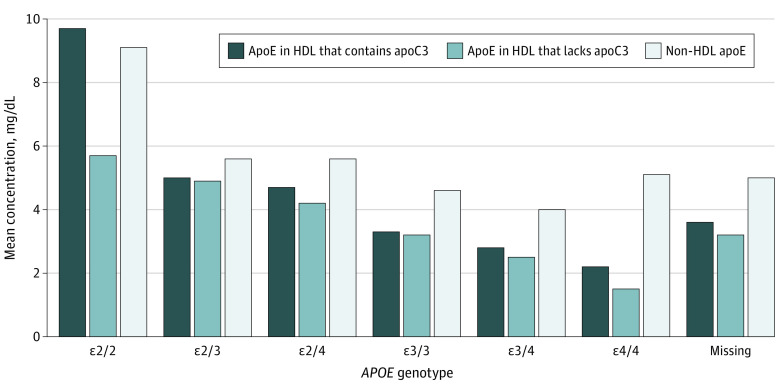
Importance: The ε4 allele of the apolipoprotein E (APOE) gene and lower apolipoprotein E (apoE) protein levels in plasma are risk factors for Alzheimer disease, but the underlying biological mechanisms are not fully understood. Half of plasma apoE circulates on high-density lipoproteins (HDLs). Higher apoE levels in plasma HDL were previously found to be associated with lower coronary heart disease risk, but the coexistence of another apolipoprotein, apoC3, modified this lower risk.
Objective: To investigate associations between the presence of apoE in different lipoproteins with cognitive function, particularly the risk of dementia.
Design, setting, and participants: This prospective case-cohort study embedded in the Ginkgo Evaluation of Memory Study (2000-2008) analyzed data from 1351 community-dwelling participants 74 years and older. Of this group, 995 participants were free of dementia at baseline (recruited from September 2000 to June 2002) and 521 participants were diagnosed with incident dementia during follow-up until 2008. Data analysis was performed from January 2018 to December 2019.
Exposures: Enzyme-linked immunosorbent assay-measured concentration of apoE in whole plasma, HDL-depleted plasma (non-HDL), HDL, and HDL subspecies that contain or lack apoC3 or apoJ.
Main outcomes and measures: Adjusted hazard ratios for risk of dementia and Alzheimer disease during follow-up and adjusted differences (β coefficients) in Alzheimer Disease Assessment-Cognitive Subscale (ADAS-cog) and Modified Mini-Mental State Examination scores at baseline.
Results: Among 1351 participants, the median (interquartile range) age was 78 (76-81) years; 639 (47.3%) were women. The median (interquartile range) follow-up time was 5.9 (3.7-6.5) years. Higher whole plasma apoE levels and higher apoE levels in HDL were associated with better cognitive function assessed by ADAS-cog (whole plasma, β coefficient, -0.15; 95% CI, -0.24 to -0.06; HDL, β coefficient, -0.20; 95% CI, -0.30 to -0.10) but were unassociated with dementia or Alzheimer disease risk. When separated by apoC3, a higher apoE level in HDL that lacks apoC3 was associated with better cognitive function (ADAS-cog per SD: β coefficient, 0.17; 95% CI, -0.27 to -0.07; Modified Mini-Mental State Examination score per SD: β coefficient, 0.25; 95% CI, 0.07 to 0.42) and lower risk of dementia (hazard ratio per SD, 0.86; 95% CI, 0.76 to 0.99). In contrast, apoE levels in HDL that contains apoC3 were unassociated with any of these outcomes.
Conclusions and relevance: In a prospective cohort of older adults with rigorous follow-up of dementia, the apoE level in HDL that lacked apoC3 was associated with better cognitive function and lower dementia risk. This finding suggests that the cardioprotective associations of this novel lipoprotein extend to dementia.
Conflict of interest statement
Figures
Comment in
-
Plasma Apolipoprotein E Levels and Risk of Dementia-You Are the Company You Keep.JAMA Netw Open. 2020 Jul 1;3(7):e209501. doi: 10.1001/jamanetworkopen.2020.9501. JAMA Netw Open. 2020. PMID: 32648920 No abstract available.
References
Publication types
MeSH terms
Substances
Grants and funding
LinkOut - more resources
Full Text Sources
Other Literature Sources
Medical
Miscellaneous