Review
. 2020 Jul 8;25(14):3130.
doi: 10.3390/molecules25143130.

RNA Granules: A View from the RNA Perspective

Affiliations
Review

RNA Granules: A View from the RNA Perspective

Siran Tian et al. Molecules. .

Abstract

RNA granules are ubiquitous. Composed of RNA-binding proteins and RNAs, they provide functional compartmentalization within cells. They are inextricably linked with RNA biology and as such are often referred to as the hubs for post-transcriptional regulation. Much of the attention has been given to the proteins that form these condensates and thus many fundamental questions about the biology of RNA granules remain poorly understood: How and which RNAs enrich in RNA granules, how are transcripts regulated in them, and how do granule-enriched mRNAs shape the biology of a cell? In this review, we discuss the imaging, genetic, and biochemical data, which have revealed that some aspects of the RNA biology within granules are carried out by the RNA itself rather than the granule proteins. Interestingly, the RNA structure has emerged as an important feature in the post-transcriptional control of granule transcripts. This review is part of the Special Issue in the Frontiers in RNA structure in the journal Molecules.

Keywords: RNA granules; RNA phase separation; RNA secondary structure; RNA self-assembly; RNA-RNA interactions; germ granules; p-bodies; stress granules.


Conflict of interest statement

The authors declare no conflict of interest.

Figures
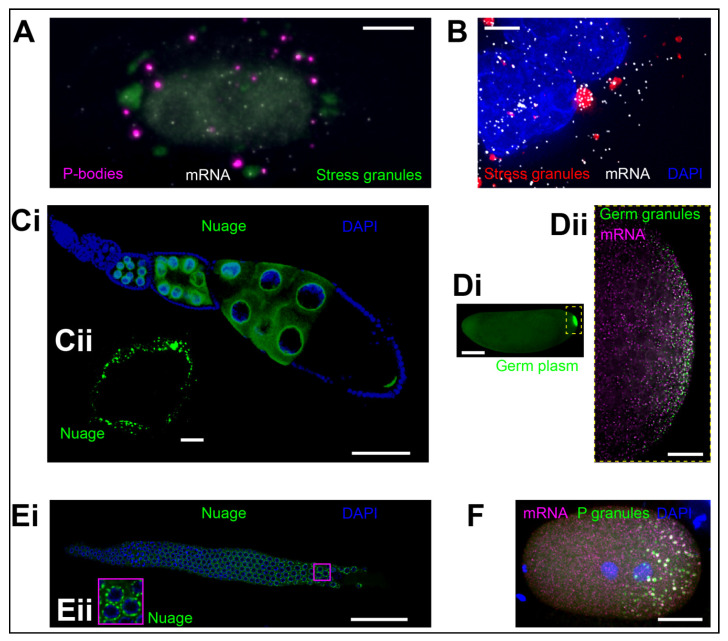
Figure 1
Figure 1
(A) Processing bodies (P-bodies) (magenta, marked by DDX6 fused with TagRFP) interacting with stress granules (green, marked by G3BP1 fused with GFP) in U2OS cells during stress. mRNAs (a transgenic mRNA genetically-tagged with MS2:MCP-Halo) are shown as white dots. Image: Courtesy of Jeff A. Chao (FMI). (B) Stress granules (red; marked by G3BP1 fused with GFP) accumulate AHNAK mRNA (white, hybridized with smFISH probes) in U2OS cells during stress. Nuclei are labeled with a DAPI stain. Image: Courtesy of Stephanie Moon (University of Michigan) and Roy R. Parker (University of Colorado, Boulder). (Ci,ii) Nuage (green, marked by Vasa fused with GFP) abutting the nurse cell nuclei (blue, marked by DAPI) in Drosophila oocytes. (ii) Shows a close-up of a single nucleus from a different oocyte from the one shown in (i). (Di,ii) Germ granules (polar granules) (ii) form within germ plasm (i) at the posterior pole of the early Drosophila embryo (green; marked by Vasa fused with GFP). mRNAs such as gcl (magenta, hybridized with smFISH probes) enrich in these granules. (Ei,ii) Nuage ((ii) magenta square: Close-up of three nuclei) (green, marked anti-CSR-1 antibody) abutting the C. elegans germ cell nuclei (blue, marked by DAPI). Image: Courtesy of Jessica Kirshner and John K. Kim (Johns Hopkins University). (F) mRNAs in P granules are enriched in the C. elegans one cell zygote. P granules enrich polyA RNA (green) and nos-2 mRNA (magenta), both marked with smFISH probes. DNA is stained with DAPI (blue). Image: Courtesy of Madeline Cassani, Andrew Folkmann, and Geraldine Seydoux (John Hopkins School of Medicine). Scale bar in (A,B,Cii) is 5 µm, in (Dii,F) is 10 µm, in (Ci,Ei) is 50 µm, and in (Di) is 100 µm.
Figure 2
Figure 2
Proposed intermolecular interactions among RNAs and proteins within RNA granules. RNA secondary structures can mask/expose the specific RNA sequences or binding motifs to neighboring RNAs or RBPs. The electrostatic interactions may facilitate RNA-protein interactions in crowded environments, and the proteins can change the conformations when the RNA binds. In addition, intermolecular RNA-RNA and protein-protein interactions can be specific or promiscuous. Intermolecular RNA-RNA and RNA-protein interactions depicted in this model were mostly studied on mRNAs, however similar principles may apply to other RNAs enriched in RNA granules such as piRNAs, microRNAs, or lncRNAs.
Figure 3
Figure 3
(A,B) CycB and gcl mRNA clusters (magenta; hybridized with smFISH probes) occupy distinct positions within Drosophila germ granules (green, labeled by Vasa fused with GFP). (C,D) Homotypic clusters contain multiple nos or pgc mRNAs (magenta and green, respectively hybridized with smFISH probes), do not have a defined stoichiometry and de-mix from each other within the same granule [85]. Scale bar in all is 1 µm.
Figure 4
Figure 4
Proposed models showing the mechanisms of mRNA self-organization in RNA granules using sequence-dependent or sequence-independent assembly. The later mechanism was demonstrated for homotypic mRNA clusters in Drosophila germ granules. Here, mRNAs distinguish between endogenous mRNAs and its derivatives and de-mix to form distinct homotypic clusters [85].

References

    1. Hyman A.A., Weber C.A., Julicher F. Liquid-liquid phase separation in biology. Annu. Rev. Cell Dev. Biol. 2014;30:39–58. doi: 10.1146/annurev-cellbio-100913-013325. - DOI - PubMed
    1. Shukla S., Parker R. Hypo- and Hyper-Assembly Diseases of RNA-Protein Complexes. Trends Mol. Med. 2016;22:615–628. doi: 10.1016/j.molmed.2016.05.005. - DOI - PMC - PubMed
    1. Di Stefano B., Luo E.C., Haggerty C., Aigner S., Charlton J., Brumbaugh J., Ji F., Rabano Jimenez I., Clowers K.J., Huebner A.J., et al. The RNA Helicase DDX6 Controls Cellular Plasticity by Modulating P-Body Homeostasis. Cell Stem Cell. 2019;25:622–638 e613. doi: 10.1016/j.stem.2019.08.018. - DOI - PMC - PubMed
    1. Savas J.N., Makusky A., Ottosen S., Baillat D., Then F., Krainc D., Shiekhattar R., Markey S.P., Tanese N. Huntington’s disease protein contributes to RNA-mediated gene silencing through association with Argonaute and P bodies. Proc. Natl. Acad. Sci. USA. 2008;105:10820–10825. doi: 10.1073/pnas.0800658105. - DOI - PMC - PubMed
    1. Anderson P., Kedersha N., Ivanov P. Stress granules, P-bodies and cancer. Biochim. Biophys. Acta. 2015;1849:861–870. doi: 10.1016/j.bbagrm.2014.11.009. - DOI - PMC - PubMed

LinkOut - more resources
