


Consumption of non-nutritive sweeteners by pre-schoolers of the food and environment Chilean cohort (FECHIC) before the implementation of the Chilean food labelling and advertising law
- PMID: 32650775
- PMCID: PMC7353755
- DOI: 10.1186/s12937-020-00583-3
Consumption of non-nutritive sweeteners by pre-schoolers of the food and environment Chilean cohort (FECHIC) before the implementation of the Chilean food labelling and advertising law
Erratum in
-
Correction to: Consumption of non-nutritive sweeteners by pre-schoolers of the food and environment Chilean cohort (FECHIC) before the implementation of the Chilean food labelling and advertising law.Nutr J. 2020 Dec 5;19(1):135. doi: 10.1186/s12937-020-00655-4. Nutr J. 2020. PMID: 33278879 Free PMC article.
Abstract
Background: Consumption of non-nutritive sweeteners (NNS) is becoming increasingly more frequent, particularly in the context of obesity prevention policies. The aim of this study was to describe the consumption of NNS in an ongoing cohort of pre-schoolers (4-6-year-old) before the implementation of the Chilean Food Labelling and Advertising Law, identify sociodemographic and anthropometric characteristics associated with their consumption, and describe the main dietary sources of each NNS sub-type.
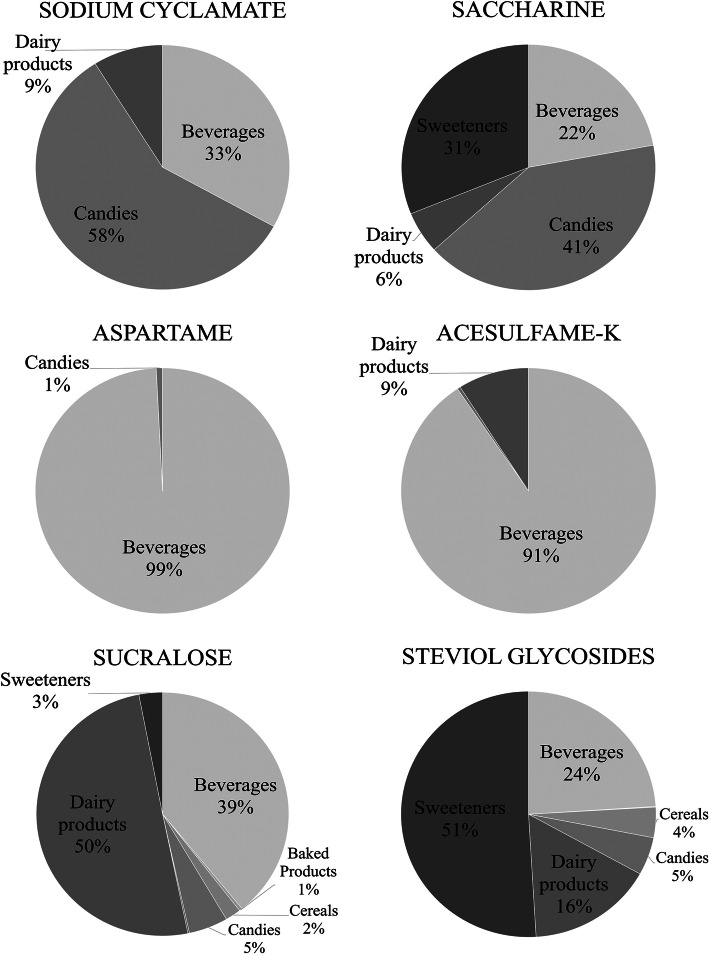
Methods: In 959 low-medium income pre-schoolers from the Food and Environment Chilean Cohort (FECHIC), dietary data from a single 24-h recall was linked to NNS content information obtained from packaged foods (n = 12,233). The prevalence of NNS consumption was estimated by food source and characterized by child and maternal sociodemographic and anthropometric variables. Intakes and main dietary sources were described for the six most prevalent NNS in Chile: Sodium Cyclamate, Saccharin, Aspartame, Acesulfame Potassium, Sucralose, and Steviol glycosides.
Results: Sixty-eight percent of the pre-schoolers consumed at least one source of NNS on the day of the dietary recall; most of them consumed NNS from foods and beverages (n = 532), while only 12% (n = 119) also consumed table-top sweeteners. The prevalence of NNS consumption was significantly higher among children whose mothers had a high educational level compared to children whose mothers did not complete high school (p < 0.05); however, it did not differ by any other variable studied. The highest intakes of NNS were observed for Aspartame [2.5 (1.4-3.7) mg/kg per consumer], followed by Sodium Cyclamate [1.6 (1.3-2.6) mg/kg per consumer] and Steviol glycosides [1.2 (0.2-2.1) mg/kg per consumer]. Beverages were the only food group that contributed to the intake of the six NNS studied, accounting for 22% of the overall intake of Saccharine and up to 99% of Aspartame intake.
Conclusions: Before the implementation of the Food Labelling and Advertising Law, NNS consumption was highly prevalent among a cohort of low-middle income Chilean pre-schoolers. Continuous monitoring of NNS consumption is essential given potential food reformulation associated with the implementation of this set of obesity-prevention policies.
Keywords: Chilean law of food labelling and advertising; Food reformulation; Non-nutritive sweeteners; Preschool children; Sweetening agents.
Conflict of interest statement
The authors declare that they have no competing interests.
Figures
References
-
- Le KA, Robin F, Roger O. Sugar replacers: from technological challenges to consequences on health. Curr Opin Clin Nutr Metab Care. 2016;19(4):310–315. - PubMed
-
- Food and Drug Administration (FDA). Food Additives & Ingredients - High-Intensity Sweeteners [WebContent]: Center for Food Safety and Applied Nutrition; 2014. Available from: https://www.fda.gov/Food/IngredientsPackagingLabeling/FoodAdditivesIngre....
-
- World Health Organization. Fact sheets: Food additives: WHO; 2018. Available from: https://www.who.int/news-room/fact-sheets/detail/food-additives.
Publication types
MeSH terms
Substances
Grants and funding
LinkOut - more resources
Full Text Sources
