


Pai syndrome: a review
- PMID: 32651596
- PMCID: PMC7575485
- DOI: 10.1007/s00381-020-04788-z
Pai syndrome: a review
Abstract
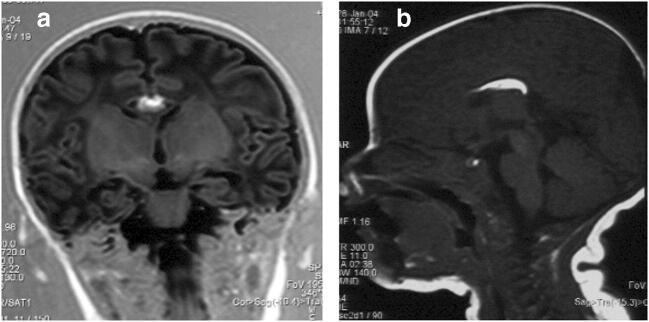
Background: Pai syndrome is a rare idiopathic developmental condition characterized by midline craniofacial abnormalities. It was originally described as the presence of a median cleft lip, cutaneous polyps of the nasal mucosa and face, and midline lipomas of the central nervous system, mostly at the corpus callosum. However, there is great phenotypical variability and these characteristics are rarely all present at once.
Objective: The aim of this review was to analyze the available evidence regarding Pai syndrome in order to better delineate this rare condition and its features.
Methods: We analyzed the PubMed database using the words "Pai syndrome", "frontonasal dysplasia", "cleft lip", "nasal polyp", "facial polyp", and "corpus callosum lipoma", including reviews, case reports and case series.
Conclusion: There is no consensus regarding the diagnostic criteria of Pai syndrome up to date. It is usually diagnosed at birth, and its incidence is often underestimated. At present, the etiology of Pai syndrome is unknown. Several hypotheses regarding its genetic background have been made; however, there are not enough data yet to elucidate this point. An improved awareness could help in diagnosing the condition and performing the necessary investigations. These patients should have a multidisciplinary follow-up.
Keywords: Cleft lip; Corpus callosum lipoma; Facial polyp; Frontonasal dysplasia; Nasal polyp; Pai syndrome.
Conflict of interest statement
The authors declare that they have no conflict of interest.
Figures

References
-
- Vaccarella F, Pini Prato A, Fasciolo A, Pisano M, Carlini C, Seymndi PL. Phenotypic variability of Pai syndrome: report of two patients and review of the literature. Int J Oral Maxillofac Surg. 2008;37:1059–1064. - PubMed
-
- Pai GS, Levkoff AH, Leithiser RE., Jr Median cleft of the upper lip associated with lipomas of the central nervous system and cutaneous polyps. Am J Med Genet. 1987;26:921–924. - PubMed
-
- Morice A, Galliani E, Amiel J, Rachwalski M, Neiva C, Thauvin-Robinet C, Vazquez MP, Picard A, Kadlub N. Diagnostic criteria in Pai syndrome: results of a case series and a literature review. Int J Oral Maxillofac Surg. 2019;48:283–290. - PubMed
-
- Castori M, Rinaldi R, Bianchi A, Caponetti A, Assumma M, Grammatico P. Pai syndrome: first patient with agenesis of the corpus callosum and literature review. Birth Defects Res A Clin Mol Teratol. 2007;79:673–679. - PubMed
-
- Lederer D, Wilson B, Lefesvre P, Poorten VV, Kirkham N, Mitra D, Verellen-Dumoulin C, Devriendt K. Atypical findings in three patients with Pai syndrome and literature review. Am J Med Genet. 2012;158A(2899):904. - PubMed
Publication types
MeSH terms
Supplementary concepts
LinkOut - more resources
Full Text Sources
Medical
