


The Psychological Impact of Epidemic and Pandemic Outbreaks on Healthcare Workers: Rapid Review of the Evidence
- PMID: 32651717
- PMCID: PMC7350408
- DOI: 10.1007/s11920-020-01166-z
The Psychological Impact of Epidemic and Pandemic Outbreaks on Healthcare Workers: Rapid Review of the Evidence
Abstract
Purpose of review: We aim to provide quantitative evidence on the psychological impact of epidemic/pandemic outbreaks (i.e., SARS, MERS, COVID-19, ebola, and influenza A) on healthcare workers (HCWs).
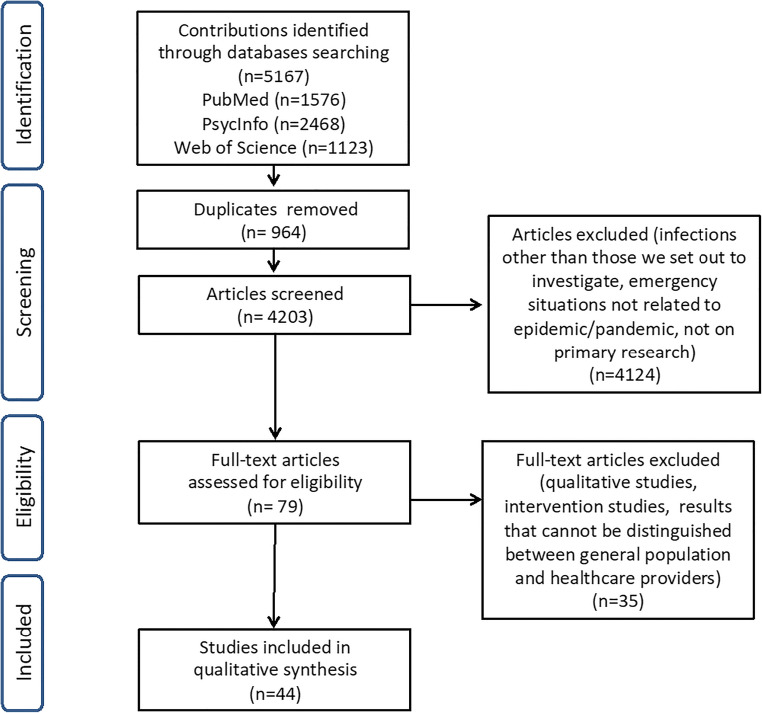
Recent findings: Forty-four studies are included in this review. Between 11 and 73.4% of HCWs, mainly including physicians, nurses, and auxiliary staff, reported post-traumatic stress symptoms during outbreaks, with symptoms lasting after 1-3 years in 10-40%. Depressive symptoms are reported in 27.5-50.7%, insomnia symptoms in 34-36.1%, and severe anxiety symptoms in 45%. General psychiatric symptoms during outbreaks have a range comprised between 17.3 and 75.3%; high levels of stress related to working are reported in 18.1 to 80.1%. Several individual and work-related features can be considered risk or protective factors, such as personality characteristics, the level of exposure to affected patients, and organizational support. Empirical evidence underlines the need to address the detrimental effects of epidemic/pandemic outbreaks on HCWs' mental health. Recommendations should include the assessment and promotion of coping strategies and resilience, special attention to frontline HCWs, provision of adequate protective supplies, and organization of online support services.
Keywords: COVID-19; Epidemic; Healthcare workers; Mental health; Pandemic; Psychological distress.
Conflict of interest statement
The authors declare that they have no conflict of interest.
References
-
- World Health Organization. Rapid reviews to strengthen health policy and systems: a practical guide. World Health Organization 2017. http://apps.who.int/iris/bitstream/10665/258698/1/9789241512763-eng.pdf
Publication types
MeSH terms
LinkOut - more resources
Full Text Sources
Medical
Research Materials
Miscellaneous
