Review
. 2020 Oct;10(10):1173-1179.
doi: 10.1002/alr.22661. Epub 2020 Jul 24.

Review of indoor aerosol generation, transport, and control in the context of COVID-19

Affiliations
Review

Review of indoor aerosol generation, transport, and control in the context of COVID-19

Michael A Kohanski et al. Int Forum Allergy Rhinol. 2020 Oct.

Abstract

The coronavirus disease-2019 (COVID-19) pandemic has heightened the awareness of aerosol generation by human expiratory events and their potential role in viral respiratory disease transmission. Concerns over high severe acute respiratory syndrome-coronavirus-2 (SARS-CoV-2) viral burden of mucosal surfaces has raised questions about the aerosol-generating potential and dangers of many otorhinolaryngologic procedures. However, the risks of aerosol generation and associated viral transmission by droplet or airborne routes for many otorhinolaryngology procedures are largely unknown. Indoor aerosol and droplet viral respiratory transmission risk is influenced by 4 factors: (1) aerosol or droplet properties; (2) indoor airflow; (3) virus-specific factors; and (4) host-specific factors. Herein we elaborate on known aerosol vs droplet properties, indoor airflow, and aerosol-generating events to provide context for risks of aerosol infectious transmission. We also provide simple but typically effective measures for mitigating the spread and inhalation of viral aerosols in indoor settings. Understanding principles of infectious transmission, aerosol and droplet generation, as well as concepts of indoor airflow, will assist in the integration of new data on SARS-CoV-2 transmission and activities that can generate aerosol to best inform on the need for escalation or de-escalation from current societal and institutional guidelines for protection during aerosol-generating procedures.

Keywords: COVID-19; SARS-CoV-2; aerosol; aerosol-generating procedure; airborne; droplet.


Figures

FIGURE 1
FIGURE 1
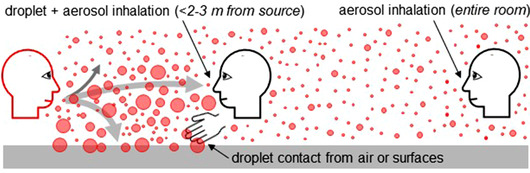
Three possible mechanisms of respiratory pathogen transmission. Transmission can occur through self‐inoculation after contact with droplets that settle on surfaces, direct deposition/inspiration of infectious droplets in the mouth or nose and deposition on the eyes, as well as through airborne transmission with inhalation of aerosols. Short range (<2 to 3 meters) aerosol transmission can be difficult to separate from droplet transmission and long‐range transmission for viral respiratory pathogens, including influenza and coronaviruses, remains controversial.
FIGURE 2
FIGURE 2
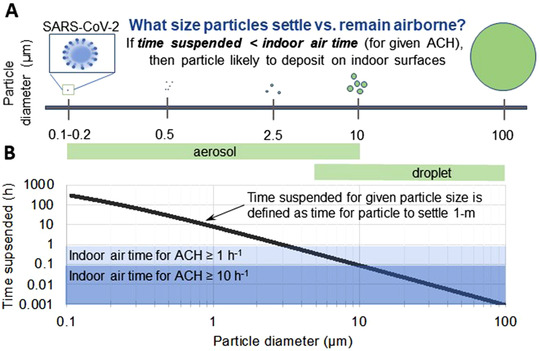
Suspension time of aerosols and droplets in indoor environments. (A) The relative sizes of aerosol and droplet particles are shown compared with a single coronavirus. (B) As particle size decreases, airborne suspension time increases—particles >5 to 10 µm have suspension times on the order of seconds and are considered droplets, whereas particles with smaller diameter remain airborne much longer and are considered aerosol. For context, the time for a particle to fall 1 meter due to gravity can be calculated using its terminal settling velocity, and particles of 100, 10, 1, and 0.1 µm will settle a distance of 1 meter in 3.3 seconds, 5.6 minutes, 9.3 hours, and 39 days, respectively. Particle settling is important when the suspension time is less than the indoor air residence time, which is how long air resides indoors before being exhausted and replaced by fresh ventilation air. The suspension time is defined as amount of time for a particle of a given size to settle 1 meter with no air flow, as depicted by the black line. The influence of the number of ACHs is depicted; that is, particles with a suspension time of >0.1 hour will be less likely to deposit on surfaces and will be cleared from a room with ≥10 ACHs, and those with suspension times >1 hour will behave similarly when there is ≥1 ACH. Although ultrafine and smaller fine aerosols never appreciably settle due to gravity on surfaces indoors, they do deposit effectually on indoor surfaces by the Brownian diffusion mechanism. Note that the graph represents suspension times and indoor air times for well‐mixed environments, and does not include impact of local airflow, source proximity, or evaporation. ACH = air changes per hour.
FIGURE 3
FIGURE 3
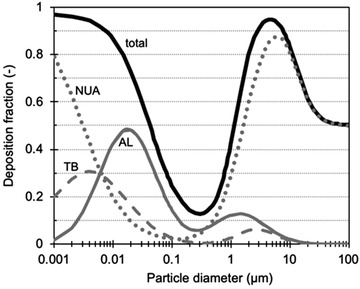
ICRP lung deposition model, predicted with fitted equations from Hinds. Total (solid black line) and regional deposition in NUA (gray dotted line), TB (hashed gray line), and AL (solid gray line) regions for light exercise with nasal breathing. A greater percentage of particles less than ∼1 to 2.5 µm deposit in the tracheobronchial and alveoli regions,, whereas larger particles deposit in the upper airway. Respirable aerosols are defined as particles <10 µm in diameter and inhalable aerosols as <2.5 µm. AL, alveolar; ICRP = International Commission on Radiological Protection; NUA, nasal upper airway; TB = tracheobronchial.

References

    1. Guan WJ, Ni ZY, Hu Y, et al. Clinical characteristics of coronavirus disease 2019 in China. N Engl J Med. 2020;382(18):1708‐1720. - PMC - PubMed
    1. Helms J, Kremer S, Merdji H, et al. Neurologic features in severe SARS‐CoV‐2 infection. N Engl J Med. 2020;382(23):2268‐2270. - PMC - PubMed
    1. Oxley TJ, Mocco J, Majidi S, et al. Large‐vessel stroke as a presenting feature of Covid‐19 in the young. N Engl J Med. 2020;382:e60. - PMC - PubMed
    1. US Centers for Disease Control and Prevention . Geographic differences in COVID‐19 cases, deaths, and incidence—United States, February 12‒April 7, 2020. 2020. https://www.cdc.gov/mmwr/volumes/69/wr/mm6915e4.htm?s_cid=mm6915e4_w. Accessed May 20, 2020.
    1. Chowell G, Abdirizak F, Lee S, et al. Transmission characteristics of MERS and SARS in the healthcare setting: a comparative study. BMC Med. 2015;13:210. - PMC - PubMed

Publication types