


Association of primary care physician supply with maternal and child health in China: a national panel dataset, 2012-2017
- PMID: 32652971
- PMCID: PMC7353716
- DOI: 10.1186/s12889-020-09220-4
Association of primary care physician supply with maternal and child health in China: a national panel dataset, 2012-2017
Abstract
Background: The Chinese government has been strengthening the primary care system since the launch of the New Healthcare System Reform in 2009. Among all endeavors, the most obvious and significant improvement lays in maternal and child health. This study was designed to explore the association of primary care physician supply with maternal and child health outcomes in China, and provide policy suggestions to the law makers.
Methods: Six-year panel dataset of 31 provinces in China from 2012 to 2017 was used to conduct the longitudinal ecological study. Linear fixed effects regression model was applied to explore the association of primary care physician supply with the metrics of maternal and child health outcomes while controlling for specialty care physician supply and socio-economic covariates. Stratified analysis was used to test whether this association varies across different regions in China.
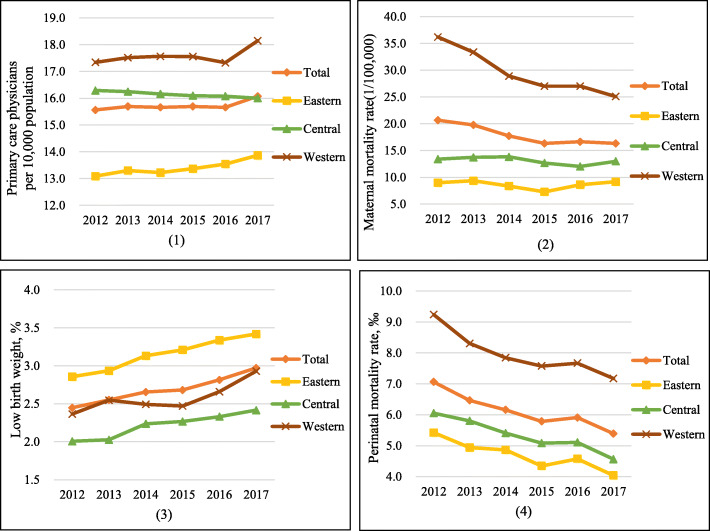
Results: The number of primary care physicians per 10,000 population increased from 15.56 (95% CI: 13.66 to 17.47) to 16.08 (95% CI: 13.86 to 18.29) from 2012 to 2017. The increase of one primary care physician per 10,000 population was associated with 5.26 reduction in maternal mortality per 100,000 live births (95% CI: - 6.745 to - 3.774), 0.106% (95% CI: - 0.189 to - 0.023) decrease in low birth weight, and 0.419 decline (95% CI: - 0.564 to - 0.273) in perinatal mortality per 1000 live births while other variables were held constant. The association was particularly prominent in the less-developed western China compared to the developed eastern and central China.
Conclusion: The sufficient supply of primary care physician was associated with improved maternal and child health outcomes in China, especially in the less-developed western region. Policies on effective and proportional allocation of resources should be made and conducted to strengthen primary care system and eliminate geographical disparities.
Keywords: Health disparities; Maternal and child health outcomes; Primary care physician supply.
Conflict of interest statement
The authors declare no conflicts of interest.
Figures
References
-
- Starfield B. Primary care: an increasingly important contributor to effectiveness, equity, and efficiency of health services. SESPAS report 2012. Gac Sanit. 2012;26(Suppl 1):20–26. - PubMed
-
- Macinko J, Starfield B, Shi L. Quantifying the health benefits of primary care physician supply in the United States. Int J Health Serv. 2007;37(1):111–126. - PubMed
-
- Kiran T, Hutchings A, Dhalla IA, Furlong C, Jacobson B. The association between quality of primary care, deprivation and cardiovascular outcomes: a cross-sectional study using data from the UK quality and outcomes framework. J Epidemiol Community Health. 2010;64(10):927–934. - PubMed
MeSH terms
Grants and funding
LinkOut - more resources
Full Text Sources
Medical
