Review
. 2021 May:113:14-26.
doi: 10.1016/j.semcdb.2020.07.004. Epub 2020 Jul 9.

A fork in the road: Where homologous recombination and stalled replication fork protection part ways

Affiliations
Review

A fork in the road: Where homologous recombination and stalled replication fork protection part ways

Stephanie Tye et al. Semin Cell Dev Biol. 2021 May.

Abstract

In response to replication hindrances, DNA replication forks frequently stall and are remodelled into a four-way junction. In such a structure the annealed nascent strand is thought to resemble a DNA double-strand break and remodelled forks are vulnerable to nuclease attack by MRE11 and DNA2. Proteins that promote the recruitment, loading and stabilisation of RAD51 onto single-stranded DNA for homology search and strand exchange in homologous recombination (HR) repair and inter-strand cross-link repair also act to set up RAD51-mediated protection of nascent DNA at stalled replication forks. However, despite the similarities of these pathways, several lines of evidence indicate that fork protection is not simply analogous to the RAD51 loading step of HR. Protection of stalled forks not only requires separate functions of a number of recombination proteins, but also utilises nucleases important for the resection steps of HR in alternative ways. Here we discuss how fork protection arises and how its differences with HR give insights into the differing contexts of these two pathways.

Keywords: BRCA1; BRCA2; Fork reversal; Homologous recombination; RAD51; Replication fork protection.


Conflict of interest statement

The authors declare they have no financial or personal relationships with other people or organizations that could inappropriately influence this work.

Figures
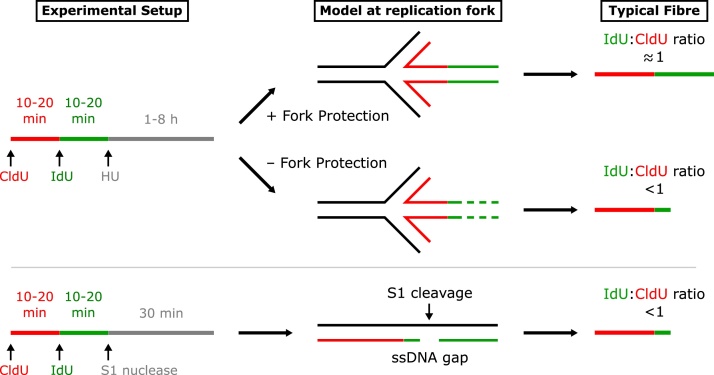
Fig. 1
Fig. 1
Schematic of the DNA fibre-spreading assay. To assess replication fork protection, cells are sequentially incubated with the thymidine analogues CldU and IdU, followed by the addition of a replication stress-inducing agent, most commonly HU. After spreading, fixing and staining, the fibres can be visualised. A second label tract shorter than the first label may be due to nucleolytic degradation of the nascent strand at stalled replication forks, indicating defective fork protection. This protocol can be modified to assay for single-stranded DNA (ssDNA) gaps, by introducing the S1 nuclease which cleaves opposite gaps to result in a shorter second label.
Fig. 2
Fig. 2
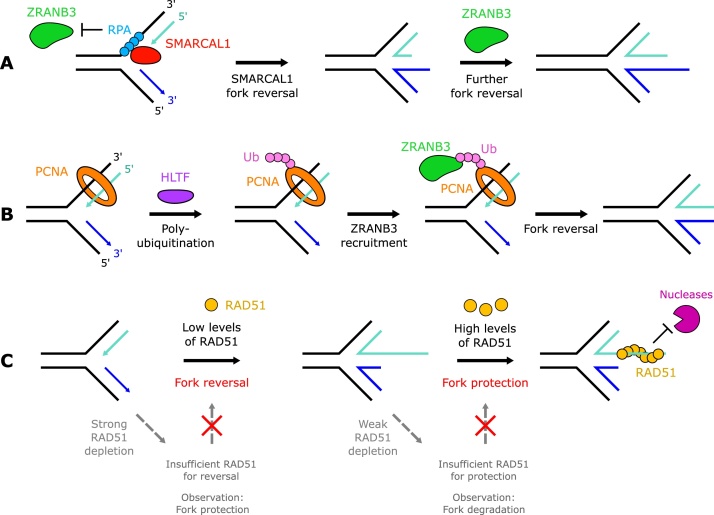
SNF2-family translocases and RAD51 mediate fork reversal. The translocases SMARCAL1, ZRANB3 and HLTF may act in a sequential manner. A: SMARCAL1, recruited and stimulated by RPA, may catalyse initial fork reversal. Once RPA has been evicted, ZRANB3 activity will no longer be suppressed, allowing further fork reversal. B: HLTF polyubiquitinates PCNA, which can recruit ZRANB3 to forks – suggesting ZRANB3 may act downstream of HLTF. C: Differential levels of RAD51 are required for fork reversal versus fork protection. Strong, near complete, RAD51 depletion prevents fork reversal, leading to fork protection. Weaker depletion leaves sufficient RAD51 capable of promoting fork reversal but not enough to support fork protection, leading to degradation by MRE11 and other nucleases.
Fig. 3
Fig. 3
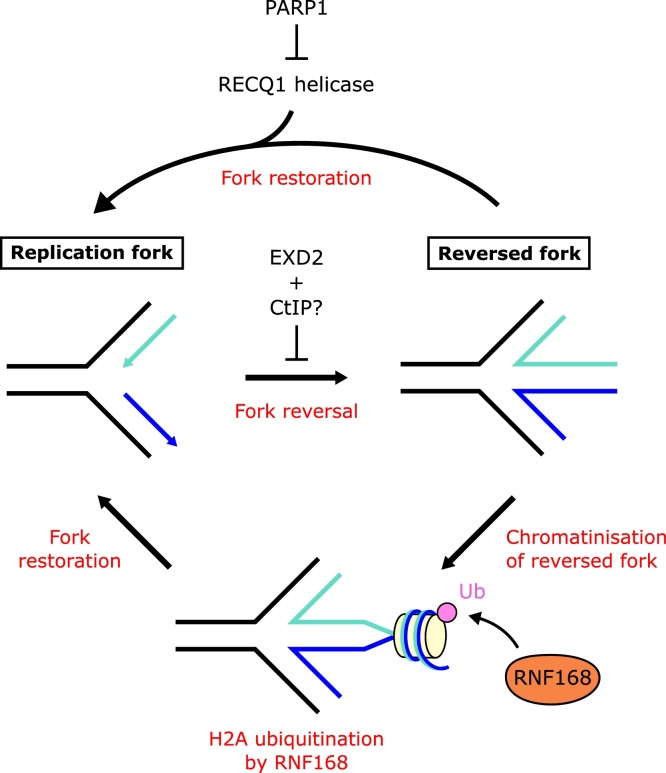
Suppression of replication fork reversal. The nuclease EXD2 may disfavour fork reversal by processing a stalled replication fork into a form that is refractory to remodelling. CtIP may also be involved in suppressing fork reversal. Reversed replication forks can be restored to a canonical fork by RECQ1 helicase. PARP1 negatively regulates RECQ1 activity, controlling the balance between reversal and restoration of replication forks. Chromatinisation of the regressed arm may act as a target for H2A ubiquitination by RNF168, which may also suppress fork reversal and promote restoration of the fork to restart replication.
Fig. 4
Fig. 4
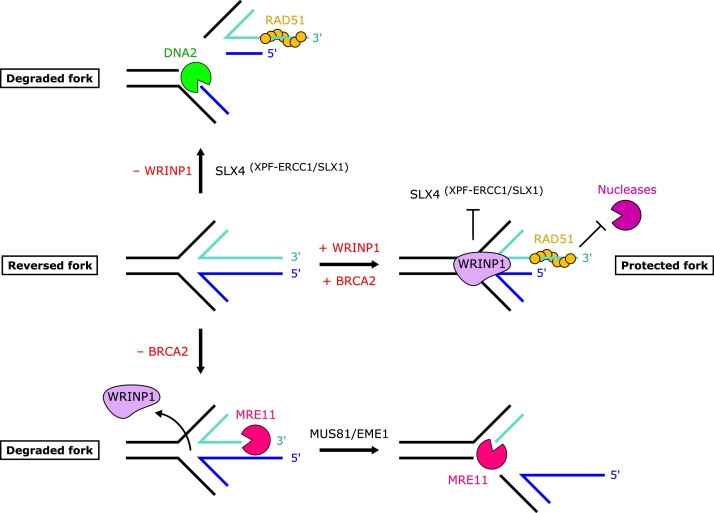
WRNIP1 protects replication forks in a distinct manner to BRCA2. WRNIP1 is able to bind the four-way junction of a reversed replication fork and protects it from cleavage by SLX4(XPF−ERCC1/SLX1). In the absence of WRNIP1, cleavage of the fork by SLX4(XPF−ERCC1/SLX1) creates a substrate for nascent DNA degradation by DNA2. In contrast, following loss of BRCA2, fork protection is compromised in a distinct manner, whereby initial degradation by MRE11 enables cleavage of the fork by MUS81/EME1, subsequently facilitating extensive MRE11-mediated degradation of DNA.
Fig. 5
Fig. 5
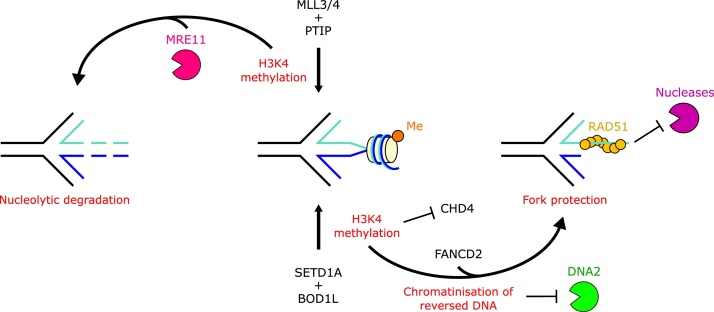
H3K4 methylation can promote distinct outcomes at reversed replication forks depending on the cellular context. In BRCA2-deficient cells, H3K4 methylation by MLL3/4 and PTIP promotes MRE11 recruitment to stalled replication forks and contributes to nascent DNA degradation. In contrast, H3K4 methylation by SETD1A and BOD1L promotes replication fork protection, by preventing the recruitment of CHD4 to the fork, and enhancing the histone chaperone function of FANCD2 to facilitate the chromatinisation of the reversed nascent strand and prevent DNA2-mediated degradation.
Fig. 6
Fig. 6
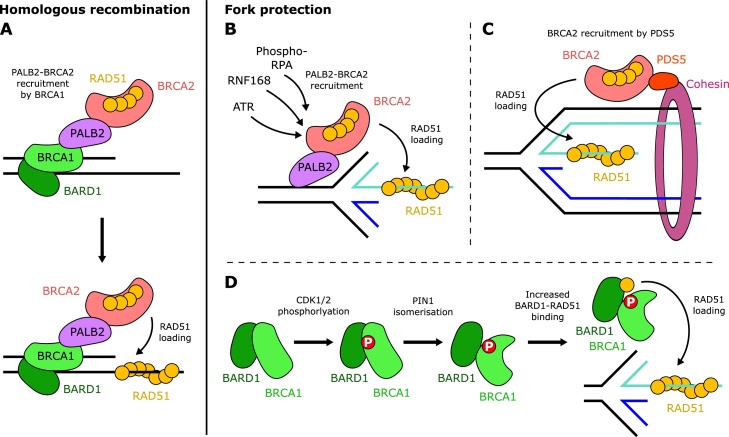
BRCA1 and BRCA2 in homologous recombinationversusfork protection. A: In homologous recombination, BRCA1 recruits BRCA2 via PALB2 to double-strand breaks. BRCA2 in turn mediates RAD51 loading and filament formation. B: In fork protection, BRCA2-PALB2 recruitment is not dependent on BRCA1, and may instead be mediated by ATR, RNF168 and phosphorylated RPA. PALB2 may also bind directly to chromatin. C: BRCA2 may also be recruited independently of PALB2, which may involve the cohesin cofactor PDS5. D: BRCA1-BARD1 plays a distinct role in replication fork protection compared to homologous recombination. CDK1/2 phosphorylation of BRCA1 recruits the peptidyl-prolyl isomerase PIN1. Subsequent isomerisation of BRCA1 increases the accessibility of BARD1, resulting in increased BARD1-RAD51 interaction which facilitates RAD51 loading onto reversed forks.
Fig. 7
Fig. 7
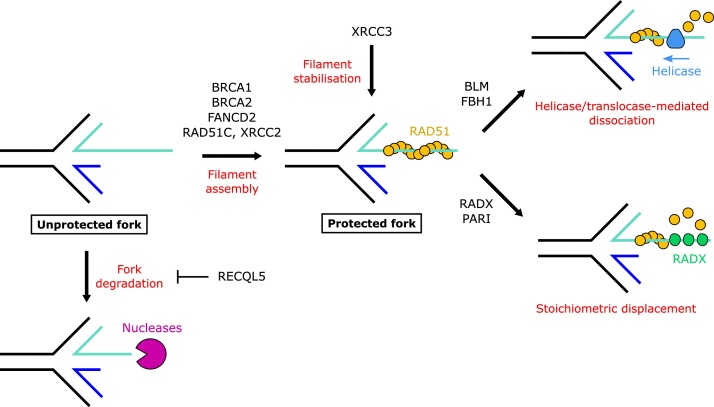
Factors directly regulating RAD51 filament stability. RAD51 filament formation onto the regressed arm of a reversed replication fork is promoted by BRCA1, BRCA2, FANCD2 and the RAD51 paralogs RAD51C and XRCC2. The RAD51 paralog XRCC3 meanwhile may stabilise filaments downstream of RAD51 recruitment. Multiple factors negatively regulate the stability of RAD51 filaments to promote disassembly. These can act as translocases to strip RAD51 from the DNA (e.g. BLM or FBH1), or may act in a non-enzymatic fashion (e.g. RADX or PARI). In contrast, RECQL5, although able to displace RAD51 filaments, has been implicated in preventing fork degradation.

References

    1. Zeman M.K., Cimprich K.A. Causes and consequences of replication stress. Nat. Cell Biol. 2014;16(1):2–9. - PMC - PubMed
    1. Zellweger R., Dalcher D., Mutreja K., Berti M., Schmid J.A., Herrador R., Vindigni A., Lopes M. Rad51-mediated replication fork reversal is a global response to genotoxic treatments in human cells. J. Cell Biol. 2015;208(5):563–579. - PMC - PubMed
    1. Neelsen K.J., Lopes M. Replication fork reversal in eukaryotes: from dead end to dynamic response. Nat. Rev. Mol. Cell Biol. 2015;16(4):207–220. - PubMed
    1. Vujanovic M., Krietsch J., Raso M.C., Terraneo N., Zellweger R., Schmid J.A., Taglialatela A., Huang J.W., Holland C.L., Zwicky K., Herrador R., Jacobs H., Cortez D., Ciccia A., Penengo L., Lopes M. Replication fork slowing and reversal upon DNA damage require PCNA polyubiquitination and ZRANB3 DNA translocase activity. Mol. Cell. 2017;67(5):882–890. e5. - PMC - PubMed
    1. Kile A.C., Chavez D.A., Bacal J., Eldirany S., Korzhnev D.M., Bezsonova I., Eichman B.F., Cimprich K.A. HLTF’s ancient HIRAN domain binds 3’ DNA ends to drive replication fork reversal. Mol. Cell. 2015;58(6):1090–1100. - PMC - PubMed

Publication types

MeSH terms