Review
. 2020 Jul:57:102884.
doi: 10.1016/j.ebiom.2020.102884. Epub 2020 Jul 10.

Mitochondria in acute myocardial infarction and cardioprotection

Affiliations
Review

Mitochondria in acute myocardial infarction and cardioprotection

Chrishan J A Ramachandra et al. EBioMedicine. 2020 Jul.

Abstract

Acute myocardial infarction (AMI) and the heart failure (HF) that often follows are among the leading causes of death and disability worldwide. As such, new treatments are needed to protect the myocardium against the damaging effects of the acute ischaemia and reperfusion injury (IRI) that occurs in AMI, in order to reduce myocardial infarct (MI) size, preserve cardiac function, and improve patient outcomes. In this regard, cardiac mitochondria play a dual role as arbiters of cell survival and death following AMI. Therefore, preventing mitochondrial dysfunction induced by acute myocardial IRI is an important therapeutic strategy for cardioprotection. In this article, we review the role of mitochondria as key determinants of acute myocardial IRI, and we highlight their roles as therapeutic targets for reducing MI size and preventing HF following AMI. In addition, we discuss the challenges in translating mitoprotective strategies into the clinical setting for improving outcomes in AMI patients.

Keywords: Acute myocardial infarction; Calcium overload; Cardioprotection; Ischaemia-reperfusion injury; Ischaemic heart disease; Mitochondria; Oxidative stress.


Conflict of interest statement

Declaration of Competing Interest Author declare no conflicts of interest.

Figures
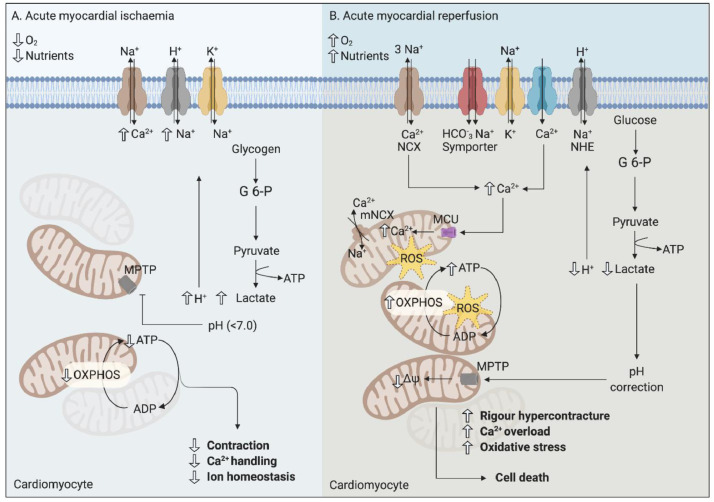
Fig. 1
Fig. 1
Biochemical and metabolic perturbations during acute myocardial ischaemia and reperfusion injury (A) During acute myocardial ischaemia, the absence of oxygen and nutrients switches cell metabolism to anaerobic glycolysis which leads to the production of lactate, accumulation of protons, and a fall in pH (which inhibits MPTP opening). This in turn, results in intracellular sodium and calcium overload. (B) At myocardial reperfusion, the availability of oxygen and nutrients allows mitochondrial re-energisation leading to further mitochondrial calcium overload, and production of oxidative stress which together with the rapid correction of pH, induces opening of the MPTP, rigour hypercontracture, and cell death. Glucose 6-phosphate, G 6-P; oxidative phosphorylation, OXPHOS; the sodium-calcium exchanger, NCX; mitochondrial sodium-calcium exchanger, mNCX; Na+/H+ exchanger, NHE; mitochondrial permeability transition pore, MPTP; reactive oxygen species, ROS.
Fig. 2
Fig. 2
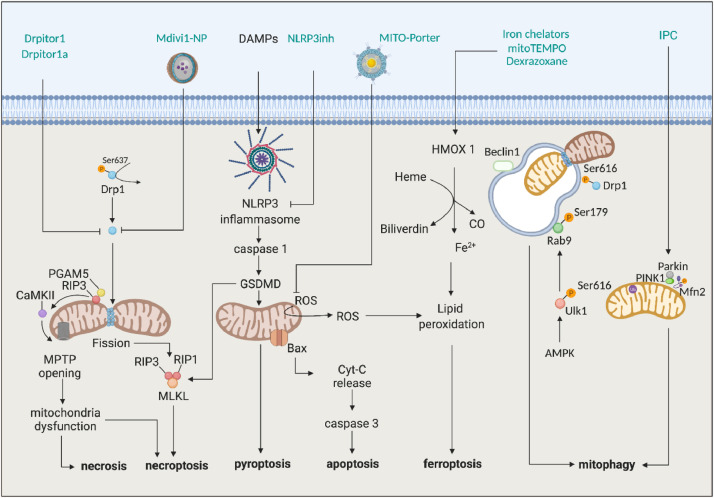
Targeting mitochondria-dependent cell death pathways for cardioprotection. Scheme showing mitochondria-dependent cell death pathways that contribute to acute myocardial IRI, and therefore provide new targets for cardioprotection. Receptor-interacting serine/threonine-protein kinase 3, RIP3; Receptor-interacting serine/threonine-protein kinase 1, RIP1; serine/threonine-protein phosphatase, PGAM5; cytochrome C, Cyt-C; 5′ AMP-activated protein kinase, AMPK; Gasdermin D, GSDMD; nucleotide-binding domain, leucine-rich-repeat containing family, pyrin domain-containing 3, NLRP3; NLRP3 inflammasome inhibitors, NLRP3inh; Unc-51 like autophagy activating kinase 1, Ulk1; Ras-related protein 9, Rab9; PTEN-induced kinase 1, PINK1; mixed lineage kinase domain-like, MLKL; Calcium/calmodulin-dependent protein kinase type II alpha chain, CaMKII; ischaemic preconditioning, IPC; Mitochondrial division inhibitor 1 with nanoparticles, Mdivi1-NP; Dynamin related protein 1, Drp1; mitochondrial permeability transition pore, MPTP; damage-associated molecular patterns DAMPs; Apoptosis regulator BAX, Bax; Mitofusin-2, Mfn2; hemeoxygenase-1, HMOX1; mitoTEMPO 2-(2,2,6,6-Tetramethylpiperidin-1-oxyl-4-ylamino)-2-oxoethyl) triphenylphosphonium chloride; carbon monoxide, CO; Ferrous ion, Fe2+.
Fig. 3
Fig. 3
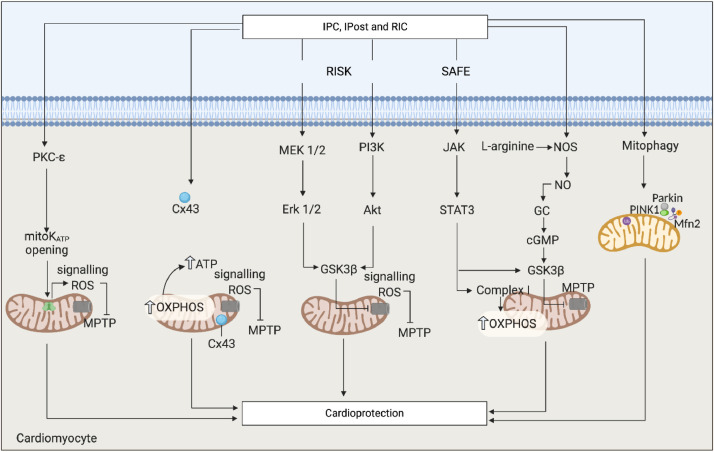
Targeting mitochondria using endogenous cardioprotective strategies. Scheme showing the recruitment of signalling pathways by ischaemic conditioning that converge on mitochondria to confer cardioprotection. Many of these signaling pathways reduce myocardial infarct size by inhibiting MPTP opening at the onset of reperfusion through the opening of mitochondrial channels (such as mitoK and Cx43), the activation of cytoprotective kinase cascades (MEK1/2-Erk1/2 and PI3K-Akt of the RISK pathway, and JAK-STAT3 of the SAFE pathway), or the release of nitric oxide and activation of cGMP. In addition, the PINK1-Parkin-Mfn2 mitophagy pathway is also activated by these endogenous cardioprotective strategies. Ischaemic preconditioning, IPC; ischaemic postconditioning, IPost, remote ischaemic conditioning, RIC; reperfusion injury salvage kinase, RISK; survival activating factor enhancement, SAFE; phosphatidylinositol 3 kinase, PI3K; nitric oxide synthase, NOS; nitric oxide, NO; protein kinase G, PKG; protein kinase C, PKC; extracellular regulated kinase 1 and 2, Erk 1/2; glycogen synthase kinase 3β, GSK3ß; Janus-activated kinase, JAK; signal transducer and activator of transcription, STAT; mitochondrial permeability transition pore, MPTP; oxidative phosphorylation, OXPHOS; connexin 43, Cx43.

References

    1. Global Health Estimates 2016: Deaths by Cause, Age, Sex, by Country and by Region, 2000–2016. Geneva, Switzerland: World Health Organization; 2018. https://www.who.int/healthinfo/global_burden_disease/estimates/en/.
    1. Neubauer S. The failing heart–an engine out of fuel. N Engl J Med. 2007;356:1140–1151. - PubMed
    1. Hernandez-Resendiz S, Prunier F, Girao H, Dorn GW, Hausenloy DJ. Targeting mitochondrial fusion and fission proteins for cardioprotection. J Cell Mol.Med. 2020 doi: 10.1111/jcmm.15384. May 14Online ahead of print. - DOI - PMC - PubMed
    1. De SD, Raffaello A, Teardo E, Szabo I, Rizzuto R. A forty-kilodalton protein of the inner membrane is the mitochondrial calcium uniporter. Nature. 2011;476:336–340. - PMC - PubMed
    1. Luongo TS, Lambert JP, Gross P, Nwokedi M, Lombardi AA, Shanmughapriya S. The mitochondrial Na(+)/Ca(2+) exchanger is essential for Ca(2+) homeostasis and viability. Nature. 2017;545:93–97. - PMC - PubMed

MeSH terms

Substances