Review
. 2020 Aug 31;375(1806):20190539.
doi: 10.1098/rstb.2019.0539. Epub 2020 Jul 13.

Speciation through chromosomal fusion and fission in Lepidoptera

Affiliations
Review

Speciation through chromosomal fusion and fission in Lepidoptera

Jurriaan M de Vos et al. Philos Trans R Soc Lond B Biol Sci. .

Abstract

Changes in chromosome numbers may strongly affect reproductive barriers, because individuals heterozygous for distinct karyotypes are typically expected to be at least partially sterile or to show reduced recombination. Therefore, several classic speciation models are based on chromosomal changes. One import mechanism generating variation in chromosome numbers is fusion and fission of existing chromosomes, which is particularly likely in species with holocentric chromosomes, i.e. chromosomes that lack a single centromere. Holocentric chromosomes evolved repeatedly across the tree of life, including in Lepidoptera. Although changes in chromosome numbers are hypothesized to be an important driver of the spectacular diversification of Lepidoptera, comparative studies across the order are lacking. We performed the first comprehensive literature survey of karyotypes for Lepidoptera species since the 1970s and tested if, and how, chromosomal variation might affect speciation. Even though a meta-analysis of karyological differences between closely related taxa did not reveal an effect on the degree of reproductive isolation, phylogenetic diversification rate analyses across the 16 best-covered genera indicated a strong, positive association of rates of chromosome number evolution and speciation. These findings suggest a macroevolutionary impact of varying chromosome numbers in Lepidoptera and likely apply to other taxonomic groups, especially to those with holocentric chromosomes. This article is part of the theme issue 'Towards the completion of speciation: the evolution of reproductive isolation beyond the first barriers'.

Keywords: chromoSSE; chromosomal speciation; chromosome number; diversification rate analysis; holocentric chromosomes; macroevolution.


Conflict of interest statement

We declare we have no competing interests.

Figures
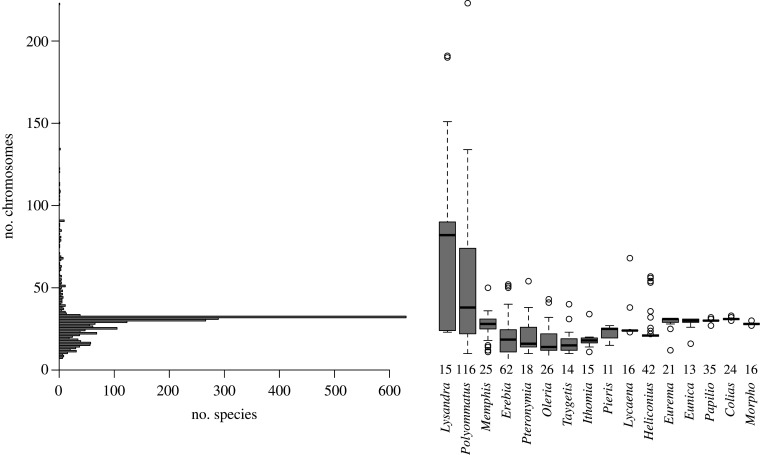
Figure 1.
Figure 1.
Distribution of chromosome numbers in Lepidoptera based on 2399 taxa (electronic supplementary material, table 1.1) with boxplots summarizing chromosome numbers for the 16 genera used for the phylogenetic analysis. The number under each boxplot indicates the available number of taxa with chromosome counts.
Figure 2.
Figure 2.
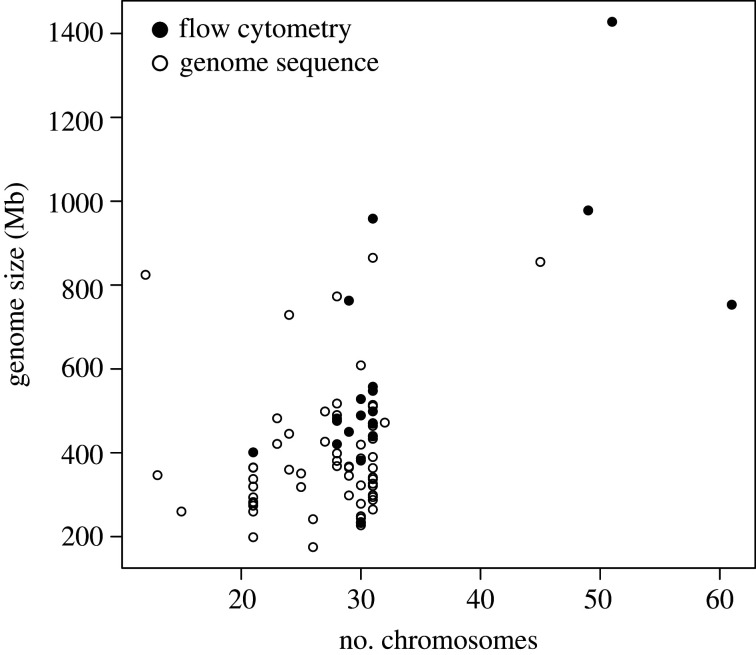
Weakly positive relationship between genome size and chromosome numbers (phylogenetic linear model, t = 3.53, p = 0.0006, r2 = 0.01). Data on genome size is either based on genome sequences (open circles) or estimates from flow cytometry (filled circles).
Figure 3.
Figure 3.
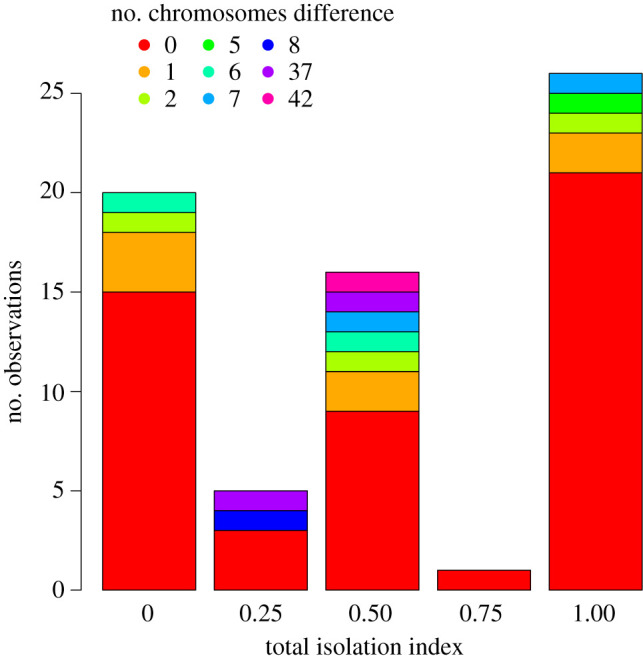
Estimates of reproductive isolation (total isolation index from [32]) between closely related species pairs that either differ in their karyotype or not.
Figure 4.
Figure 4.
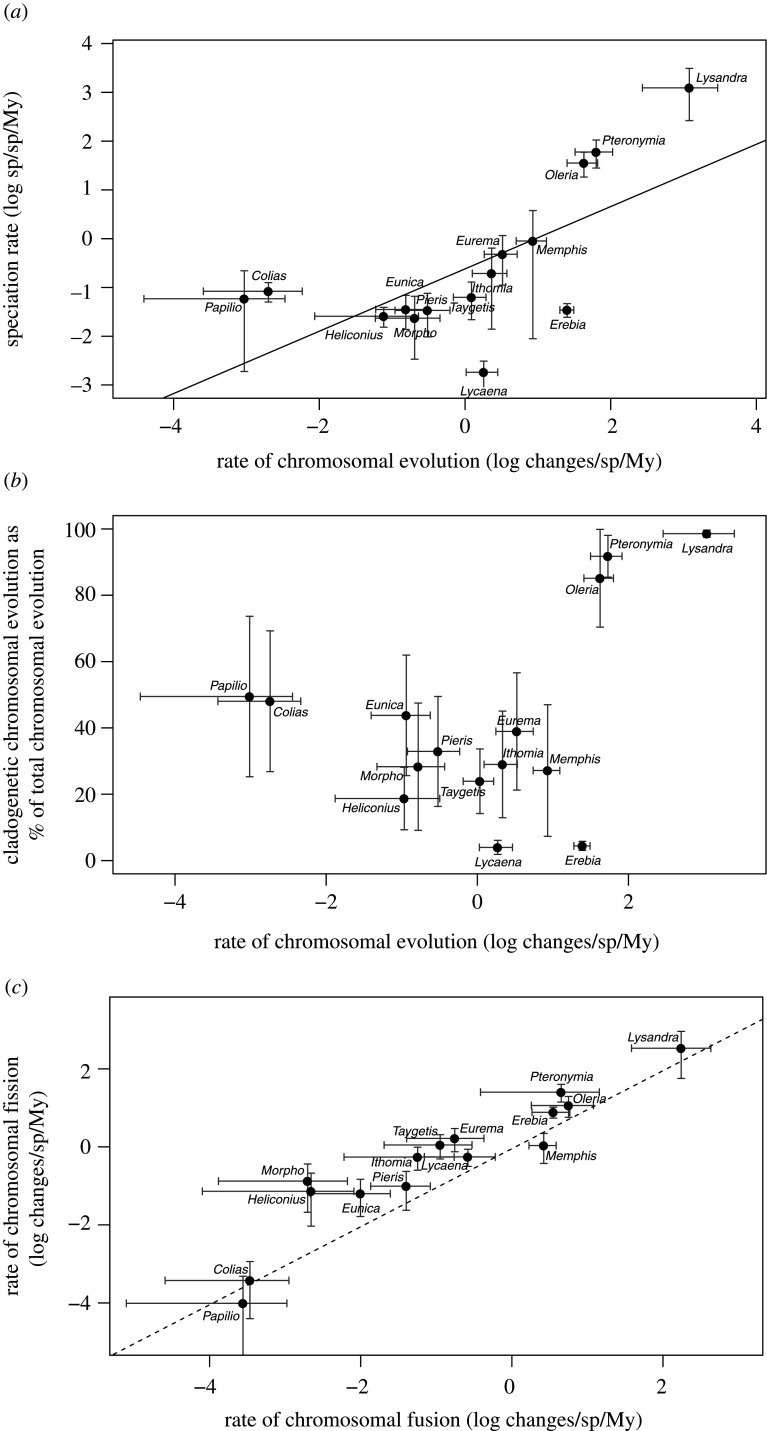
Joint phylogenetic analyses of chromosomal evolution and speciation rates based on the ChromoSSE model across 15 Lepidoptera genera. (a) Total speciation (the sum of all speciation rate parameters) is positively associated with total chromosomal variation (the sum of all chromosomal change parameters—phylogenetic linear model, t = 3.26, p = 0.006, black line). Dots indicate posterior mean rates estimated for each genus, with error bars, extending 1 s.d. in either direction. Names of genera for each observation are indicated. (b) The cladogenetic component of chromosomal change (in % of total chromosomal evolution) differs strongly among genera, but is not significantly associated with total chromosomal evolution (phylogenetic linear model, logit-transformation, t = 1.52 p = 0.150). Annotation as in (a). (c) Rates of fission exceed rates of fusion (summing cladogenetic and anagenetic components) in most genera, indicated by their position above the dashed line that indicates y = x. Annotation as in (a).

References

    1. Robinson R. 1971. Lepidoptera genetics. Oxford, UK: Pergamon Press Inc.
    1. Lukhtanov V. 2015. The blue butterfly Polyommatus (Plebicula) atlanticus (Lepidoptera, Lycaenidae) holds the record of the highest number of chromosomes in the non-polyploid eukaryotic organisms. Comp. Cytogenet. 9, 683–690. ( 10.3897/CompCytogen.v9i4.5760) - DOI - PMC - PubMed
    1. Lukhtanov VA, Kandul NP, Plotkin JB, Dantchenko AV, Haig D, Pierce NE. 2005. Reinforcement of pre-zygotic isolation and karyotype evolution in Agrodiaetus butterflies. Nature 436, 385–389. ( 10.1038/nature03704) - DOI - PubMed
    1. Talavera G, Lukhtanov VA, Rieppel L, Pierce NE, Vila R. 2013. In the shadow of phylogenetic uncertainty: the recent diversification of Lysandra butterflies through chromosomal change. Mol. Phylogenet. Evol. 69, 469–478. ( 10.1016/j.ympev.2013.08.004) - DOI - PubMed
    1. Lucek K. 2018. Evolutionary mechanisms of varying chromosome numbers in the radiation of Erebia butterflies. Genes 9, 1–9. ( 10.3390/genes9030166) - DOI - PMC - PubMed