Review
. 2020 Aug;41(8):652-664.
doi: 10.1016/j.it.2020.06.010. Epub 2020 Jul 9.

Organoid Models of Tumor Immunology

Affiliations
Review

Organoid Models of Tumor Immunology

Kanako Yuki et al. Trends Immunol. 2020 Aug.

Abstract

Cellular interactions in the tumor microenvironment (TME) significantly govern cancer progression and drug response. The efficacy of clinical immunotherapies has fostered an exponential interest in the tumor immune microenvironment, which in turn has engendered a pressing need for robust experimental systems modeling patient-specific tumor-immune interactions. Traditional 2D in vitro tumor immunotherapy models have reconstituted immortalized cancer cell lines with immune components, often from peripheral blood. However, newly developed 3D in vitro organoid culture methods now allow the routine culture of primary human tumor biopsies and increasingly incorporate immune components. Here, we present a viewpoint on recent advances, and propose translational applications of tumor organoids for immuno-oncology research, immunotherapy modeling, and precision medicine.

Keywords: immunotherapy; organoids; tumor microenvironment.


Figures

Figure 1.
Figure 1.
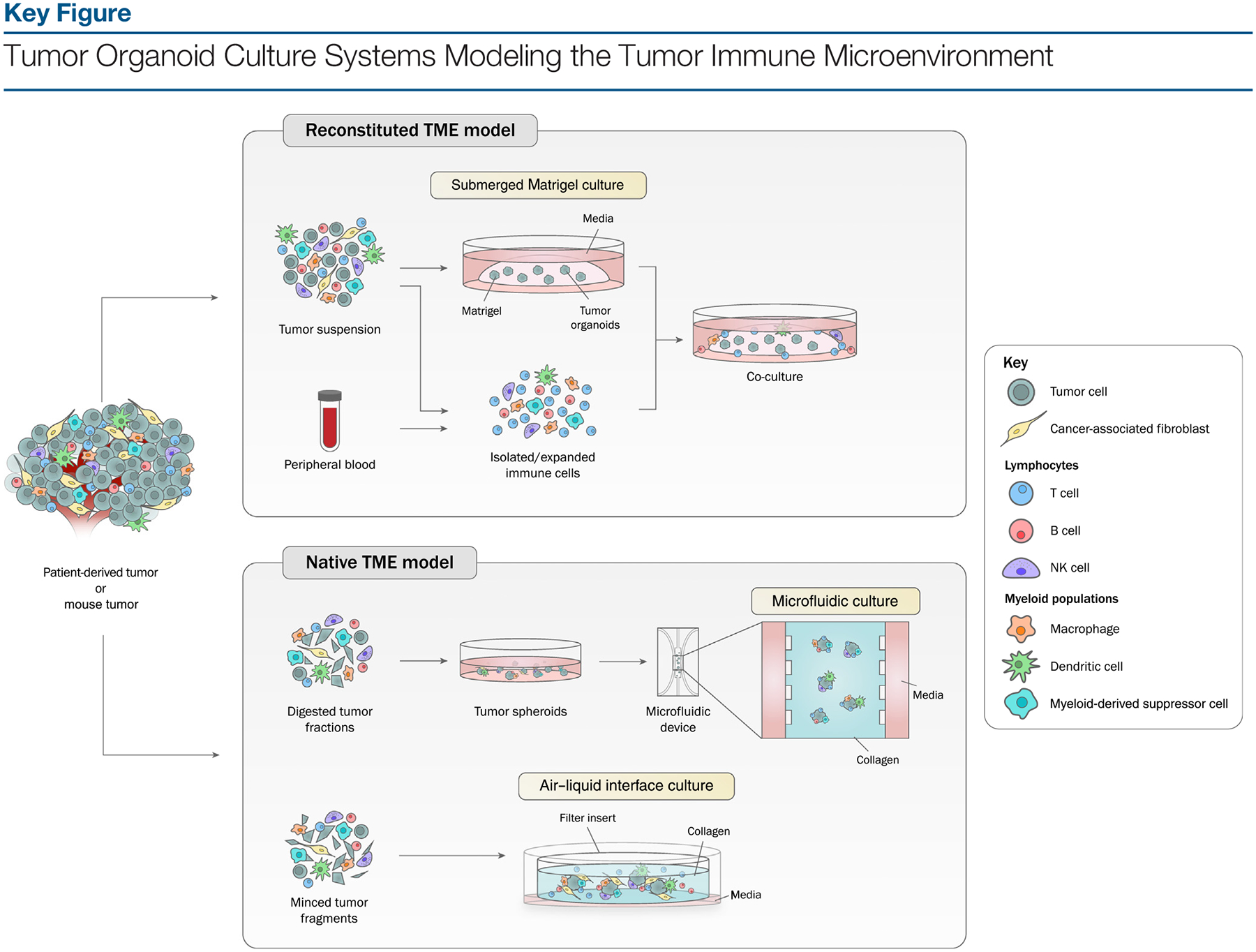
The tumor immune microenvironment can be generated in organoids by two types of approaches. In reconstituted models, organoids containing exclusively tumor cells, often from physically and enzymatically dissociated tissues, are cultured in extracellular matrix domes (e.g., Matrigel or BME-2) and submerged beneath tissue culture medium. Exogenous immune cells, such as those from autologous peripheral blood or tumor, are isolated and subsequently co-cultured with grown organoids. In holistic native TME models, the intrinsic immune microenvironment of tumor specimens is preserved along with tumor cells without reconstitution. Tumor spheroids from digested tumor tissues can be mixed with collagen and injected into microfluidic culture devices. Alternatively, in air-liquid interface (ALI) culture, minced primary tissue fragments containing both tumor cells and immune components are embedded in collagen gels within an inner transwell dish. The top of the collagen gel is exposed to air, allowing cells access to a sufficient oxygen supply. Abbreviation: NK, natural killer.
Figure 2.
Figure 2.
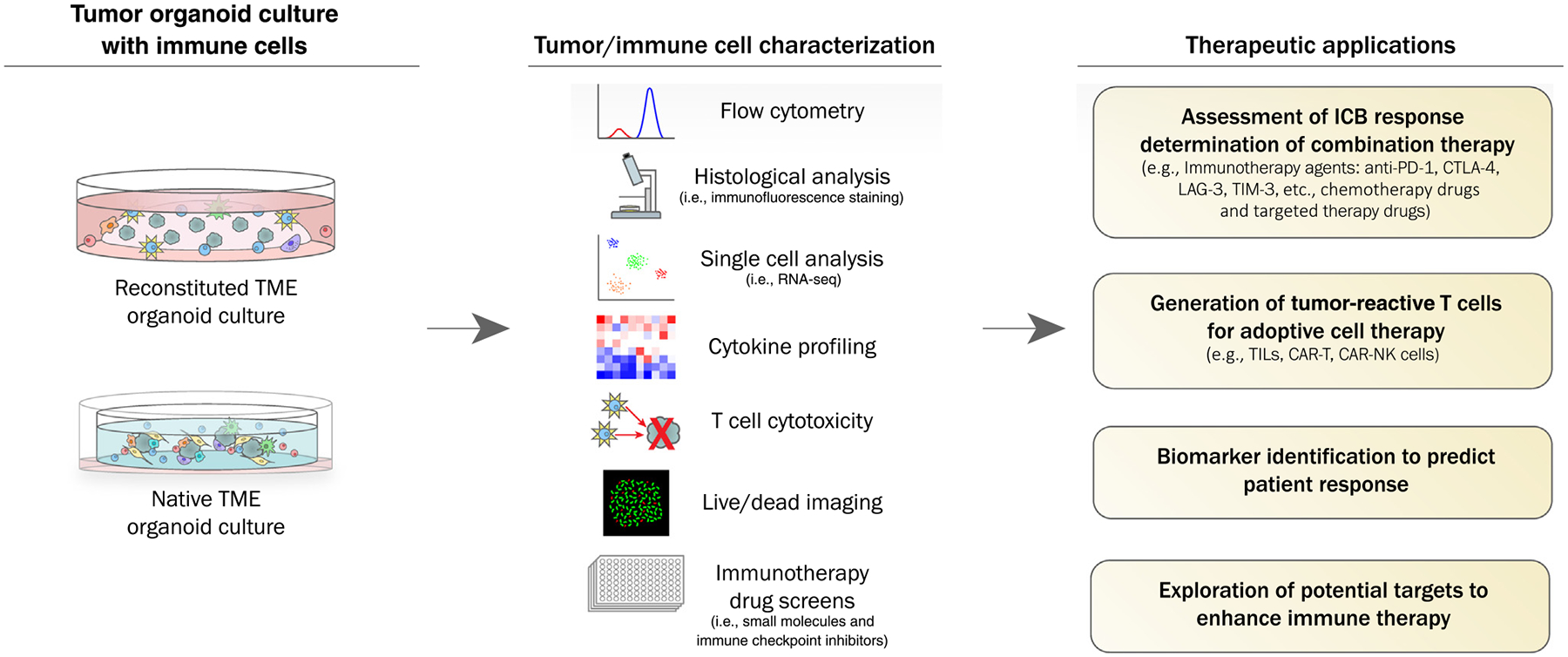
Patient-Derived Organoids (PDOs) for Personalized Cancer Immunotherapy. The native immune tumor microenvironment (TME) can be modeled using PDO air-liquid interface (ALI) organoids or PDO tumor (PDOT) microfluidic devices; alternatively, the TME can be reconstituted by adding purified immune populations to submerged tumor epithelial organoids. Multiple downstream applications include defining interactions between tumor cells and immune cells, development of immunotherapies, biomarker research, and prediction of individualized patient responses. Abbreviations: CAR, chimeric antigen receptor; CTLA-4, cytotoxic T-lymphocyte-associated protein 4; ICB, immune checkpoint blockade; NK, natural killer; PD-1, programmed cell death-1; TIL, tumor-infiltrating lymphocyte.

References

References

    1. Palucka AK and Coussens LM (2016) The basis of oncoimmunology. Cell 164, 1233–1247 - PMC - PubMed
    1. Quail DF and Joyce JA (2013) Microenvironmental regulation of tumor progression and metastasis. Nat. Med 19, 1423–1437 - PMC - PubMed
    1. Gajewski TF et al. (2013) Innate and adaptive immune cells in the tumor microenvironment. Nat. Immunol 14, 1014–1022 - PMC - PubMed
    1. Mantovani A et al. (2008) Cancer-related inflammation. Nature 454, 436–444 - PubMed
    1. Kitamura T et al. (2015) Immune cell promotion of metastasis. Nat. Rev. Immunol 15, 73–86 - PMC - PubMed

Publication types