


When in Doubt, Follow the Crowd? Responsiveness to Social Proof Nudges in the Absence of Clear Preferences
- PMID: 32655456
- PMCID: PMC7325907
- DOI: 10.3389/fpsyg.2020.01385
When in Doubt, Follow the Crowd? Responsiveness to Social Proof Nudges in the Absence of Clear Preferences
Abstract
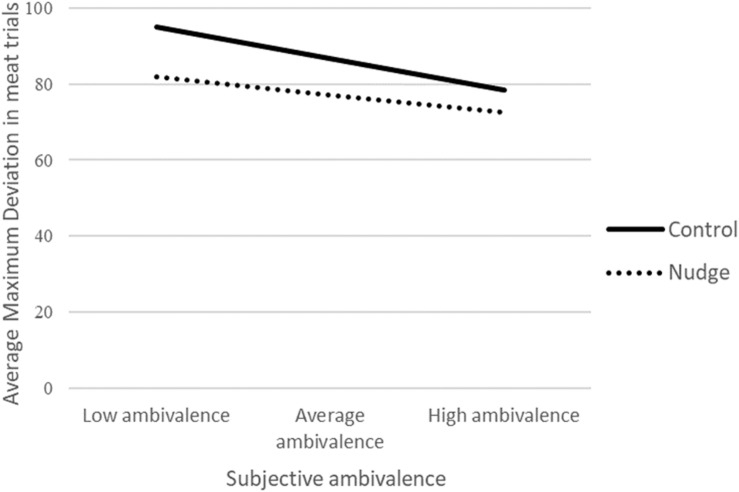
Nudges have gained popularity as a behavioral change tool that aims to facilitate the selection of the sensible choice option by altering the way choice options are presented. Although nudges are designed to facilitate these choices without interfering with people's prior preferences, both the relation between individuals' prior preferences and nudge effectiveness, as well as the notion that nudges 'facilitate' decision-making have received little empirical scrutiny. Two studies examine the hypothesis that a social proof nudge is particularly effective when people have no clear prior preference, either because people are indifferent (in a color-categorization task; Study 1, N = 255) or because people experience a choice conflict (making shopping decisions about meat products; Study 2, N = 97). Both studies employed a social proof nudge to steer participants' choices. The potential facilitating effect of the nudge was tested using a mouse-tracker paradigm that implicitly assessed experienced uncertainty during decision-making. Results showed that the nudge was effective in steering participants' decisions; the facilitation effect (i.e., reduced uncertainty regarding the decision) was only observed for conflicting preferences, but not under indifference. A better understanding of when and how nudges can influence individuals' behavior may help in deciding whether nudges are an appropriate policy tool for changing particular undesirable behavior.
Keywords: conflict; indifference; nudge; preferences; social proof; uncertainty.
Copyright © 2020 Venema, Kroese, Benjamins and de Ridder.
Figures

References
-
- Asch S. E. (1952). Social Psychology. Englewood Cliffs, NJ: Prentice Hall.
-
- Bond R., Smith P. B. (1996). Culture and conformity: a meta-analysis of studies using Asch’s (1952b, 1956) line judgment task. Psychol. Bull. 119 111–137. 10.1037/0033-2909.119.1.111 - DOI
-
- Bovens L. (2009). “The ethics of nudge,” in Preference Change: Approaches from Philosophy, Economics and Psychology, eds Grüne-Yanoff T., Hansson S. O. (New York: Springer; ), 207–219. 10.1007/978-90-481-2593-7_10 - DOI
LinkOut - more resources
Full Text Sources
