Review
. 2020 May 20;20(3):e20.
doi: 10.4110/in.2020.20.e20. eCollection 2020 Jun.

The Roles of CCR7 for the Homing of Memory CD8+ T Cells into Their Survival Niches

Affiliations
Review

The Roles of CCR7 for the Homing of Memory CD8+ T Cells into Their Survival Niches

Hanbyeul Choi et al. Immune Netw. .

Abstract

Memory CD8+ T cells in the immune system are responsible for the removal of external Ags for a long period of time to protect against re-infection. Naïve to memory CD8+ T cell differentiation and memory CD8+ T cell maintenance require many different factors including local environmental factors. Thus, it has been suggested that the migration of memory CD8+ T cells into specific microenvironments alters their longevity and functions. In this review, we have summarized the subsets of memory CD8+ T cells based on their migratory capacities and described the niche hypothesis for their survival. In addition, the basic roles of CCR7 in conjunction with the migration of memory CD8+ T cells and recent understandings of their survival niches have been introduced. Finally, the applications of altering CCR7 signaling have been discussed.

Keywords: CD8-positive T-lymphocytes; Cell movement; Chemotaxis; Immunologic memory; Immunotherapy; Receptors, CCR7.


Conflict of interest statement

Conflict of Interest: The authors declare no potential conflicts of interest.

Figures
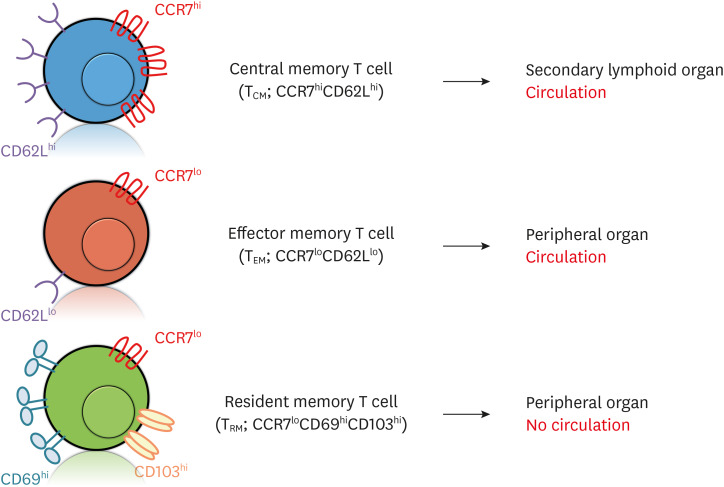
Figure 1
Figure 1. Subsets of TM cells. There are 3 major subsets of TM cells: TCM, TEM and TRM. These subsets are identified on the basis of differential expressions in several chemokine receptors and adhesion molecules. While TCM cells express high levels of CCR7 and CD62L (L-selectin) (CCR7hiCD62Lhi), TEM cells express low levels of CCR7 and CD62L (CCR7loCD62Llo). These phenotypes indicate that TCM cells circulate to SLOs, whereas TEM cells circulate to peripheral organs. TRM cells express low levels of CCR7 and high levels of CD69 and CD103 (CCR7loCD69hiCD103hi) to remain in peripheral organs.
Figure 2
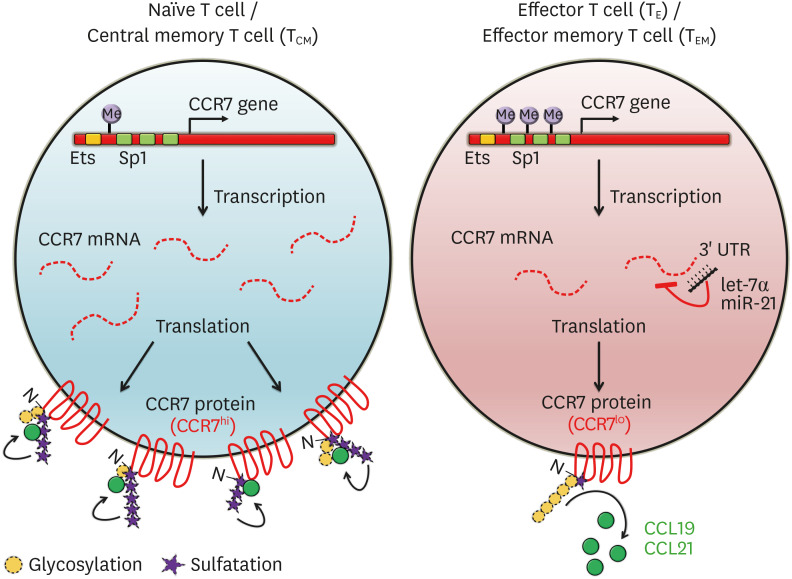
Figure 2. The regulation of CCR7 expression in T cells. The distinguishing features of naïve, TE, and TM cells reflect different programs of gene expression regulated by various factors. First, the gene encoding CCR7 protein is modulated by epigenetic mechanisms, such as methylation. The CCR7 chromatin can silenced by methylation of the promoter regions, in which transcription factor binding sites such as Sp1 and Ets-1 in effector and TEM cells are located. In contrast, this locus is demethylated, allowing the gene to be expressed in naïve and TCM cells. Additional inhibitory mechanisms of CCR7 gene expression include miRNA-dependent regulation. The indicated miRNAs such as let-7α and miR-21 bind to the 3′ UTR of CCR7 mRNA and decay the mRNA, thereby inhibiting translation efficiency. Following the translation, CCR7 protein can be post-translationally modified to modulate their affinity with their ligands, CCL19 and CCL21. The glycosylation of N-terminus of CCR7 protein suppresses CCR7 activity, while sulfation increases its affinity for the ligands.
Figure 3
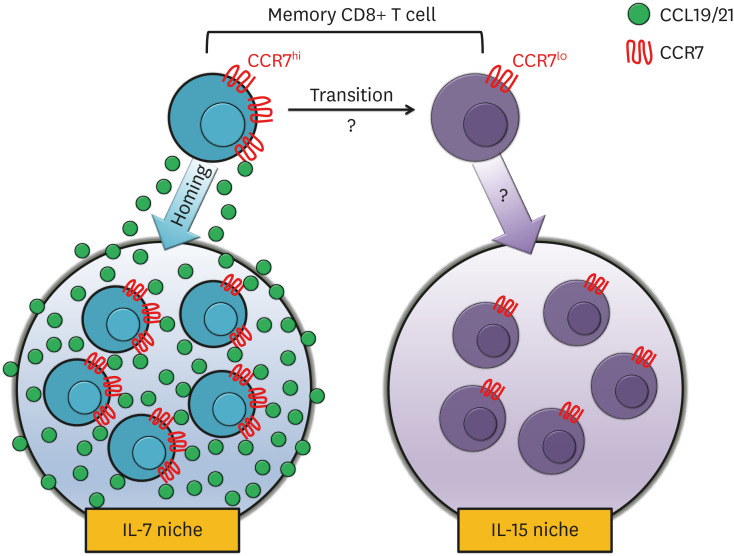
Figure 3. CCR7 introduces microenvironmental niche for memory CD8+ T cells. The schematic model indicates the trafficking patterns of CCR7hi or CCR7lo CD8+ TM cells to find individual niches for their survival. CCR7hi CD8+ TM cells migrate toward high concentration of CCL19 or CCL21, where IL-7 is also expressed. In the contrary, CCR7lo TM cells migrate toward IL-15-rich microenvironment, even though the homing receptors for this migration have not been identified yet. Altogether, CCR7hi and CCR7lo CD8+ TM cells do not share their survival cytokines, and CCR7 biases the survival of CD8+ TM cells toward IL-7 niche.

References

    1. Weninger W, Crowley MA, Manjunath N, von Andrian UH. Migratory properties of naive, effector, and memory CD8+ T cells. J Exp Med. 2001;194:953–966. - PMC - PubMed
    1. Butcher EC, Williams M, Youngman K, Rott L, Briskin M. Lymphocyte trafficking and regional immunity. Adv Immunol. 1999;72:209–253. - PubMed
    1. Campbell JJ, Murphy KE, Kunkel EJ, Brightling CE, Soler D, Shen Z, Boisvert J, Greenberg HB, Vierra MA, Goodman SB, et al. CCR7 expression and memory T cell diversity in humans. J Immunol. 2001;166:877–884. - PubMed
    1. Abdelsamed HA, Moustaki A, Fan Y, Dogra P, Ghoneim HE, Zebley CC, Triplett BM, Sekaly RP, Youngblood B. Human memory CD8 T cell effector potential is epigenetically preserved during in vivo homeostasis. J Exp Med. 2017;214:1593–1606. - PMC - PubMed
    1. Volkert M, Marker O, Bro-Jørgensen K. Twp populations of T lymphocytes immune to the lymphocytic choriomeningitis virus. J Exp Med. 1974;139:1329–1343. - PMC - PubMed