


The Compassionate Communities Connectors model for end-of-life care: a community and health service partnership in Western Australia
- PMID: 32656530
- PMCID: PMC7333490
- DOI: 10.1177/2632352420935130
The Compassionate Communities Connectors model for end-of-life care: a community and health service partnership in Western Australia
Abstract
Background: There is an international drive towards increasing provision of community-led models of social and practical support for people living with advanced illness.
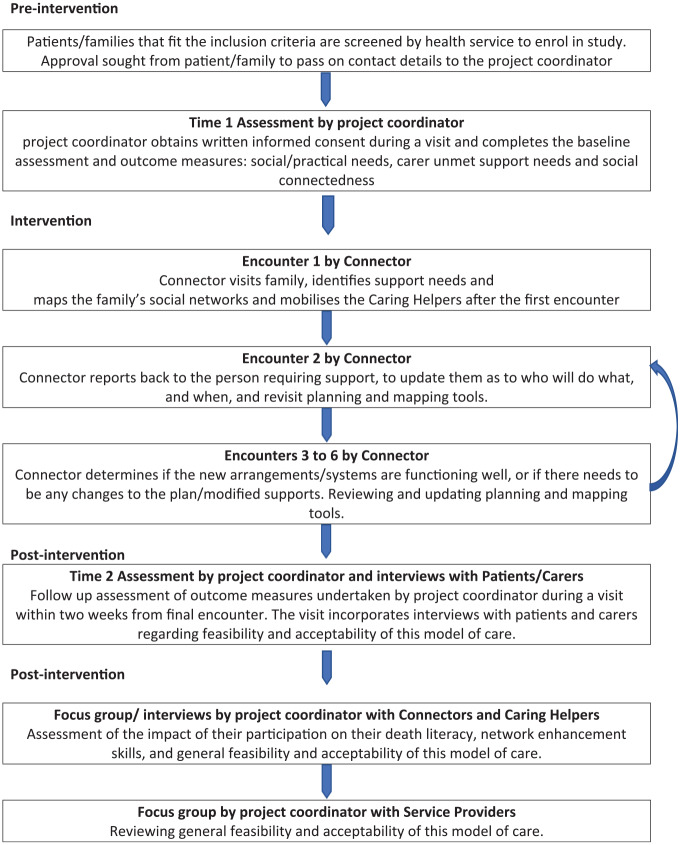
Aim: This feasibility project aims to develop, implement and evaluate a model of community volunteers, identified as Compassionate Communities Connectors, to support people living with advanced life limiting illnesses/palliative care needs. The aims also include the development and evaluation of a training programme for volunteers and assessment of the feasibility, acceptability and preliminary effectiveness of this model of care.
Methods: The approach seeks to map and mobilise people's personal networks of care through the Connectors enlisting Caring Helpers (community volunteers). Up to 10 Connectors will be trained to work with at least 30 families selected by the palliative care service as requiring support. The primary outcome is the effect of the intervention on social connectedness. Secondary outcomes are the intervention's effect on unplanned hospital utilisation, caregiver support needs, advance care plans and satisfaction with intervention for patients/carers, volunteers and service providers.
Conclusion: It is expected that this intervention will enhance patient, carer and family social, psychological and practical support and reduce the need for dying people to be admitted to a hospital.
Keywords: Caring Helpers; Community Connectors; Compassionate Communities; end-of-life care; family carers; palliative care; practical support; social connectedness; social support; volunteers.
© The Author(s), 2020.
Conflict of interest statement
Conflict of interest statement: The authors declared no potential conflicts of interest with respect to the research, authorship, and/or publication of this article.
References
-
- Productivity Commission. Introducing competition and informed user choice into human services: reforms to human services. Report no. 85, 27 October 2017. Canberra, ACT, Australia: Australian Government.
-
- Kellehear A. Compassionate cities: public health and end-of-life care. London: Routledge, 2005.
-
- Kellehear A. The Compassionate City Charter. Compassionate Communities: Case Studies from Britain and Europe. Abingdon: Routledge, 2015.
-
- Sallnow L, Richardson H, Murray SA, et al. The impact of a new public health approach to end-of-life care: a systematic review. Palliat Med 2016; 30: 200–211. - PubMed
LinkOut - more resources
Full Text Sources
