


What Gets Measured Gets Done: How Mental Health Agencies can Leverage Measurement-Based Care for Better Patient Care, Clinician Supports, and Organizational Goals
- PMID: 32656631
- PMCID: PMC7854781
- DOI: 10.1007/s10488-020-01063-w
What Gets Measured Gets Done: How Mental Health Agencies can Leverage Measurement-Based Care for Better Patient Care, Clinician Supports, and Organizational Goals
Abstract
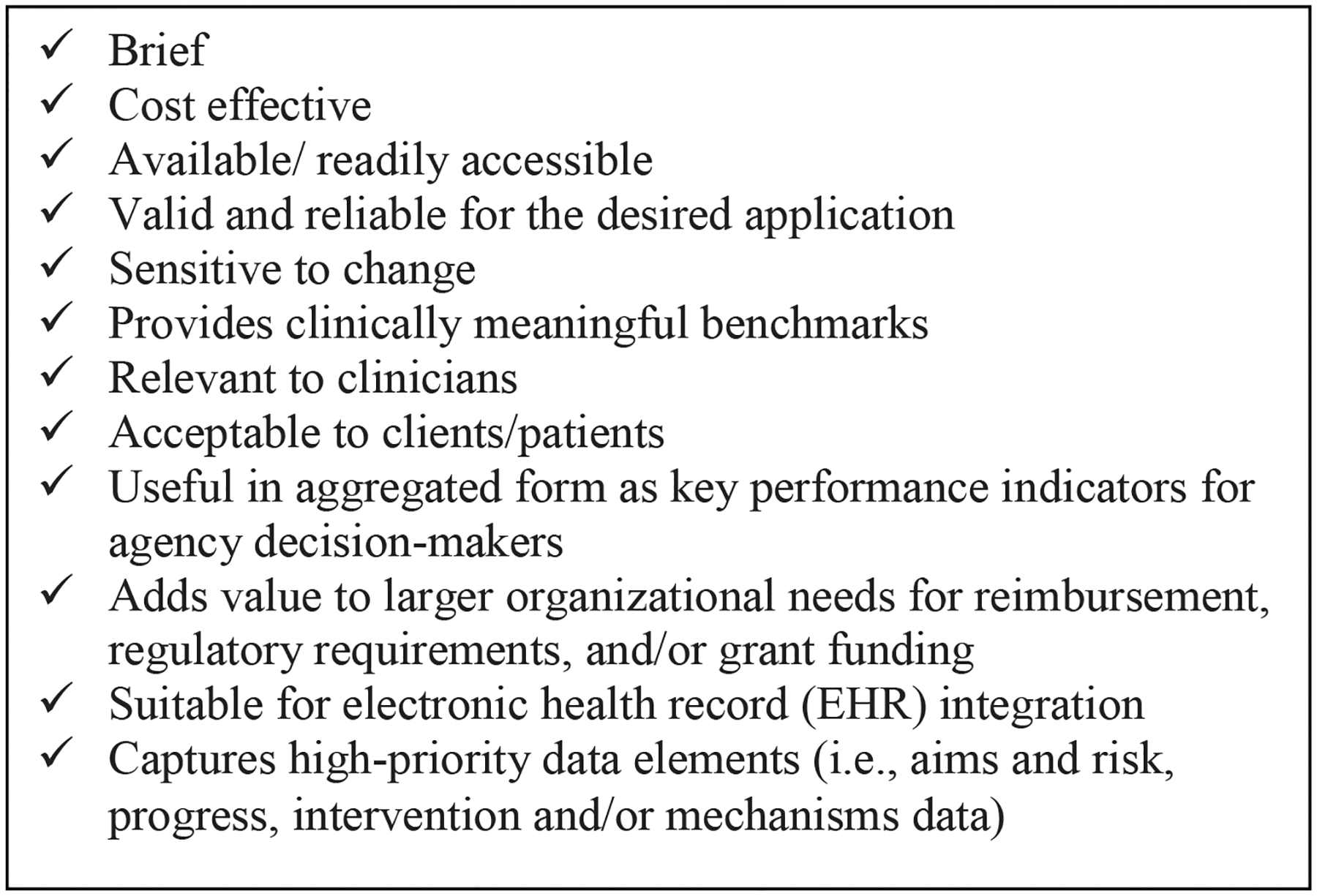
Mental health clinicians and administrators are increasingly asked to collect and report treatment outcome data despite numerous challenges to select and use instruments in routine practice. Measurement-based care (MBC) is an evidence-based practice for improving patient care. We propose that data collected from MBC processes with patients can be strategically leveraged by agencies to also support clinicians and respond to accountability requirements. MBC data elements are outlined using the Precision Mental Health Framework (Bickman et al. in Adm Policy Mental Health Mental Health Serv Res 43:271-276, 2016), practical guidance is provided for agency administrators, and conceptual examples illustrate strategic applications of one or more instruments to meet various needs throughout the organization.
Keywords: Measurement-based care; Organizational quality improvement; Progress monitoring.
Figures
References
-
- Agency for Healthcare Research and Quality. (September 2018). Quality improvement in primary care. Retrieved from https://www.ahrq.gov/research/findings/factsheets/quality/qipc/index.html
-
- Alberti PM, Bonham AC, & Kirch DG (2013). Making equity a value in value-based health care. Academic Medicine : Journal of the Association of American Medical Colleges, 88(11), 1619–1623. - PubMed
-
- American Psychological Association Task Force on Evidence-Based Practice for Children and Adolescents. (2008). Disseminating evidence-based practice for children & adolescents: A systems approach to enhancing care. Washington, DC: American Psychological Association; Retrieved from https://www.apa.org/practice/resources/evidence/children-report.pdf
-
- Ashworth M, Evans C, & Clement S (2009). Measuring psychological outcomes after cognitive behaviour therapy in primary care: A comparison between a new patient-generated measure “PSYCHLOPS”(psychological outcome profiles) and “HADS”(hospital anxiety and depression scale). Journal of Mental Health, 18(2), 169–177.
-
- Ashworth M, Guerra D, & Kordowicz M (2019). Individualised or standardised outcome measures: A co-habitation? Administration and Policy in Mental Health and Mental Health Services Research, 1–4. - PubMed
Publication types
MeSH terms
Grants and funding
LinkOut - more resources
Full Text Sources
Medical
