Review
. 2020 Sep 1;319(3):G375-G381.
doi: 10.1152/ajpgi.00199.2020. Epub 2020 Jul 13.

Gastrointestinal organoids: a next-generation tool for modeling human development

Affiliations
Review

Gastrointestinal organoids: a next-generation tool for modeling human development

Akaljot Singh et al. Am J Physiol Gastrointest Liver Physiol. .

Abstract

Gastrointestinal organoids are an exciting new tool for modeling human development, physiology, and disease in human tissue. Derived from pluripotent stem cells, gastrointestinal organoids consist of epithelial and mesenchymal cells organized in an intricate, three-dimensional structure that recapitulates the physiology and microscopic anatomy of the human gastrointestinal (GI) tract. In vitro derivation of gastrointestinal organoids from definitive endoderm has permitted an exploration of the complex signaling pathways required for the initial maturation of each individual gastrointestinal organ. Further maturation beyond an early fetal state currently requires transplantation into an immunocompromised host. Transplantation-induced maturation provides an opportunity to functionally interrogate the key mechanisms underlying development of the human GI tract. Gastrointestinal organoids can also be used to model human diseases and ultimately may serve as the basis for developing novel, personalized therapies for human intestinal diseases.

Keywords: disease modeling; enteroid; gastrointestinal development; human intestinal organoid; stem cells.


Conflict of interest statement

No conflicts of interest, financial or otherwise, are declared by the authors.

Figures
None
Graphical abstract
Fig. 1.
Fig. 1.
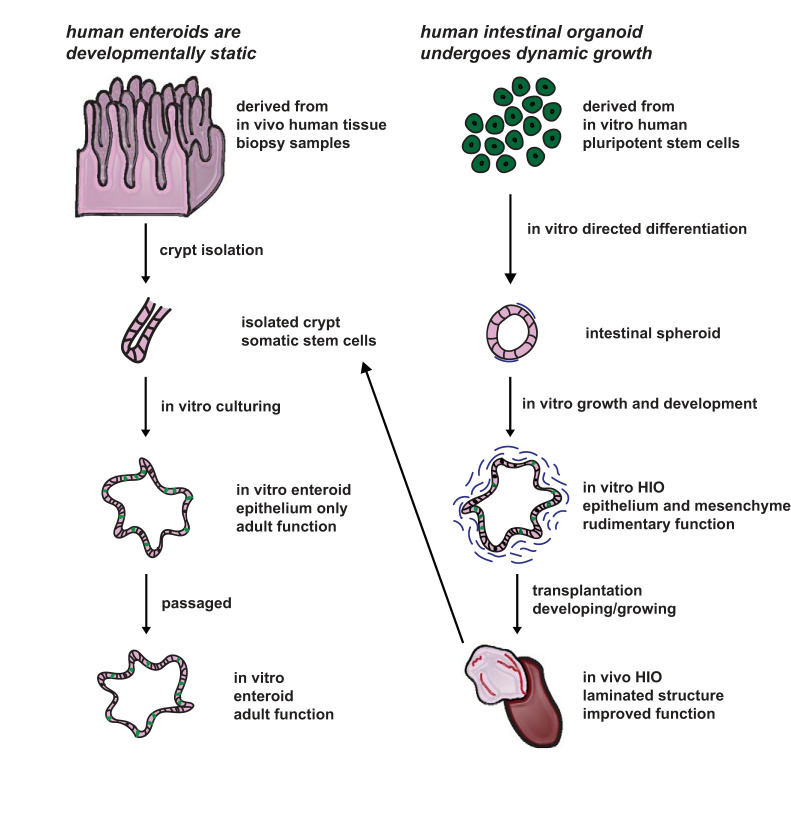
Human enteroids are developmentally static, whereas human intestinal organoids (HIOs) are developing dynamically. Enteroids are derived from a patient’s surgical or biopsy sample. Crypts are isolated from the tissue and, through in vitro culture, functional units of gut epithelium, or enteroids, grow. These structures may be passaged and exponentially expanded. HIOs are derived from pluripotent stem cells and, through directed differentiation, develop into functional units containing both epithelium and mesenchyme. Upon transplantation and engraftment, crypts may be isolated from HIO tissues to generate enteroids.
Fig. 2.
Fig. 2.
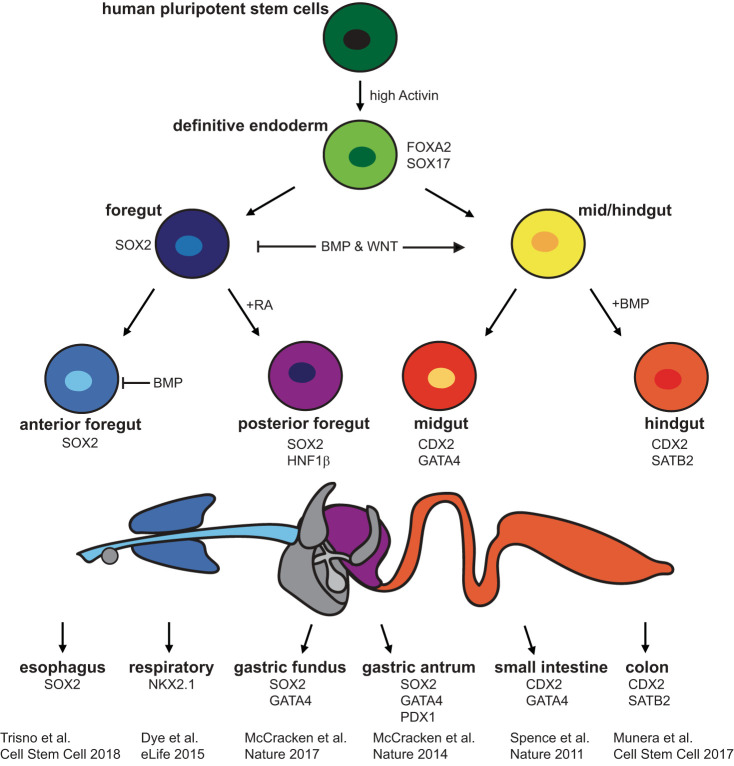
Differentiation pathway schematic for gastrointestinal organoids. Pluripotent stem cells exposed to high activin become definitive endoderm, which can then be driven toward foregut, or mid/hindgut fates through modulation of bone morphogenic protein (BMP) and WNT. From here, additional cues are provided to produce a variety of gastrointestinal organoids, including esophageal, respiratory, gastric, and intestinal. CDX2, caudal type homeobox 2; HNF1β, hepatocyte nuclear factor-1β; PDX1, pancreatic and duodenal homeobox 1; RA, retinoic acid; SATB2, special AT-rich sequence-binding protein 2; SOX2, SRY-box 2; SOX17, SRY-box 17.
Fig. 3.
Fig. 3.
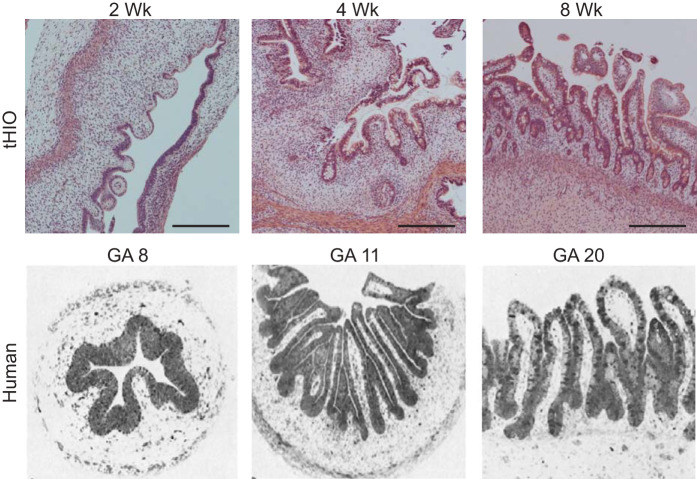
In vivo human intestinal organoid (HIO) development is similar to fetal human intestinal development. Hematoxylin and eosin-stained sections of transplanted HIOs (tHIOs) harvested 2, 4, and 8 wk posttransplantation (top) compared with historical sections of fetal human intestine (bottom). Development of epithelial structuration in tHIOs progresses in a similar fashion to native tissue. [Human intestine images are reproduced with permission (15).]

References

    1. Amiel J, Lyonnet S. Hirschsprung disease, associated syndromes, and genetics: a review. J Med Genet 38: 729–739, 2001. doi:10.1136/jmg.38.11.729. - DOI - PMC - PubMed
    1. Aoki R, Shoshkes-Carmel M, Gao N, Shin S, May CL, Golson ML, Zahm AM, Ray M, Wiser CL, Wright CV, Kaestner KH. Foxl1-expressing mesenchymal cells constitute the intestinal stem cell niche. Cell Mol Gastroenterol Hepatol 2: 175–188, 2016. doi:10.1016/j.jcmgh.2015.12.004. - DOI - PMC - PubMed
    1. Ares GJ, Buonpane C, Yuan C, Wood D, Hunter CJ. A novel human epithelial enteroid model of necrotizing enterocolitis. J Vis Exp 146: 10.3791/59194, 2019. doi:10.3791/59194. - DOI - PMC - PubMed
    1. Berdon WE, Baker DH, Blanc WA, Gay B, Santulli TV, Donovan C. Megacystis-microcolon-intestinal hypoperistalsis syndrome: a new cause of intestinal obstruction in the newborn. Report of radiologic findings in five newborn girls. AJR Am J Roentgenol 126: 957–964, 1976. doi:10.2214/ajr.126.5.957. - DOI - PubMed
    1. Blutt SE, Klein OD, Donowitz M, Shroyer N, Guha C, Estes MK. Use of organoids to study regenerative responses to intestinal damage. Am J Physiol Gastrointest Liver Physiol 317: G845–G852, 2019. doi:10.1152/ajpgi.00346.2018. - DOI - PMC - PubMed