First-line non-anthracycline-based chemotherapy for extranodal nasal-type NK/T-cell lymphoma: a retrospective analysis from the CLCG
- PMID: 32658985
- PMCID: PMC7362384
- DOI: 10.1182/bloodadvances.2020001852
First-line non-anthracycline-based chemotherapy for extranodal nasal-type NK/T-cell lymphoma: a retrospective analysis from the CLCG
Erratum in
-
Qi S-N, Yang Y, Song Y-Q, et al. First-line non-anthracycline-based chemotherapy for extranodal nasal-type NK/T-cell lymphoma: a retrospective analysis from the CLCG. Blood Adv. 2020;4(13):3141-3153.Blood Adv. 2021 Jun 17;5(12):2576. doi: 10.1182/bloodadvances.2021005072. Blood Adv. 2021. PMID: 34137814 Free PMC article. No abstract available.
Abstract
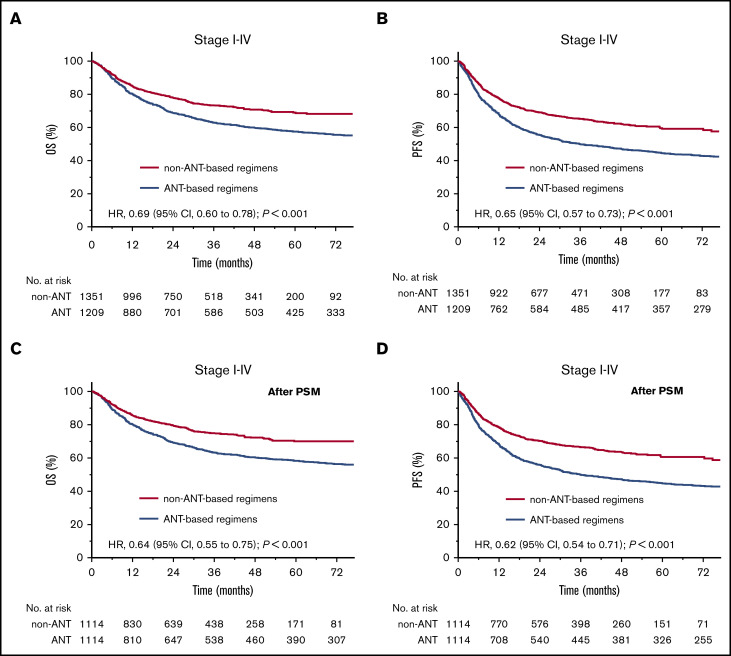
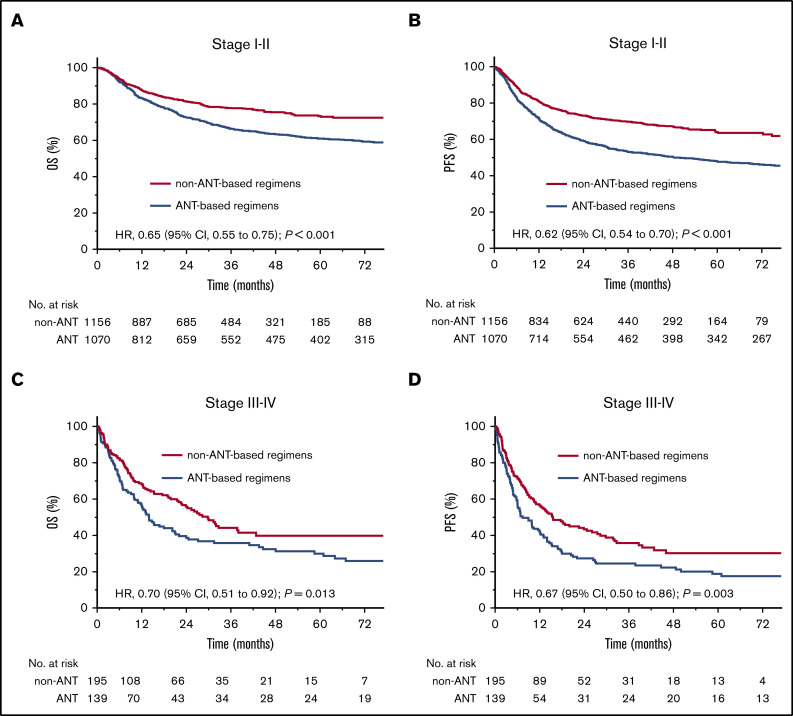
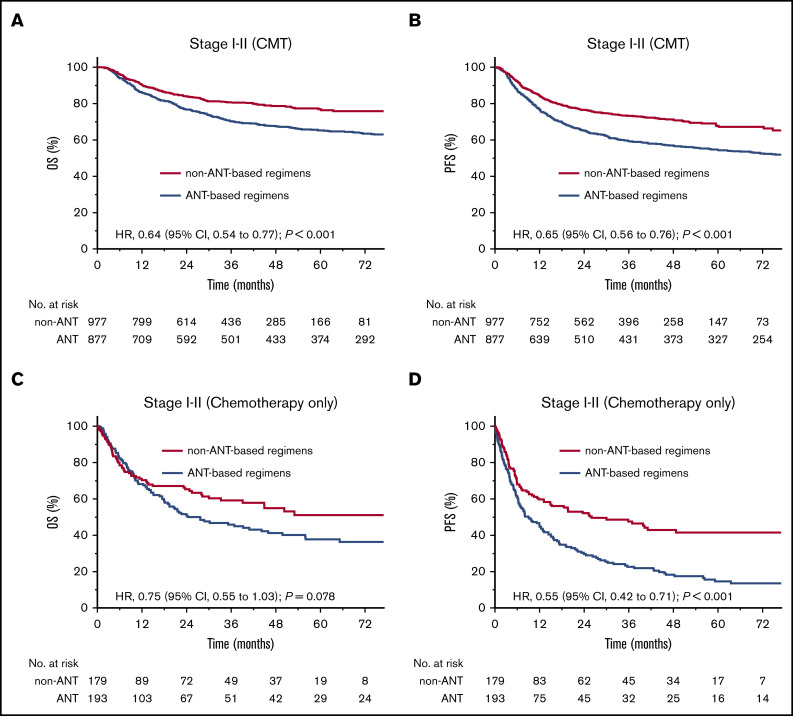
The present study investigated the survival benefit of non-anthracycline (ANT)-based vs ANT-based regimens in a large-scale, real-world cohort of patients with extranodal natural killer (NK)/T-cell lymphoma, nasal type (ENKTCL). Within the China Lymphoma Collaborative Group (CLCG) database (2000-2015), we identified 2560 newly diagnosed patients who received chemotherapy with or without radiotherapy. Propensity score matching (PSM) and multivariable analyses were used to compare overall survival (OS) and progression-free survival (PFS) between the 2 chemotherapy regimens. We explored the survival benefit of non-ANT-based regimens in patients with different treatments in early-stage disease and in risk-stratified subgroups. Non-ANT-based regimens significantly improved survivals compared with ANT-based regimens. The 5-year OS and PFS were 68.9% and 59.5% for non-ANT-based regimens compared with 57.5% and 44.5% for ANT-based regimens in the entire cohort. The clinical advantage of non-ANT-based regimens was substantial across the subgroups examined, regardless of stage and risk-stratified subgroup, and remained significant in early-stage patients who received radiotherapy. The survival benefits of non-ANT-based regimens were consistent after adjustment using multivariable and PSM analyses. These findings provide additional evidence supporting non-ANT-based regimens as a first-line treatment of patients with ENKTCL.
© 2020 by The American Society of Hematology.
Conflict of interest statement
Conflict-of-interest disclosure: C.H. has received grants from the National Institutes of Health/National Cancer Institute and personal fees from Varian Medical Systems outside the submitted work. The remaining authors declare no competing financial interests. A complete list of the members of the China Lymphoma Collaborative Group appears in “Appendix.”
Figures



References
-
- Vose J, Armitage J, Weisenburger D; International T-Cell Lymphoma Project . International peripheral T-cell and natural killer/T-cell lymphoma study: pathology findings and clinical outcomes. J Clin Oncol. 2008;26(25):4124-4130. - PubMed
-
- Vargo JA, Patel A, Glaser SM, et al. The impact of the omission or inadequate dosing of radiotherapy in extranodal natural killer T-cell lymphoma, nasal type, in the United States. Cancer. 2017;123(16):3176-3185. - PubMed
-
- Yang Y, Zhang YJ, Zhu Y, et al. Prognostic nomogram for overall survival in previously untreated patients with extranodal NK/T-cell lymphoma, nasal-type: a multicenter study. Leukemia. 2015;29(7):1571-1577. - PubMed
-
- Li YX, Yao B, Jin J, et al. Radiotherapy as primary treatment for stage IE and IIE nasal natural killer/T-cell lymphoma. J Clin Oncol. 2006;24(1):181-189. - PubMed
-
- Yang Y, Zhu Y, Cao JZ, et al. Risk-adapted therapy for early-stage extranodal nasal-type NK/T-cell lymphoma: analysis from a multicenter study. Blood. 2015;126(12):1424-1432, quiz 1517. - PubMed
Publication types
MeSH terms
Substances
LinkOut - more resources
Full Text Sources
Miscellaneous