


Haematological characteristics and risk factors in the classification and prognosis evaluation of COVID-19: a retrospective cohort study
- PMID: 32659214
- PMCID: PMC7351397
- DOI: 10.1016/S2352-3026(20)30217-9
Haematological characteristics and risk factors in the classification and prognosis evaluation of COVID-19: a retrospective cohort study
Abstract
Background: COVID-19 is an ongoing global pandemic. Changes in haematological characteristics in patients with COVID-19 are emerging as important features of the disease. We aimed to explore the haematological characteristics and related risk factors in patients with COVID-19.
Methods: This retrospective cohort study included patients with COVID-19 admitted to three designated sites of Wuhan Union Hospital (Wuhan, China). Demographic, clinical, laboratory, treatment, and outcome data were extracted from electronic medical records and compared between patients with moderate, severe, and critical disease (defined according to the diagnosis and treatment protocol for novel coronavirus pneumonia, trial version 7, published by the National Health Commission of China). We assessed the risk factors associated with critical illness and poor prognosis. Dynamic haematological and coagulation parameters were investigated with a linear mixed model, and coagulopathy screening with sepsis-induced coagulopathy and International Society of Thrombosis and Hemostasis overt disseminated intravascular coagulation scoring systems was applied.
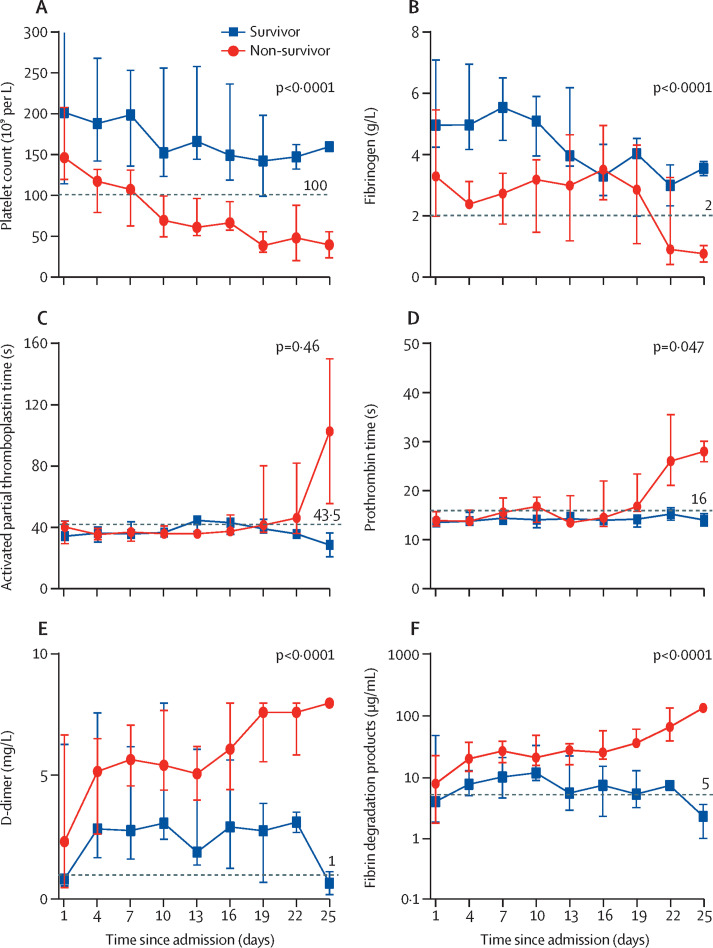
Findings: Of 466 patients admitted to hospital from Jan 23 to Feb 23, 2020, 380 patients with COVID-19 were included in our study. The incidence of thrombocytopenia (platelet count <100 × 109 cells per L) in patients with critical disease (42 [49%] of 86) was significantly higher than in those with severe (20 [14%] of 145) or moderate (nine [6%] of 149) disease (p<0·0001). The numbers of lymphocytes and eosinophils were significantly lower in patients with critical disease than those with severe or moderate disease (p<0·0001), and prothrombin time, D-dimer, and fibrin degradation products significantly increased with increasing disease severity (p<0·0001). In multivariate analyses, death was associated with increased neutrophil to lymphocyte ratio (≥9·13; odds ratio [OR] 5·39 [95% CI 1·70-17·13], p=0·0042), thrombocytopenia (platelet count <100 × 109 per L; OR 8·33 [2·56-27·15], p=0·00045), prolonged prothrombin time (>16 s; OR 4·94 [1·50-16·25], p=0·0094), and increased D-dimer (>2 mg/L; OR 4·41 [1·06-18·30], p=0·041). Thrombotic and haemorrhagic events were common complications in patients who died (19 [35%] of 55). Sepsis-induced coagulopathy and International Society of Thrombosis and Hemostasis overt disseminated intravascular coagulation scores (assessed in 12 patients who survived and eight patients who died) increased over time in patients who died. The onset of sepsis-induced coagulopathy was typically before overt disseminated intravascular coagulation.
Interpretation: Rapid blood tests, including platelet count, prothrombin time, D-dimer, and neutrophil to lymphocyte ratio can help clinicians to assess severity and prognosis of patients with COVID-19. The sepsis-induced coagulopathy scoring system can be used for early assessment and management of patients with critical disease.
Funding: National Key Research and Development Program of China.
Copyright © 2020 Elsevier Ltd. All rights reserved.
Figures
Comment in
-
Coagulation disorder in COVID-19.Lancet Haematol. 2020 Sep;7(9):e630-e632. doi: 10.1016/S2352-3026(20)30218-0. Epub 2020 Jul 10. Lancet Haematol. 2020. PMID: 32659213 Free PMC article. No abstract available.
-
Routine haematological parameters in COVID-19 prognosis.Lancet Haematol. 2020 Oct;7(10):e709. doi: 10.1016/S2352-3026(20)30286-6. Lancet Haematol. 2020. PMID: 32976747 Free PMC article. No abstract available.
References
MeSH terms
Substances
LinkOut - more resources
Full Text Sources
Medical
