


Identification of enterobacteria in viscera of pigs afflicted with porcine reproductive and respiratory syndrome and other viral co-infections
- PMID: 32659314
- PMCID: PMC7352111
- DOI: 10.1016/j.micpath.2020.104385
Identification of enterobacteria in viscera of pigs afflicted with porcine reproductive and respiratory syndrome and other viral co-infections
Abstract
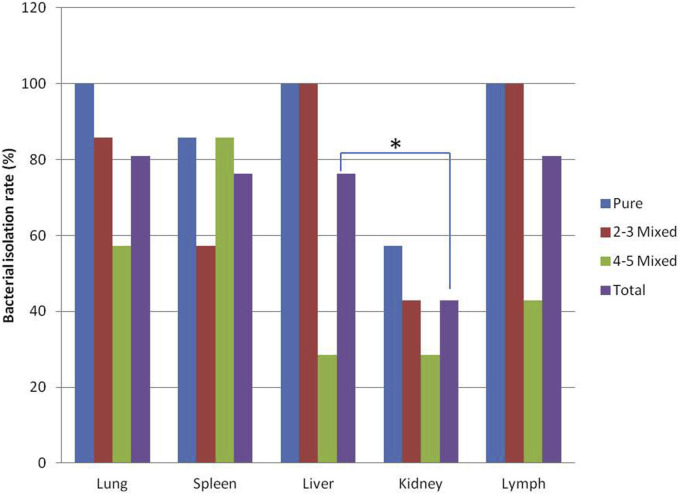
In order to investigate enterobacteria presence involved in the secondary infections in Porcine Reproductive and Respiratory Syndrome (PRRS) pigs with different viral co-infections, we identified enterobacteria for guiding clinical treatment. Twenty-one diseased pigs were diagnosed with the PRRS virus (PRRSV) and other 7 virus primers by PCR/RT-PCR in the lung and spleen samples. Enterobacteria were isolated using MacConkey agar from 5 visceral samples of PRRS pigs, and identified by 16S rDNA sequencing. PRRSV was positive in 100% of the lung samples and 81.0% of the spleen samples. Seven diseased pigs were diagnosed with only PRRSV infection (33.3%), 7 pigs with PRRSV and 1 or 2 other viruses (33.3%) and 7 pigs with PRRSV and more than 2 types of other viruses (33.3%). PRRSV was more inclined to co-infect pigs with porcine group A rotavirus (PARV) with the co-infection rate of 52.4% (11/21). Approximately 13 types of bacteria were successfully isolated from lung, spleen, liver, kidney and lymph node samples of different PRRS pigs. Enterobacteria were isolated in 100% of lung, liver and lymph samples from pigs infected with PRRSV alone. However, the isolation rates were significantly decreased in the more than 3 viruses co-infection group. Escherichia coli was the most prevalent bacterium, followed by Morganella, Proteus, Shigella, Salmonella, Klebsiella and Aeromonas. Most of the isolated enterobacteria were opportunistic pathogens. Therefore, timely combination with antimicrobial agents is necessary for effective treatment of PRRS-infected pigs.
Keywords: 16S rDNA sequencing; Enterobacteria; PCR; Porcine reproductive and respiratory syndrome; Viral co-infection.
Copyright © 2020. Published by Elsevier Ltd.
Conflict of interest statement
The authors declared that they have no conflict of interest to this work.
Figures



References
-
- Albina E. Epidemiology of porcine reproductive and respiratory syndrome (PRRS): An overview. Vet. Microbiol. 1997;55:309–316. - PubMed
-
- Tian K., Yu X., Zhao T., Feng Y., Cao Z., Wang C., Hu Y., Chen X., Hu D., Tian X., Liu D., Zhang S., Deng X., Ding Y., Yang L., Zhang Y., Xiao H., Qiao M., Wang B., Hou L., Wang X., Yang X., Kang L., Sun M., Jin P., Wang S., Kitamura Y., Yan J., Gao G.F. Emergence of fatal PRRSV variants: unparalleled outbreaks of atypical PRRS in China and molecular dissection of the unique hallmark. PLoS One. 2007;6:e526. - PMC - PubMed
-
- Ma J., Chen Y., Li S., Sun S. Diagnosis and treatment of porcine reproductive and respiratory syndrome. J. Anim. Sci. Vet. Med. 2017;36:140–142.
MeSH terms
LinkOut - more resources
Full Text Sources
