Review
. 2020 Jul 9;25(14):3147.
doi: 10.3390/molecules25143147.

Synthesis of Medium-Sized Heterocycles by Transition-Metal-Catalyzed Intramolecular Cyclization

Affiliations
Review

Synthesis of Medium-Sized Heterocycles by Transition-Metal-Catalyzed Intramolecular Cyclization

Mickael Choury et al. Molecules. .

Abstract

Medium-sized heterocycles (with 8 to 11 atoms) constitute important structural components of several biologically active natural compounds and represent promising scaffolds in medicinal chemistry. However, they are under-represented in the screening of chemical libraries as a consequence of being difficult to access. In particular, methods involving intramolecular bond formation are challenging due to unfavorable enthalpic and entropic factors, such as transannular interactions and conformational constraints. The present review focuses on the synthesis of medium-sized heterocycles by transition-metal-catalyzed intramolecular cyclization, which despite its drawbacks remains a straightforward and attractive synthesis strategy. The obtained heterocycles differ in their nature, number of heteroatoms, and ring size. The methods are classified according to the metal used (palladium, copper, gold, silver), then subdivided according to the type of bond formed, namely carbon-carbon or carbon-heteroatom.

Keywords: intramolecular cyclization; medium-sized heterocycles; transition-metal catalysis.


Conflict of interest statement

The authors declare that there are no conflicts of interest.

Figures

Figure 1
Figure 1
Examples of natural and bioactive compounds containing a medium-sized heterocycle.
Scheme 1
Scheme 1
Schematic representation of an intramolecular Heck reaction accessing medium-sized heterocycles.
Scheme 2
Scheme 2
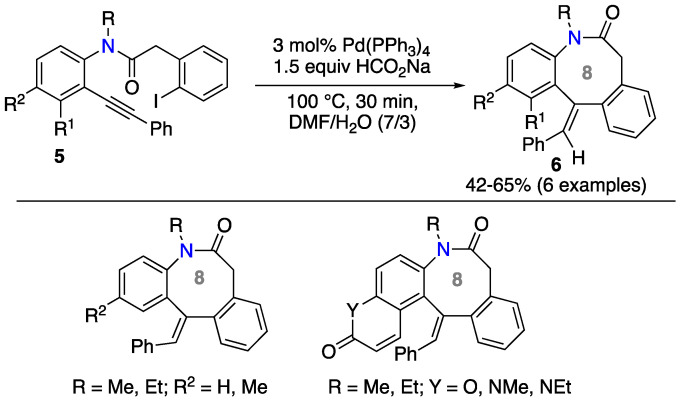
Synthesis of benzo[d]azocines by reductive cyclocarbopalladation of alkynes.
Scheme 3
Scheme 3
Synthesis of azocino[cd]indoles by reductive cyclocarbopalladation of alkynes.
Scheme 4
Scheme 4
Synthesis of dibenzoazocines by reductive cyclocarbopalladation of alkynes.
Scheme 5
Scheme 5
Pd-catalyzed reductive cyclization of bromoenynamides.
Scheme 6
Scheme 6
Pd-catalyzed reductive cyclization to access thiazocine and thiazonine derivatives.
Scheme 7
Scheme 7
Pd-catalyzed reductive cyclization to access thiazecine and thiazaundecine derivatives.
Scheme 8
Scheme 8
Pd-catalyzed cyclization–allenylation–amination to access tetrahydro-2-benzoxocine.
Scheme 9
Scheme 9
Intramolecular Sonogashira reaction to access medium-sized O,S-heterocycles.
Scheme 10
Scheme 10
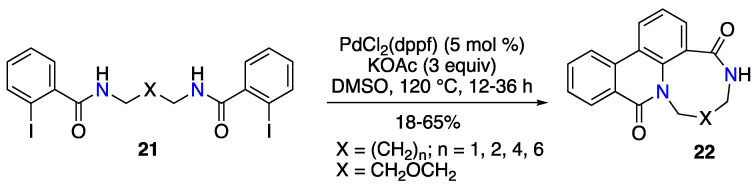
Synthesis of medium-sized N-polyheterocycles by a Pd-catalyzed intramolecular N-arylation–C–H activation–aryl–aryl bond-forming domino reaction.
Scheme 11
Scheme 11
Synthesis of benzoxazocines by intramolecular Pd-catalyzed N-arylation.
Scheme 12
Scheme 12
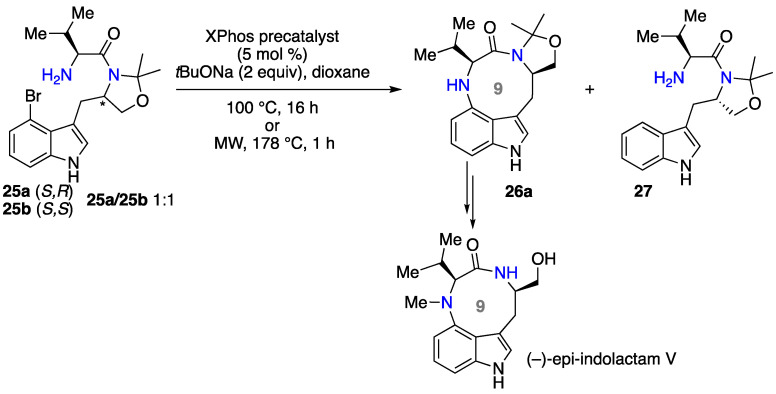
Synthesis of 9-membered N-heterocycle by intramolecular Pd-catalyzed N-arylation.
Scheme 13
Scheme 13
Synthesis of 8-membered N,N-heterocycles by Pd-catalyzed oxidative cis-aminopalladation.
Scheme 14
Scheme 14
Synthesis of 8-membered N-heterocycles by Pd-catalyzed cyclizations of bromoallenes.
Scheme 15
Scheme 15
Synthesis of 8- or 9-membered N-heterocycles by Pd-catalyzed heteroannulation of 1,2-dienes.
Scheme 16
Scheme 16
Synthesis of 8-membered N-heterocycles by Pd-catalyzed intramolecular carbonylation.
Scheme 17
Scheme 17
Synthesis of medium-sized O-heterocycles by Pd-catalyzed cyclization of allendiols.
Scheme 18
Scheme 18
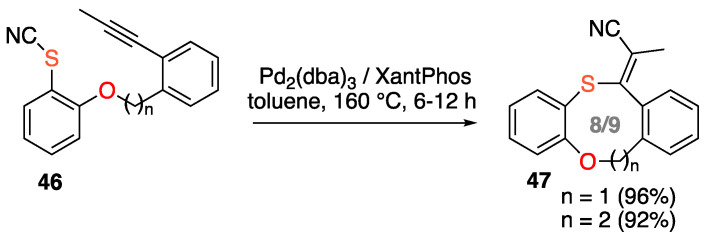
Synthesis of medium-sized O,S-heterocycles by Pd-catalyzed cyanosulfenylation.
Scheme 19
Scheme 19
Synthesis of 8-membered heterocycles by Pd-catalyzed cyclization of bromoallenes.
Scheme 20
Scheme 20
Synthesis of 9-membered N,O-heterocycles by Pd-catalyzed [5 + 4] formal cycloaddition.
Scheme 21
Scheme 21
Synthesis of 8-membered N,O-heterocycles by Pd-catalyzed [5 + 3] formal cycloaddition.
Scheme 22
Scheme 22
Synthesis of 8- to 11-membered heterocycles by Pd-catalyzed [n + 2] formal cycloaddition.
Scheme 23
Scheme 23
Stereoselective synthesis of biaryl-containing medium-sized heterocycles via an intramolecular copper-mediated C–C bond formation.
Scheme 24
Scheme 24
Synthesis of 8- to 9-membered heterocycles by Cu-catalyzed cyclization involving Sn amino protocol (SnAP) reagents.
Scheme 25
Scheme 25
Synthesis of bridged aza-[n.2.1]-indolyl medium-sized heterocycles by copper-catalyzed hydroamination–Friedel–Crafts domino process.
Scheme 26
Scheme 26
Synthesis of a sultam skeleton via Cu-catalyzed intramolecular N-Arylation.
Scheme 27
Scheme 27
Synthesis of medium N-heterocycles via Cu-catalyzed intramolecular N-arylation.
Scheme 28
Scheme 28
One-pot synthesis of medium-sized N-heterocycles via SN2 reaction followed by Cu-catalyzed intramolecular N-arylation.
Scheme 29
Scheme 29
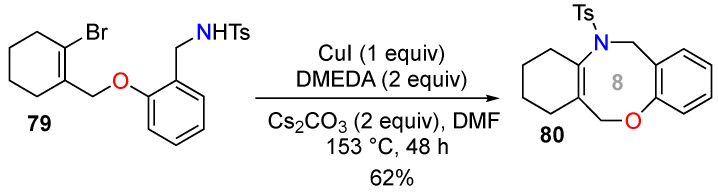
Synthesis of a benzoxazocine by Cu-catalyzed N-vinylation.
Scheme 30
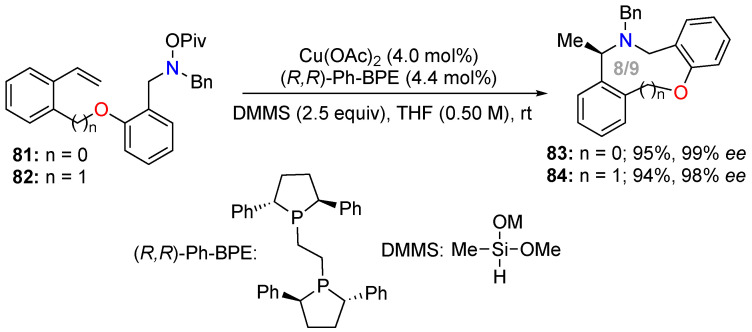
Scheme 30
Asymmetric synthesis of medium-sized N,O-heterocycles via copper-catalyzed intramolecular hydroamination.
Scheme 31
Scheme 31
Copper-catalyzed intramolecular O-arylation to access dibenzoxazocines and oxazonines.
Scheme 32
Scheme 32
Gold-catalyzed cyclization of alkynylindole.
Scheme 33
Scheme 33
Gold-catalyzed alkyne hydroarylation of propargyl amide derivatives.
Scheme 34
Scheme 34
Gold-catalyzed cascade reactions of aniline derivatives.
Scheme 35
Scheme 35
Gold-catalyzed cascade reactions of indole derivatives.
Scheme 36
Scheme 36
Gold-catalyzed cascade reactions for the construction of ten- and eleven-membered rings.
Scheme 37
Scheme 37
Gold(I)-catalyzed cycloisomerization of vinylidenecyclopropane-enes.
Scheme 38
Scheme 38
Synthesis of benzoxocines by gold(I)-catalyzed 8-endo-dig cyclization.
Scheme 39
Scheme 39
Synthesis of 8- and 9-membered ring ethers and amines by gold(I)-catalyzed cascade reaction.
Scheme 40
Scheme 40
Ag(I)- and Au(I)-catalyzed hydroalkoxylation of alkynoic acids.
Scheme 41
Scheme 41
Au(I)-catalyzed hydroalkoxylation for oxazocenone synthesis.
Scheme 42
Scheme 42
Ag(I)-catalyzed 8-endo-dig cyclization for quinazolinone-fused 8-membered heterocycle synthesis.
Scheme 43
Scheme 43
Au(I)-catalyzed cyclization of 2-alkynyl-N-propargylanilines.

References

    1. Nakamura I., Yamamoto Y. Transition-Metal-Catalyzed Reactions in Heterocyclic Synthesis. Chem. Rev. 2004;104:2127–2198. doi: 10.1021/cr020095i. - DOI - PubMed
    1. Gulevich A.V., Dudnik A.S., Chernyak N., Gevorgyan V. Transition Metal-Mediated Synthesis of Monocyclic Aromatic Heterocycles. Chem. Rev. 2013;113:3084–3213. doi: 10.1021/cr300333u. - DOI - PMC - PubMed
    1. Newkome G.R. Eight-Membered and Larger Rings. In: Suschitzky H., Scriven E.F.V., editors. Progress in Heterocyclic Chemistry. Volume 3. Elsevier; Amsterdam, The Netherlands: 1991. pp. 319–330.
    1. Quirke J.M.E. Eight-Membered and Larger Rings Systems. In: Suschitzky H., editor. Heterocyclic Chemistry. Volume 5. Royal Society of Chemistry; London, UK: 1986. pp. 455–481. The Royal Society of Chemistry’s Books.
    1. Illuminati G., Mandolini L. Ring Closure Reactions of Bifunctional Chain Molecules. Acc. Chem. Res. 1981;14:95–102. doi: 10.1021/ar00064a001. - DOI

MeSH terms

LinkOut - more resources