


Transanal minimally invasive surgery (TAMIS) versus endoscopic submucosal dissection (ESD) for resection of non-pedunculated rectal lesions (TRIASSIC study): study protocol of a European multicenter randomised controlled trial
- PMID: 32660488
- PMCID: PMC7359465
- DOI: 10.1186/s12876-020-01367-z
Transanal minimally invasive surgery (TAMIS) versus endoscopic submucosal dissection (ESD) for resection of non-pedunculated rectal lesions (TRIASSIC study): study protocol of a European multicenter randomised controlled trial
Abstract
Background: In the recent years two innovative approaches have become available for minimally invasive en bloc resections of large non-pedunculated rectal lesions (polyps and early cancers). One is Transanal Minimally Invasive Surgery (TAMIS), the other is Endoscopic Submucosal Dissection (ESD). Both techniques are standard of care, but a direct randomised comparison is lacking. The choice between either of these procedures is dependent on local expertise or availability rather than evidence-based. The European Society for Endoscopy has recommended that a comparison between ESD and local surgical resection is needed to guide decision making for the optimal approach for the removal of large rectal lesions in Western countries. The aim of this study is to directly compare both procedures in a randomised setting with regard to effectiveness, safety and perceived patient burden.
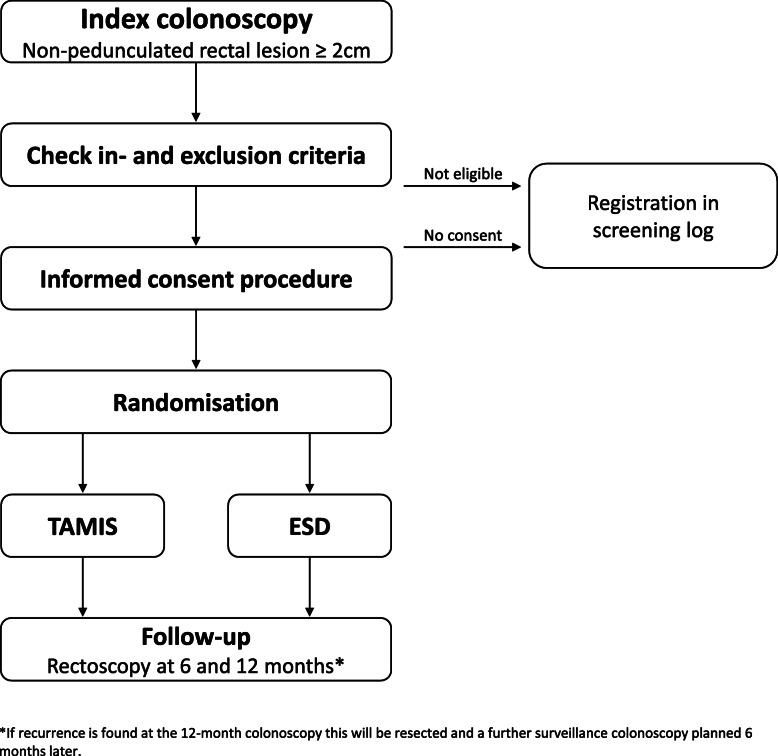
Methods: Multicenter randomised trial in 15 hospitals in the Netherlands. Patients with non-pedunculated lesions > 2 cm, where the bulk of the lesion is below 15 cm from the anal verge, will be randomised between either a TAMIS or an ESD procedure. Lesions judged to be deeply invasive by an expert panel will be excluded. The primary endpoint is the cumulative local recurrence rate at follow-up rectoscopy at 12 months. Secondary endpoints are: 1) Radical (R0-) resection rate; 2) Perceived burden and quality of life; 3) Cost effectiveness at 12 months; 4) Surgical referral rate at 12 months; 5) Complication rate; 6) Local recurrence rate at 6 months. For this non-inferiority trial, the total sample size of 198 is based on an expected local recurrence rate of 3% in the ESD group, 6% in the TAMIS group and considering a difference of less than 6% to be non-inferior.
Discussion: This is the first European randomised controlled trial comparing the effectiveness and safety of TAMIS and ESD for the en bloc resection of large non-pedunculated rectal lesions. This is important as the detection rate of these adenomas is expected to further increase with the introduction of colorectal screening programs throughout Europe. This study will therefore support an optimal use of healthcare resources in the future.
Trial registration: Netherlands Trial Register, NL7083 , 06 July 2018.
Keywords: Adenoma; Endoscopic submucosal dissection; Rectal cancer; Transanal minimally invasive surgery.
Conflict of interest statement
JB is a consultant for Boston Scientific.
Figures
References
-
- gco.iarc.fr [Internet]. Lyon: World Health Organization: The Global Cancer Observatory. [Updated 2019 may; cited 2019 Dec 10] Available from: http://gco.iarc.fr/today/data/factsheets/populations/908-europe-fact-she... [.
-
- De Graaf EJ, Doornebosch PG, Tollenaar RA, Meershoek-Klein Kranenbarg E, de Boer AC, Bekkering FC, et al. Transanal endoscopic microsurgery versus total mesorectal excision of T1 rectal adenocarcinomas with curative intention. Eur J Surg Oncol. 2009;35(12):1280–1285. doi: 10.1016/j.ejso.2009.05.001. - DOI - PubMed
-
- Barendse RM, Musters GD, de Graaf EJR, van den Broek FJC, Consten ECJ, Doornebosch PG, et al. Randomised controlled trial of transanal endoscopic microsurgery versus endoscopic mucosal resection for large rectal adenomas (TREND study) Gut. 2018;67(5):837–846. doi: 10.1136/gutjnl-2016-313101. - DOI - PubMed
Publication types
MeSH terms
Grants and funding
LinkOut - more resources
Full Text Sources
Medical
Research Materials
Miscellaneous
