


Efficacy and Safety of Glimepiride With or Without Linagliptin Treatment in Patients With HNF1A Diabetes (Maturity-Onset Diabetes of the Young Type 3): A Randomized, Double-Blinded, Placebo-Controlled, Crossover Trial (GLIMLINA)
- PMID: 32661107
- PMCID: PMC7440905
- DOI: 10.2337/dc20-0408
Efficacy and Safety of Glimepiride With or Without Linagliptin Treatment in Patients With HNF1A Diabetes (Maturity-Onset Diabetes of the Young Type 3): A Randomized, Double-Blinded, Placebo-Controlled, Crossover Trial (GLIMLINA)
Abstract
Objective: Sulfonylureas are first-line treatment of hepatocyte nuclear factor 1-α (HNF1A) diabetes (maturity-onset diabetes of the young type 3), but many patients do not achieve optimal glycemic control without episodes of hypoglycemia. We investigated the combination of the sulfonylurea glimepiride and the dipeptidyl peptidase 4 inhibitor linagliptin versus glimepiride monotherapy with respect to glycemic variability, glycemic control, and risk of hypoglycemia.
Research design and methods: In a randomized, double-blinded, crossover trial, patients with HNF1A diabetes (n = 19; mean ± SD age 43 ± 14 years, BMI 24.8 ± 2.8 kg/m2, and glycated hemoglobin [HbA1c] 7.4 ± 0.2% [57.1 ± 7.3 mmol/mol]) were randomly assigned to treatment with glimepiride + linagliptin 5 mg (16 weeks), washout (4 weeks), and glimepiride + placebo (16 weeks) (or vice versa). Glimepiride was titrated targeting a fasting plasma glucose of 4.5-6.0 mmol/L without hypoglycemia. Treatments were evaluated by continuous glucose monitoring (CGM), HbA1c, and meal test.
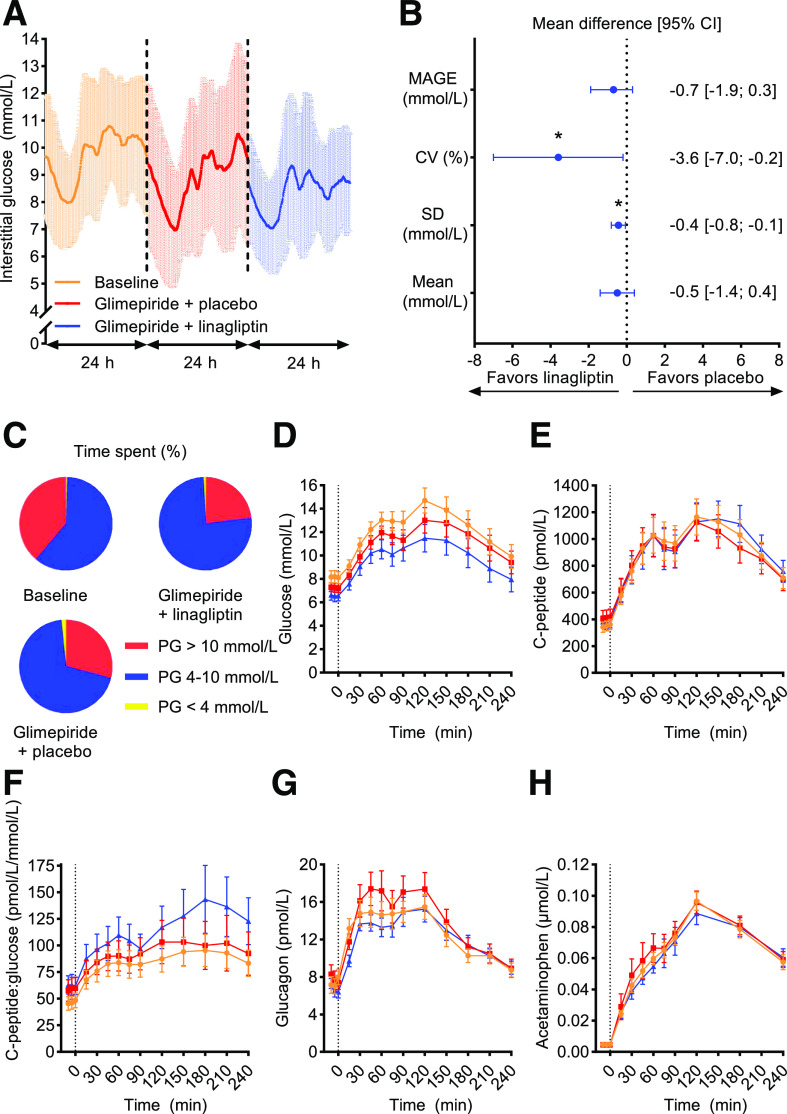
Results: Compared with glimepiride + placebo, glimepiride + linagliptin did not significantly improve the primary end point, mean amplitude of glycemic excursions (MAGE) (mean difference -0.7 mmol/L, P = 0.1540), but displayed significant reductions in coefficient of variation on CGM (-3.6%, P = 0.0401), HbA1c (-0.5%, P = 0.0048), and glimepiride dose (-0.7 mg/day, P = 0.0099). β-cell glucose sensitivity (assessed as C-peptide-to-glucose ratio) during meal test improved with glimepiride + linagliptin. Incidences of hypoglycemia were similar with both treatments.
Conclusions: Linagliptin as add-on treatment to glimepiride improved glycemic variability and control without increasing risk of hypoglycemia in patients with HNF1A diabetes.
© 2020 by the American Diabetes Association.
Figures
References
-
- Pihoker C, Gilliam LK, Ellard S, et al.; SEARCH for Diabetes in Youth Study Group . Prevalence, characteristics and clinical diagnosis of maturity onset diabetes of the young due to mutations in HNF1A, HNF4A, and glucokinase: results from the SEARCH for Diabetes in Youth. J Clin Endocrinol Metab 2013;98:4055–4062 - PMC - PubMed
-
- Shields BM, Hicks S, Shepherd MH, Colclough K, Hattersley AT, Ellard S. Maturity-onset diabetes of the young (MODY): how many cases are we missing? Diabetologia 2010;53:2504–2508 - PubMed
-
- Colclough K, Bellanne-Chantelot C, Saint-Martin C, Flanagan SE, Ellard S. Mutations in the genes encoding the transcription factors hepatocyte nuclear factor 1 alpha and 4 alpha in maturity-onset diabetes of the young and hyperinsulinemic hypoglycemia. Hum Mutat 2013;34:669–685 - PubMed
-
- Isomaa B, Henricsson M, Lehto M, et al. Chronic diabetic complications in patients with MODY3 diabetes. Diabetologia 1998;41:467–473 - PubMed
-
- Steele AM, Shields BM, Shepherd M, Ellard S, Hattersley AT, Pearson ER. Increased all-cause and cardiovascular mortality in monogenic diabetes as a result of mutations in the HNF1A gene. Diabet Med 2010;27:157–161 - PubMed
Publication types
MeSH terms
Substances
Supplementary concepts
Associated data
LinkOut - more resources
Full Text Sources
Medical
Miscellaneous
