. 2020 Sep 18;88(10):e00292-20.
doi: 10.1128/IAI.00292-20. Print 2020 Sep 18.

Generation and Characterization of Typhoid Toxin-Neutralizing Human Monoclonal Antibodies

Affiliations

Generation and Characterization of Typhoid Toxin-Neutralizing Human Monoclonal Antibodies

Xuyao Jiao et al. Infect Immun. .

Abstract

Typhoid toxin is a virulence factor of Salmonella enterica serovar Typhi, the causative agent of typhoid fever, and is thought to be responsible for the symptoms of severe disease. This toxin has a unique A2B5 architecture with two active subunits, the ADP ribosyl transferase PltA and the DNase CdtB, linked to a pentameric B subunit, which is alternatively made of PltB or PltC. Here, we describe the generation and characterization of typhoid toxin-neutralizing human monoclonal antibodies by immunizing genetically engineered mice that have a full set of human immunoglobulin variable region genes. We identified several monoclonal antibodies with strong in vitro and in vivo toxin-neutralizing activity and different mechanisms of toxin neutralization. These antibodies could serve as the basis for the development of novel therapeutic strategies against typhoid fever.

Keywords: Salmonella Paratyphi; Salmonella Typhi; bacterial pathogenesis; bacterial toxins; infectious diseases; monoclonal antibodies; therapeutics; typhoid fever.


Figures

FIG 1
FIG 1
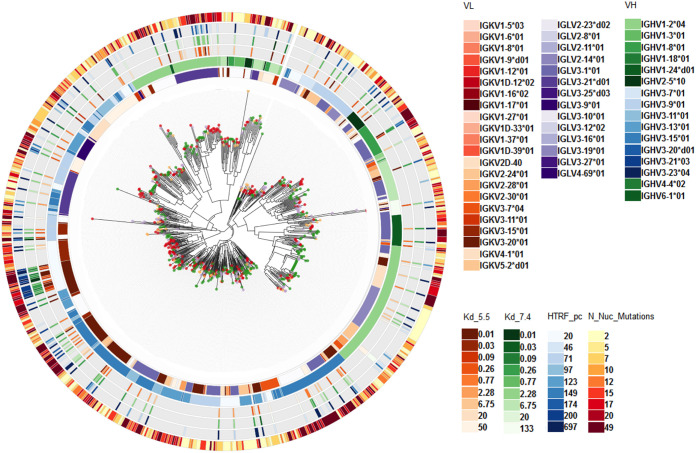
Antibody repertoire analysis from typhoid toxin immunized mice. The immunoglobulin heavy-and light-chain (IgH&L) phylogeny was built as a neighbor-joining tree from the single-cell sequencing of plasma cells. Colors on the tips of the phylogeny correspond to the individual mouse analyzed. The circular plot around the phylogeny shows antibody sequences and functional properties as per the color key. The inner circle corresponds to the sequence assigned IgL V gene, followed by IgH V gene, antibody binding affinity to typhoid toxin at pH 5.5 (dissociation constant [Kd] from 0.01 to 50 nM) or pH 7.4 (Kd from 0.01 to 133 nM), with the outer circle corresponding to IgH&L mutations from the predicted germ line sequence indicative of somatic hypermutation.
FIG 2
FIG 2
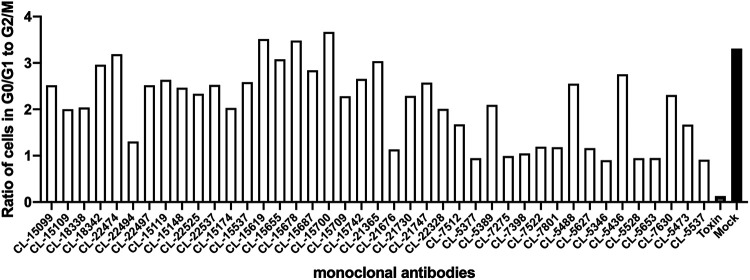
In vitro typhoid toxin-neutralizing activity of candidate human monoclonal antibodies. Neutralizing activity is depicted as a ratio of the number of cells in G0/G1 to G2/M of the cell cycle, as determined by their DNA content measured by flow cytometry. Controls include cells treated with toxin alone (toxin) or medium alone (mock).
FIG 3
FIG 3
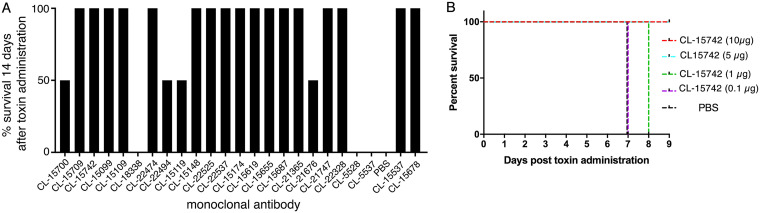
In vivo typhoid toxin-neutralizing activity of candidate human monoclonal antibodies assayed in mice. (A) The toxin-neutralizing activity was measured in mice by intraperitoneally administering equal amounts (10 μg) of each of the antibodies prior to the administration of a lethal dose (2 μg) of typhoid toxin. A minimum of 2 animals were used to assay each antibody. Data are expressed as the percentage of animals that survived toxin administration. (B) Titration of the neutralizing activity of a selected monoclonal antibody. The toxin-neutralizing activity was measured in mice as indicated above after administration of the indicated amounts of the monoclonal antibody. A minimum of 3 animals were used for each amount of antibody tested.
FIG 4
FIG 4
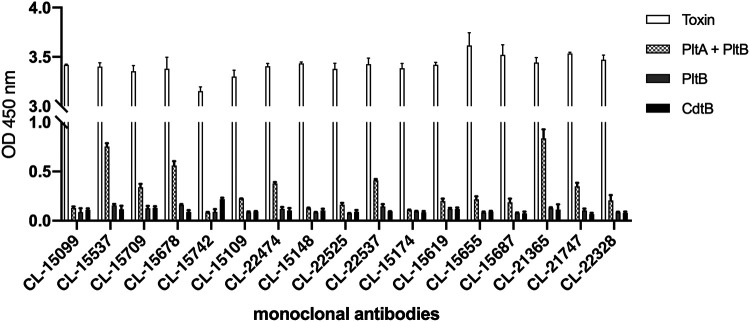
Reactivity of the monoclonal antibodies to different components of typhoid toxin measured by solid-phase ELISA. Numbers represent absorbance at 450 nm and are the mean ± standard deviation of 3 technical replicates. This experiment was conducted at least three independent times with equivalent results. OD, optical density.
FIG 5
FIG 5
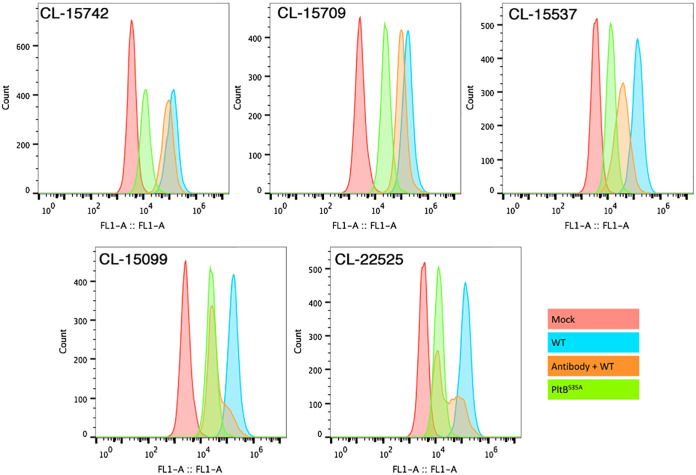
Inhibition of toxin binding by different monoclonal antibodies. Cells were treated with fluorescently labeled typhoid toxin or a mutant unable to bind its cellular receptor due to a mutation in its PltB subunit (PltBS35A), which had been preincubated with the indicated monoclonal antibodies. Toxin binding was evaluated by flow cytometry. This experiment was carried out at least three times with equivalent results. WT, wild type.
FIG 6
FIG 6
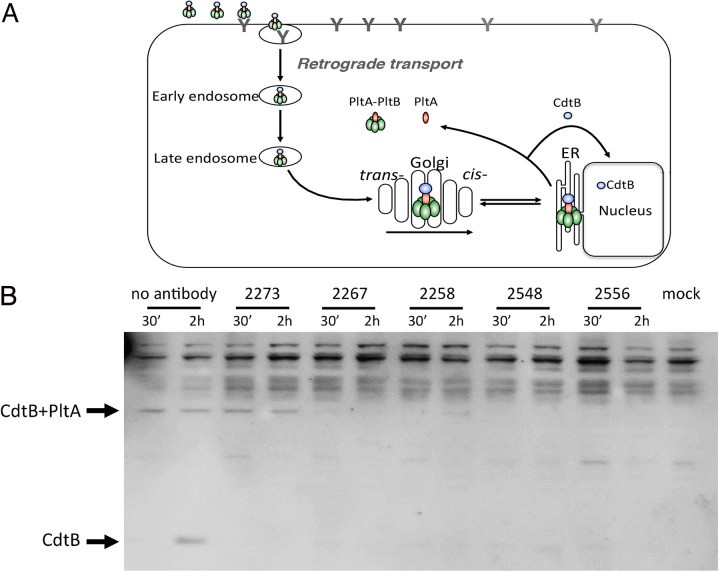
Inhibition of holotoxin disassembly by the different monoclonal antibodies. (A) Diagram of typhoid toxin intracellular transport. (B) Cells were treated with typhoid toxin that had been preincubated with the indicated monoclonal antibodies. At the indicated times, cells were lysed and analyzed by western immunoblotting with an antibody directed to the CdtB subunit of typhoid toxin. Indicated are the expected migration positions of CdtB and the CdtB/PltA complex. This experiment was repeated three times with equivalent results. ER, endoplasmic reticulum.
FIG 7
FIG 7
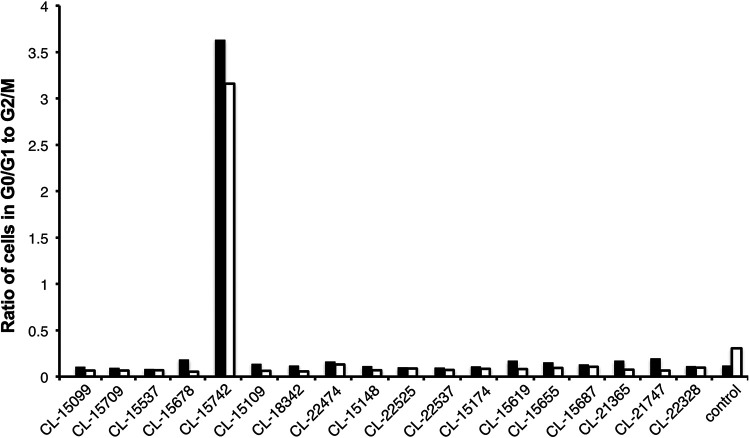
In vitro PltC-typhoid toxin-neutralizing activity of candidate human monoclonal antibodies. Neutralizing activity is depicted as a ratio of the number of cells in G0/G1 to G2/M of the cell cycle, as determined by their DNA content measured by flow cytometry. The results of two independent experiments (open and closed bars) are shown. Cells treated with toxin that had been incubated with buffer are indicated as “control.”

References

    1. Dougan G, Baker S. 2014. Salmonella enterica serovar Typhi and the pathogenesis of typhoid fever. Annu Rev Microbiol 68:317–336. doi:10.1146/annurev-micro-091313-103739. - DOI - PubMed
    1. Parry C, Hien TT, Dougan G, White N, Farrar J. 2002. Typhoid fever. N Engl J Med 347:1770–1782. doi:10.1056/NEJMra020201. - DOI - PubMed
    1. Buckle G, Walker C, Black R. 2012. Typhoid fever and paratyphoid fever: systematic review to estimate global morbidity and mortality for 2010. J Glob Health 2:010401. doi:10.7189/jogh.01.010401. - DOI - PMC - PubMed
    1. Mogasale V, Maskery B, Ochiai R, Lee J, Mogasale V, Ramani E, Kim Y, Park J, Wierzba T. 2014. Burden of typhoid fever in low-income and middle-income countries: a systematic, literature-based update with risk-factor adjustment. Lancet Glob Health 2:e570–e580. doi:10.1016/S2214-109X(14)70301-8. - DOI - PubMed
    1. Kim J, Mogasale V, Im J, Ramani E, Marks F. 2017. Updated estimates of typhoid fever burden in sub-Saharan Africa. Lancet Glob Health 5:e969. doi:10.1016/S2214-109X(17)30328-5. - DOI - PubMed

Publication types

MeSH terms

LinkOut - more resources