


Review
doi: 10.1038/s42255-019-0041-z.
Epub 2019 Mar 14.
Metabolic Messengers: Adiponectin
Affiliations
- PMID: 32661510
- PMCID: PMC7357716
- DOI: 10.1038/s42255-019-0041-z
Item in Clipboard
Review
Metabolic Messengers: Adiponectin
Nat Metab.
2019 Mar.
Abstract
Adiponectin is one of the most widely studied adipokines to date. First described in the mid-1990's, studying its regulation, biogenesis and physiological effects has proven to be extremely insightful and improved our understanding of the mechanisms that ensure systemic metabolic homeostasis. Here, we provide a brief overview of the current state of the field with respect to adiponectin, its history, sites and mechanisms of action, and the critical questions that will need to be addressed in the future.
Conflict of interest statement
Competing Interests The authors report no conflicts of interest
Figures
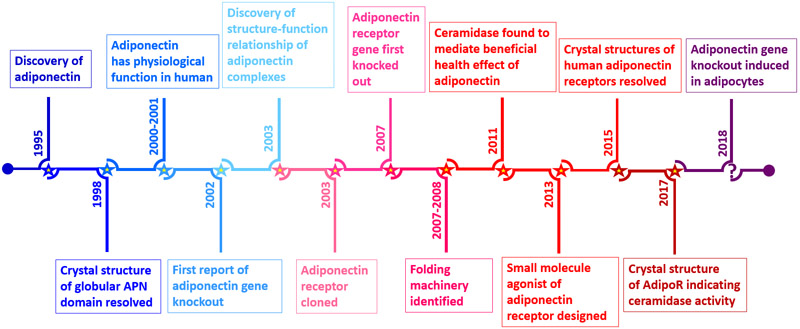
First discovered in 1995, adiponectin’s physiological function in humans became soon apparent (2000-2001). Its receptor was discovered in 2003 and important signaling pathways were established. Not only were the genetic deletions of both adiponectin (2002 and 2018) and its receptors AdipoR1/2 (2007) published, but the pleiotropic effects of adiponectin was shown to be mediated by ceramidase function. The small molecule AdipoRon was the first AdipoR agonist (2013). The initial crystal structure of the AdipoR published in 2015 was further refined in 2017, which revealed that it contains an active site reminiscent of an enzymatic function consistent with a ceramidase activity within the receptor itself.
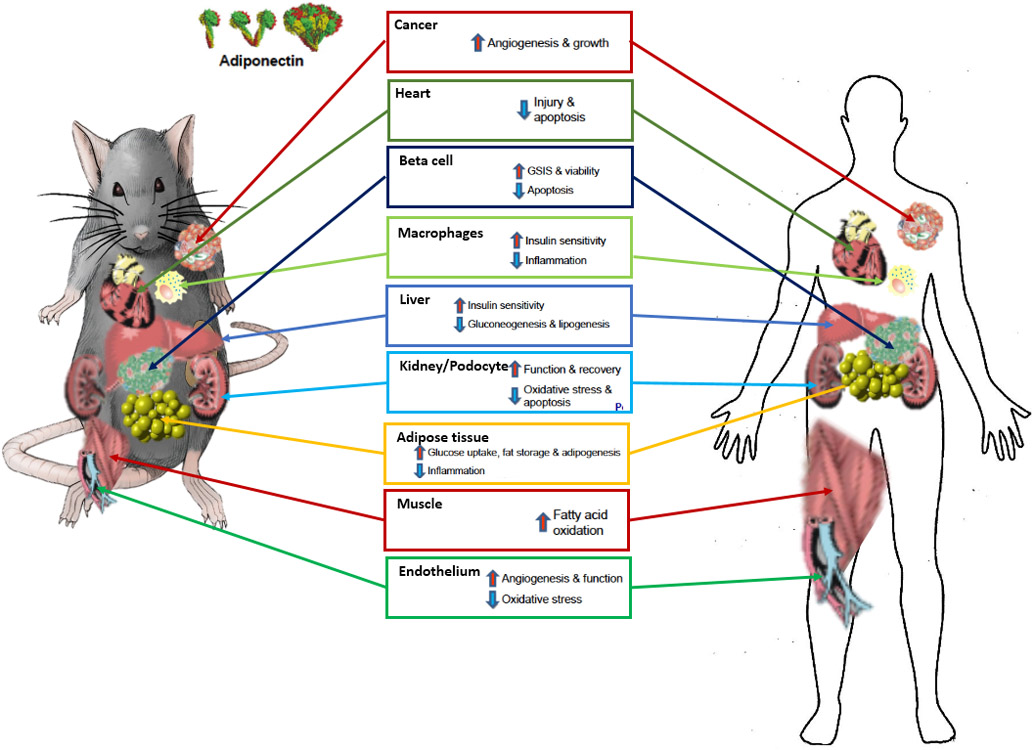
Both adiponectin as well as its receptors are highly conserved between mouse and human. Most observations were made in rodents, but are supported by strong correlational data in the clinic. The physiological effects of adiponectin are therefore strongly preserved between rodents and humans. Adiponectin forms higher order structures through multimerization. The high molecular weight multimer (HMW) of adiponectin is the most biologically active form, targeting a diverse set of tissues and cell types and regulating important metabolic processes. Adiponectin’s effects range from anti-inflammatory and anti-apoptotic to insulin sensitizing.
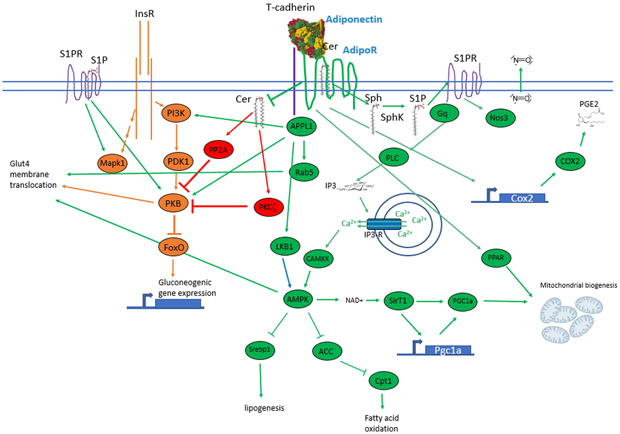
Adiponectin binds to the AdipoR, and its binding may be enhanced by T-cadherin. AdipoR signaling targets the cellular metabolic pathways through regulation of mitochondrial biogenesis, lipogenesis and fatty acid oxidation. AdipoR signaling (green) interfaces with insulin receptor signaling (InsR) (orange), which is mediated by sphingosine-1-phosphate receptor (S1PR) and ceramide. High ceramide levels suppress insulin signaling mainly through the inactivation of serine/threonine protein phosphatase 2A (PP2A). By hydrolyzing Ceramide (Cer) to Sphingosine (Sph), AdipoR reduces Cer levels that de-repress PKB via PKCζ. De-repressed PKB inhibits FOXO and thereby downregulates gluconeogenic gene expression. Sph can be phosphorylated to sphingosine-1-phosphate (S1P) that activates S1PR which can induce the downstream mediators of InsR signaling Mapk1 and PKB. S1PR also initiates a PLC mediated IP3 downstream signal that triggers Calcium (Ca2+) resulting in activation of AMPK by CAMKK. AMPK spreads the signal across many downstream factors e.g. SirT1, Srebp1 and ACC. AdipoR induces PPARs through a yet to be elucidated pathway. The localization of glucose transporter to the plasma membrane can be impacted by Rab5, AMPK and PKB. The scaffold protein APPL1 binds important signaling mediators and thereby contributes to the crosstalk of AdipoR and InsR as well. ADIPOR also regulates the expression of Cox2 that produces prostaglandin E2 (PGE2).
References
-
- Berg AH, Combs T, Du X, Brownlee M & Scherer PE The Adipocyte-Secreted Protein Acrp30 Enhances Hepatic Insulin Action. Nat Med 7, 947–953 (2001). - PubMed
-
- Yamauchi T, et al. The fat-derived hormone adiponectin reverses insulin resistance associated with both lipoatrophy and obesity. Nat. Med 7, 941–946 (2001). - PubMed
-
- Okamoto Y, et al. Adiponectin reduces atherosclerosis in apolipoprotein E-deficient mice. Circulation 106, 2767–2770 (2002). - PubMed
Publication types
MeSH terms
Substances
Grants and funding
LinkOut - more resources
Full Text Sources
