


doi: 10.1016/j.tim.2020.02.011.
Epub 2020 Apr 8.
Shigella sonnei
Affiliations
- PMID: 32663462
- PMCID: PMC7611039
- DOI: 10.1016/j.tim.2020.02.011
Item in Clipboard
Shigella sonnei
Trends Microbiol.
2020 Aug.
No abstract available
Keywords: O-antigen; antimicrobial resistance; bacillary dysentery; type VI secretion system.
Figures
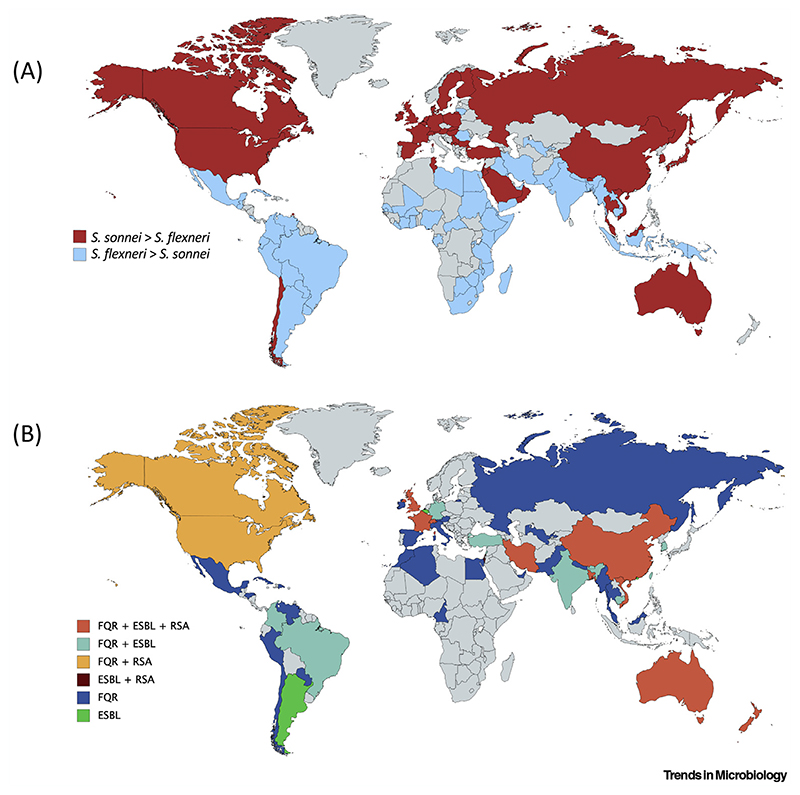
(A) Cases of S. sonnei versus Shigella flexneri. Cases of S. sonnei are increasing globally. Red indicates countries where S. sonnei is the dominant cause of shigellosis (when compared with S. flexneri). Blue indicates countries where a higher proportion of S. flexneri is still being reported (although S. sonnei cases may be rapidly increasing). Data presented according to Thompson et al. (see Literature). (B) Distribution of S. sonnei resistance to first- and second-line antibiotics. FQR, fluoroquinolone resistance; ESBL, extended-spectrum β-lactamase-producing (i.e., resistant to third-generation cephalosporins or carbapenems); RSA, reduced sensitivity to azithromycin. Countries are colored according to antibiotic-resistant cases reported in Table S1 in the supplemental information online.
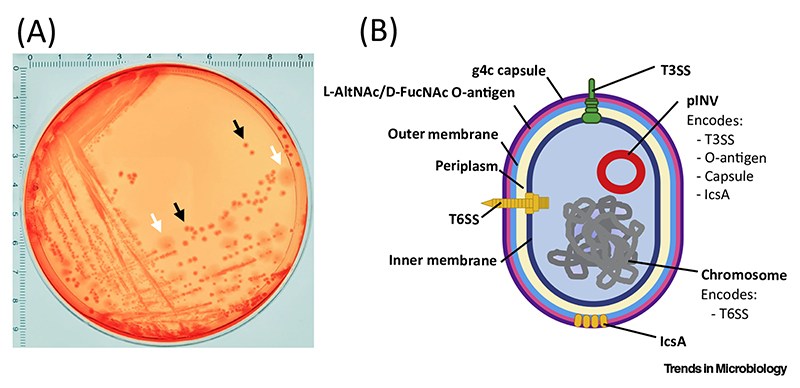
(A) S. sonnei 53G platedon Congo Red agar.Thevirulenceplasmid (pINV) of S. sonnei is essential for pathogenesis in vivo but is unstable outside the host (and is lost when bacteria are cultured in vitro). As a result of maintenance or loss of pINV, S. sonnei presents two different phenotypes on Congo Red plates. Black arrows indicate small smooth red colonies (Phase I S. sonnei). These colonies retain pINV and accumulate Congo Red dye because they express a type III secretion system (T3SS). The small smooth phenotype is due to expression of O-antigen (O-Ag). White arrows indicate large rough white colonies (Phase II S. sonnei). These colonies are unable to accumulate Congo Red and have an irregular shape because they lose pINV (which encodes both T3SS and O-Ag). In this case, bacteria were plated from a glycerol stock (originally obtained from a liquid culture of a single Phase I colony) and incubated overnight at 37°C. Grid numbers indicate the size in centimetres. (B) Schematic representing key S. sonnei virulence determinants. S. sonnei encodes a T3SS crucial for host cell invasion; IcsAwhich mediates actin-based motility; aT6SS crucial for bacterial competition and niche occupancy; a horizontally acquired g4c capsule and O-antigen involved in resistance to phagocytosis, complement-mediated lysis, and phagolysosomal degradation. L-AltNAc, 2-acetamido-2-deoxy-L-altruronic acid; D-FucNAc, N-acetyl-2-acetamido-4-amino-2,4-dideoxy-D-fucose. Figure adapted from Torraca et al. (see Literature).
References
-
- Anderson MC, et al. Shigella sonnei encodes a functional T6SS used for interbacterial competition and niche occupancy. Cell Host Microbe. 2017;21:769–776.:e3. - PubMed
-
- Baker KS, et al. Intercontinental dissemination of azithromycin-resistant shigellosis through sexual transmission: A cross-sectional study. Lancet Infect Dis. 2015;15:913–921. - PubMed
MeSH terms
Substances
Grants and funding
LinkOut - more resources
Full Text Sources
