


Effect of the COVID-19 Pandemic on Treatment Delays in Patients with ST-Segment Elevation Myocardial Infarction
- PMID: 32664309
- PMCID: PMC7408681
- DOI: 10.3390/jcm9072183
Effect of the COVID-19 Pandemic on Treatment Delays in Patients with ST-Segment Elevation Myocardial Infarction
Abstract
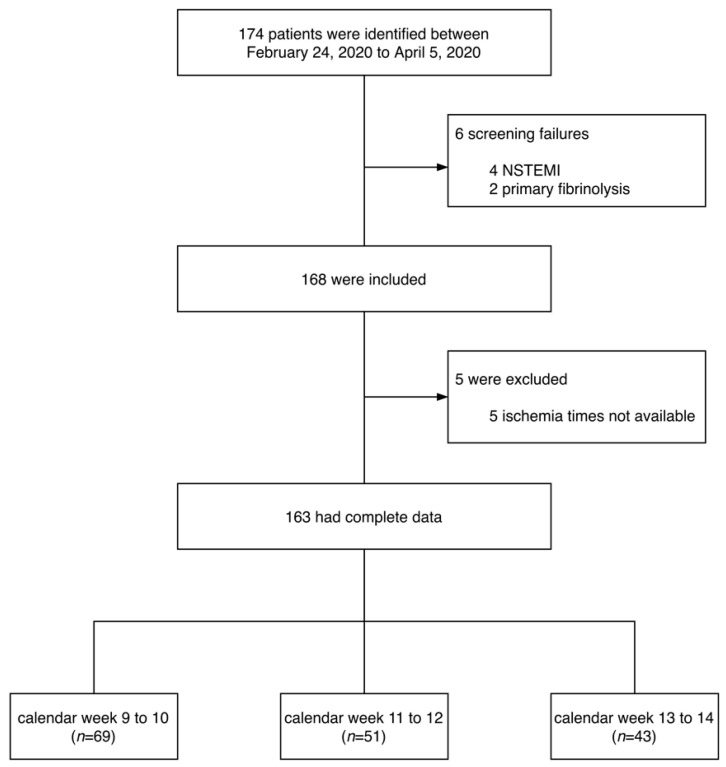
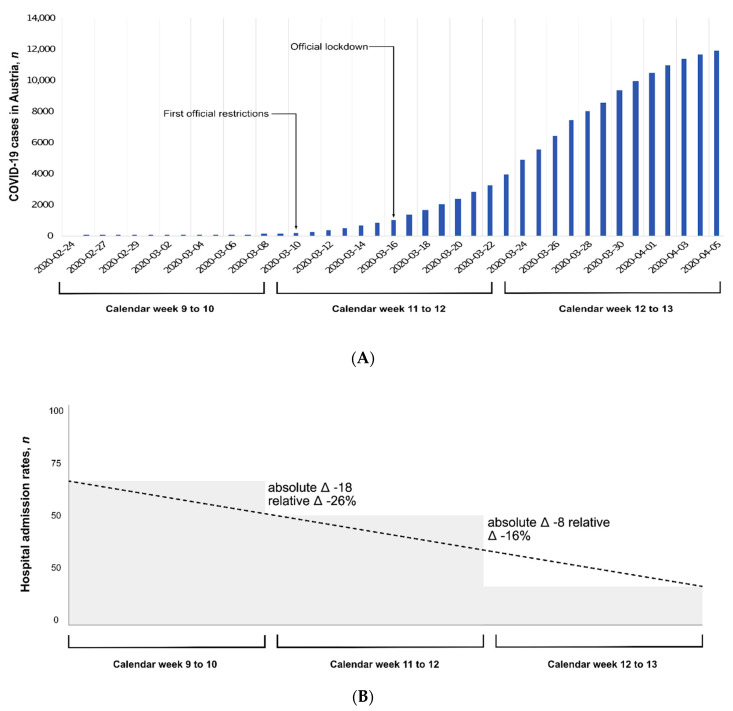
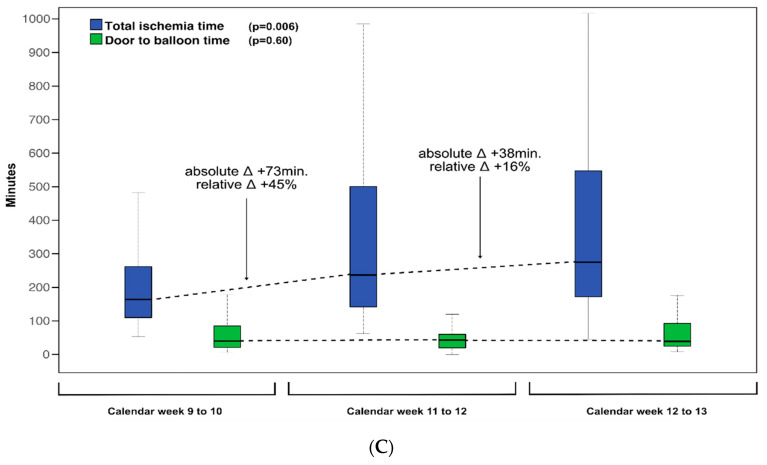
Coronavirus disease 19 (COVID-19) and its associated restrictions could affect ischemic times in patients with ST-segment elevation myocardial infarction (STEMI). The objective of this study was to investigate the influence of the COVID-19 outbreak on ischemic times in consecutive all-comer STEMI patients. We included consecutive STEMI patients (n = 163, median age: 61 years, 27% women) who were referred to seven tertiary care hospitals across Austria for primary percutaneous coronary intervention between 24 February 2020 (calendar week 9) and 5 April 2020 (calendar week 14). The number of patients, total ischemic times and door-to-balloon times in temporal relation to COVID-19-related restrictions and infection rates were analyzed. While rates of STEMI admissions decreased (calendar week 9/10 (n = 69, 42%); calendar week 11/12 (n = 51, 31%); calendar week 13/14 (n = 43, 26%)), total ischemic times increased from 164 (interquartile range (IQR): 107-281) min (calendar week 9/10) to 237 (IQR: 141-560) min (calendar week 11/12) and to 275 (IQR: 170-590) min (calendar week 13/14) (p = 0.006). Door-to-balloon times were constant (p = 0.60). There was a significant difference in post-interventional Thrombolysis in myocardial infarction (TIMI) flow grade 3 in patients treated during calendar week 9/10 (97%), 11/12 (84%) and 13/14 (81%; p = 0.02). Rates of in-hospital death and re-infarction were similar between groups (p = 0.48). Results were comparable when dichotomizing data on 10 March and 16 March 2020, when official restrictions were executed. In this cohort of all-comer STEMI patients, we observed a 1.7-fold increase in ischemic time during the outbreak of COVID-19 in Austria. Patient-related factors likely explain most of this increase. Counteractive steps are needed to prevent further cardiac collateral damage during the ongoing COVID-19 pandemic.
Keywords: Coronavirus disease 2019; ST-segment elevation myocardial infarction; total ischemic time.
Conflict of interest statement
The authors declare no conflict of interest.
Figures
References
-
- Verity R., Okell L.C., Dorigatti I., Winskill P., Whittaker C., Imai N., Cuomo-Dannenburg G., Thompson H., Walker P.G.T., Fu H., et al. Estimates of the severity of coronavirus disease 2019: A model-based analysis. Lancet Infect. Dis. 2020;20:669–677. doi: 10.1016/S1473-3099(20)30243-7. - DOI - PMC - PubMed
-
- Grasselli G., Zangrillo A., Zanella A., Antonelli M., Cabrini L., Castelli A., Cereda D., Coluccello A., Foti G., Fumagalli R., et al. Baseline Characteristics and outcomes of 1591 patients infected with SARS-CoV-2 admitted to ICUs of the Lombardy Region, Italy. JAMA. 2020;323:1574–1581. doi: 10.1001/jama.2020.5394. - DOI - PMC - PubMed
LinkOut - more resources
Full Text Sources
Miscellaneous
