Review
. 2020 Jul 12;12(7):1875.
doi: 10.3390/cancers12071875.

Combinatorial Immunotherapies for Metastatic Colorectal Cancer

Affiliations
Review

Combinatorial Immunotherapies for Metastatic Colorectal Cancer

Eline Janssen et al. Cancers (Basel). .

Abstract

Colorectal cancer (CRC) is one of the most frequent and deadly forms of cancer. About half of patients are affected by metastasis, with the cancer spreading to e.g., liver, lungs or the peritoneum. The majority of these patients cannot be cured despite steady advances in treatment options. Immunotherapies are currently not widely applicable for this disease, yet show potential in preclinical models and clinical translation. The tumour microenvironment (TME) has emerged as a key factor in CRC metastasis, including by means of immune evasion-forming a major barrier to effective immuno-oncology. Several approaches are in development that aim to overcome the immunosuppressive environment and boost anti-tumour immunity. Among them are vaccination strategies, cellular transplantation therapies, and targeted treatments. Given the complexity of the system, we argue for rational design of combinatorial therapies and consider the implications of precision medicine in this context.

Keywords: TGF-b; checkpoint blockade; immune suppression; metastasis; solid tumour; tumor microenvironment.


Conflict of interest statement

The authors declare no conflict of interest.

Figures
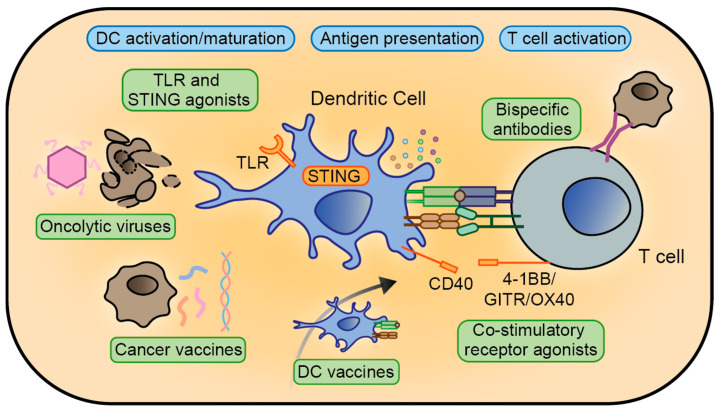
Figure 1
Figure 1
Schematic overview of therapeutic strategies aimed at boosting immune recognition. This process involves dendritic cell (DC) activation and maturation, antigen processing and presentation to T cells, and the subsequent activation of T cells with cytokines and other co-stimulatory signals. Some of these steps can be circumvented using ex vivo-generated DC vaccines or by the application of bispecific antibody products. Cancer cells are depicted in grey.
Figure 2
Figure 2
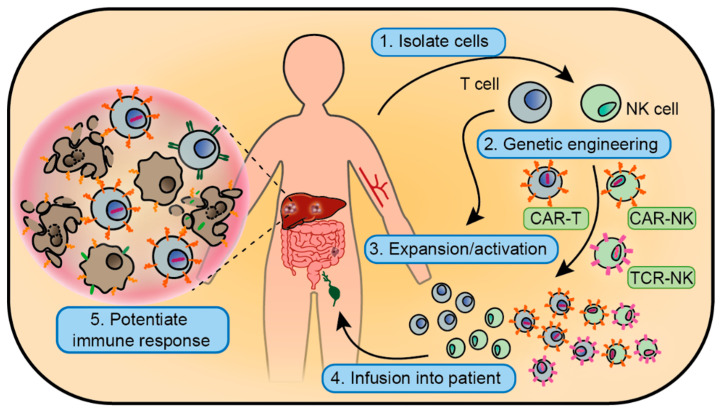
Schematic overview of adoptive cell therapies. T cells or NK cells can be isolated from the patient, or from healthy donors, and expanded ex vivo. During this process, they can be genetically engineered to express a CAR or TCR variant. Upon infusion, these killer cells can reinforce the existing immune response or effect a new one.
Figure 3
Figure 3
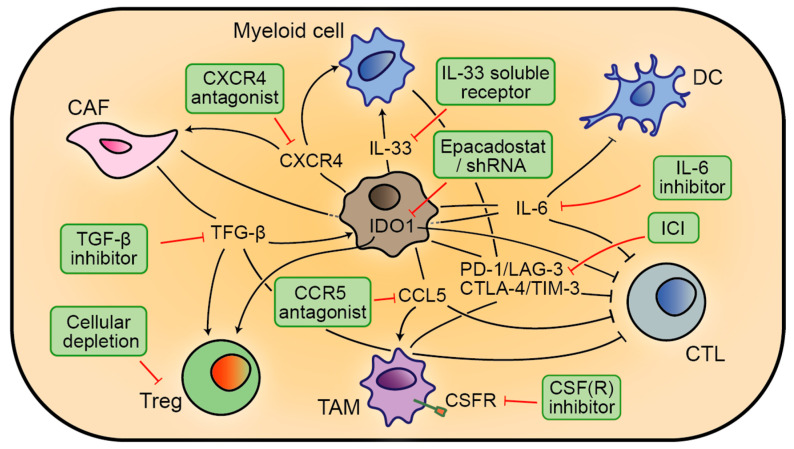
Schematic overview of some of the players, targets, and strategies that are involved in modulating and re-educating the immunosuppressive TME for mCRC, with the aim of promoting anti-tumour immunity. An IDO1-expressing epithelial CRC cell (grey) is depicted in the middle.

References

    1. Dunn G.P., Bruce A.T., Ikeda H., Old L.J., Schreiber R.D. Cancer immunoediting: From immunosurveillance to tumor escape. Nat. Immunol. 2002;3:991–998. doi: 10.1038/ni1102-991. - DOI - PubMed
    1. Schreiber R.D., Old L.J., Smyth M.J. Cancer Immunoediting: Integrating Immunity’s Roles in Cancer Suppression and Promotion. Science. 2011;331:1565–1570. doi: 10.1126/science.1203486. - DOI - PubMed
    1. Vinay D.S., Ryan E.P., Pawelec G., Talib W.H., Stagg J., Elkord E., Lichtor T., Decker W.K., Whelan R.L., Kumara H.M.C.S., et al. Immune evasion in cancer: Mechanistic basis and therapeutic strategies. Semin. Cancer Biol. 2015;35:S185–S198. doi: 10.1016/j.semcancer.2015.03.004. - DOI - PubMed
    1. Hanahan D., Weinberg R.A., Adams J.M., Cory S., Aguirre-Ghiso J.A., Ahmed Z., Bicknell R., Al-Hajj M., Wicha M.S., Benito-Hernandez A., et al. Hallmarks of cancer: The next generation. Cell. 2011;144:646–674. doi: 10.1016/j.cell.2011.02.013. - DOI - PubMed
    1. Ullman T.A., Itzkowitz S.H. Intestinal Inflammation and Cancer. Gastroenterology. 2011;140:1807–1816. doi: 10.1053/j.gastro.2011.01.057. - DOI - PubMed

LinkOut - more resources