


Large-scale countrywide screening for tick-borne pathogens in field-collected ticks in Latvia during 2017-2019
- PMID: 32665019
- PMCID: PMC7362577
- DOI: 10.1186/s13071-020-04219-7
Large-scale countrywide screening for tick-borne pathogens in field-collected ticks in Latvia during 2017-2019
Abstract
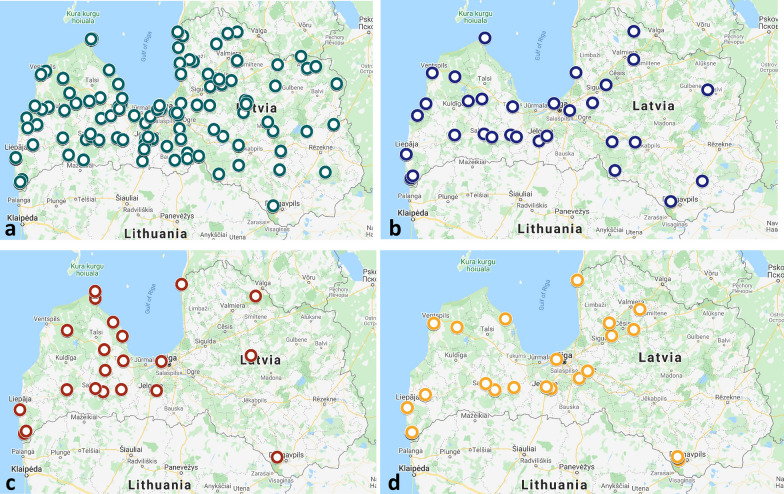
Background: Tick-borne diseases are of substantial concern worldwide in both humans and animals. Several hard tick species are of medical and veterinary interest in Europe, and changes in the range of tick species can affect the spread of zoonotic pathogens. The aim of the present study was to map the current prevalence and distribution pattern of ticks and related tick-borne pathogens in Latvia, a Baltic state in northern Europe.
Methods: Nearly 4600 Ixodes ricinus, I. persulcatus and Dermacentor reticulatus tick samples were collected in all regions of Latvia during 2017-2019 and were screened by molecular methods to reveal the prevalence and distribution pattern of a wide spectrum of tick-borne pathogens.
Results: New localities of D. reticulatus occurrence were found in western and central Latvia, including the Riga region, indicating that the northern border of D. reticulatus in Europe has moved farther to the north. Among the analyzed ticks, 33.42% carried at least one tick-borne pathogen, and 5.55% of tick samples were positive for two or three pathogens. A higher overall prevalence of tick-borne pathogens was observed in I. ricinus (34.92%) and I. persulcatus (31.65%) than in D. reticulatus (24.2%). The molecular analysis revealed the presence of tick-borne encephalitis virus, Babesia spp., Borrelia spp., Anaplasma phagocytophilum and Rickettsia spp. Overall, 15 and 7 tick-borne pathogen species were detected in Ixodes spp. and D. reticulatus ticks, respectively. This is the first report of Borrelia miyamotoi in Latvian field-collected ticks.
Conclusions: This large-scale countrywide study provides a snapshot of the current distribution patterns of Ixodes and Dermacentor ticks in Latvia and gives us a reliable overview of tick-borne pathogens in Latvian field-collected ticks.
Keywords: Dermacentor reticulatus; Ixodes persulcatus; Ixodes ricinus; Latvia; Tick-borne pathogens.
Conflict of interest statement
The authors declare that they have no competing interests.
Figures


References
-
- de la Fuente J, Estrada-Pena A, Venzal JM, Kocan KM, Sonenshine DE. Overview: ticks as vectors of pathogens that cause disease in humans and animals. Front Biosci. 2008;13:6938–6946. - PubMed
-
- ECDC. Tick maps. Stockholm: European Centre for Disease Prevention and Control; 2019. https://www.ecdc.europa.eu/en/disease-vectors/surveillance-and-disease-d.... Accessed 13 Jan 2020.
MeSH terms
Supplementary concepts
Grants and funding
LinkOut - more resources
Full Text Sources
Medical
Miscellaneous
