. 2020 Jul 14;11(4):e00886-20.
doi: 10.1128/mBio.00886-20.

Vitamin Biosynthesis by Human Gut Butyrate-Producing Bacteria and Cross-Feeding in Synthetic Microbial Communities

Affiliations

Vitamin Biosynthesis by Human Gut Butyrate-Producing Bacteria and Cross-Feeding in Synthetic Microbial Communities

Eva C Soto-Martin et al. mBio. .

Abstract

We investigated the requirement of 15 human butyrate-producing gut bacterial strains for eight B vitamins and the proteinogenic amino acids by a combination of genome sequence analysis and in vitro growth experiments. The Ruminococcaceae species Faecalibacterium prausnitzii and Subdoligranulum variabile were auxotrophic for most of the vitamins and the amino acid tryptophan. Within the Lachnospiraceae, most species were prototrophic for all amino acids and several vitamins, but biotin auxotrophy was widespread. In addition, most of the strains belonging to Eubacterium rectale and Roseburia spp., but few of the other Lachnospiraceae strains, were auxotrophic for thiamine and folate. Synthetic coculture experiments of five thiamine or folate auxotrophic strains with different prototrophic bacteria in the absence and presence of different vitamin concentrations were carried out. This demonstrated that cross-feeding between bacteria does take place and revealed differences in cross-feeding efficiency between prototrophic strains. Vitamin-independent growth stimulation in coculture compared to monococulture was also observed, in particular for F. prausnitzii A2-165, suggesting that it benefits from the provision of other growth factors from community members. The presence of multiple vitamin auxotrophies in the most abundant butyrate-producing Firmicutes species found in the healthy human colon indicates that these bacteria depend upon vitamins supplied from the diet or via cross-feeding from other members of the microbial community.IMPORTANCE Microbes in the intestinal tract have a strong influence on human health. Their fermentation of dietary nondigestible carbohydrates leads to the formation of health-promoting short-chain fatty acids, including butyrate, which is the main fuel for the colonic wall and has anticarcinogenic and anti-inflammatory properties. A good understanding of the growth requirements of butyrate-producing bacteria is important for the development of efficient strategies to promote these microbes in the gut, especially in cases where their abundance is altered. The demonstration of the inability of several dominant butyrate producers to grow in the absence of certain vitamins confirms the results of previous in silico analyses. Furthermore, establishing that strains prototrophic for thiamine or folate (butyrate producers and non-butyrate producers) were able to stimulate growth and affect the composition of auxotrophic synthetic communities suggests that the provision of prototrophic bacteria that are efficient cross feeders may stimulate butyrate-producing bacteria under certain in vivo conditions.

Keywords: amino acid biosynthesis; butyrate; cross-feeding; human gut microbiota; vitamin biosynthesis.


Figures

FIG 1
FIG 1
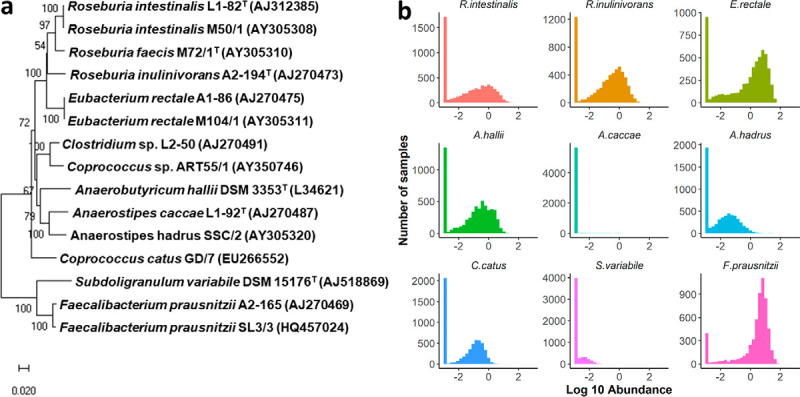
Strains used in this study. (a) 16S rRNA gene-based phylogenetic tree of the 15 butyrate-producing strains of this study. Prealigned sequences (identified by their accession number in brackets) were downloaded from the Ribosomal Database project (http://rdp.cme.msu.edu/index.jsp) (64) and a neighbor-joining tree generated with standard settings with MEGA X (65). The percentage of replicate trees in which the associated taxa clustered together in the bootstrap test (500 replicates) are shown next to the branches. The scale bar represents the number of base substitutions per site. Names provided as per the NCBI taxonomy website (https://www.ncbi.nlm.nih.gov/taxonomy). Clostridium sp. L2-50 shares 96% 16S rRNA gene sequence identity with Coprococcus sp. ART55/1 and likely belongs to the genus Coprococcus (66). (b) Abundance distribution of selected species in human metagenomes in fecal samples. Data were retrieved from curatedMetagenomicData (https://waldronlab.github.io/curatedMetagenomicData/; accessed 2018; n = 5,848), which provides uniformly processed human metagenomics data sets (67), showing a variability of distribution. Abundance distributions were visualized with R v 3.5.2. using a logarithmic scale.
FIG 2
FIG 2
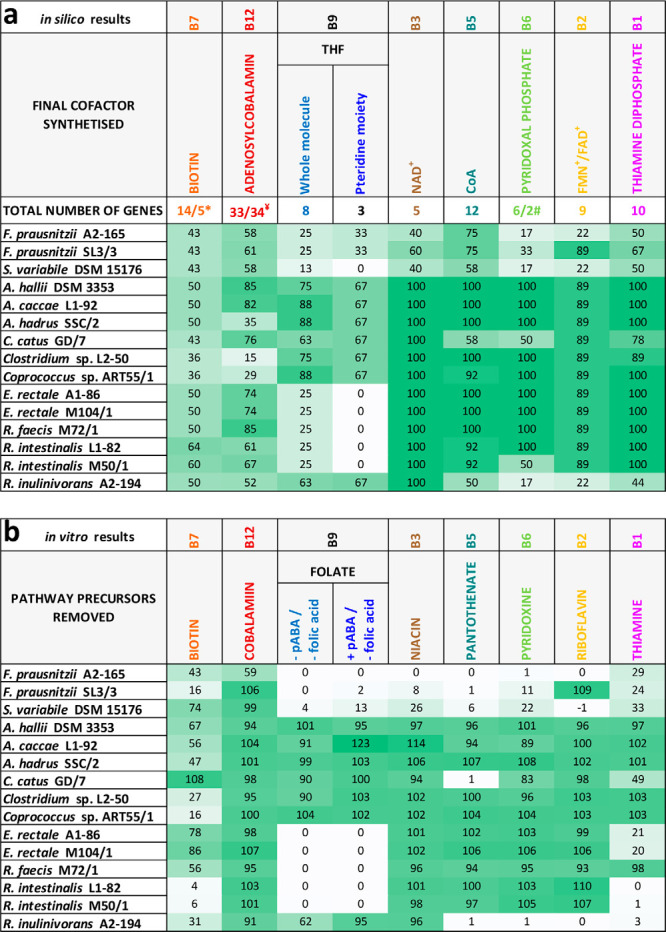
Overview of the in silico and in vitro results generated for eight vitamin pathways in 15 strains of butyrate-producing bacteria. (a) In silico results. The percentage of gene presence in the de novo biosynthetic pathways is shown (when different routes of vitamin biosynthesis are present, only the highest percentage of genes is displayed; for details, see Fig. S1 and Table S1). *, 14 genes in the main route (all strains except R. intestinalis M50/1) and five genes in the alternative route (R. intestinalis M50/1); ¥, either one or two genes for step 13; #, six genes in the main route (F. prausnitzii, S. variabile DSM 15176, R. inulinivorans A2-194) and two genes in the alternative route (rest of the strains). (b) In vitro results. The percentage of growth in the absence of the respective vitamin or precursor relative to the positive control with all vitamins present is shown (significant differences are given in Fig. 3). pABA, p-aminobenzoic acid. Color gradients reflect percentage (0% [white] to the maximum percentage [dark green]).
FIG 3
FIG 3
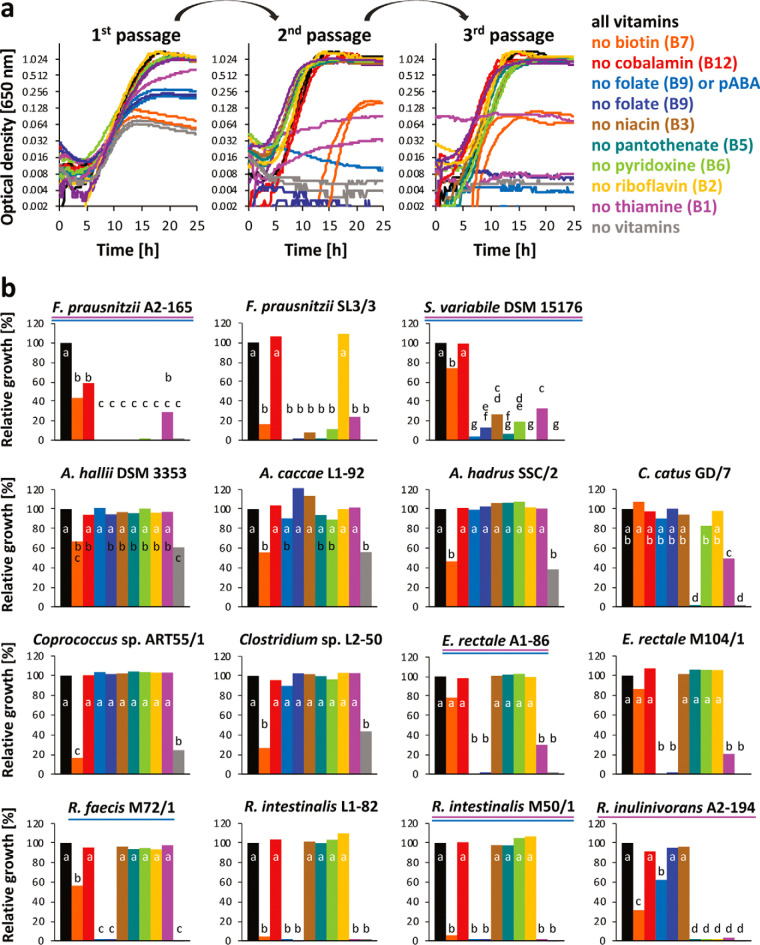
Growth of butyrate-producing bacteria in the absence of vitamins. (a) Growth of R. intestinalis M50/1 in 96-well plates during three passages in CAH-CDM lacking individual vitamins and their respective precursors in comparison to a positive control (black lines) with all vitamins and a negative control (gray lines) with none of the vitamins present. (b) Final optical densities relative to the positive control of the third passage of 15 different strains. F. prausnitzii strains and C. catus GD/7 were grown in Hungate tubes. All other strains were grown in 96-well plates. The final OD values reached by the control with all vitamins ranged from 0.392 to 1.372 for the different strains. All growth curves are given in Fig. S3 in the supplemental material. The pooled standard deviation ranged between 2.2 and 14.7 per strain. Letters refer to the Tukey test results. Treatments with a letter in common are not significantly different (P value of <0.05). Strains used as thiamine and folate auxotrophs in synthetic community cross-feeding experiments are underlined in pink and blue, respectively.
FIG 4
FIG 4
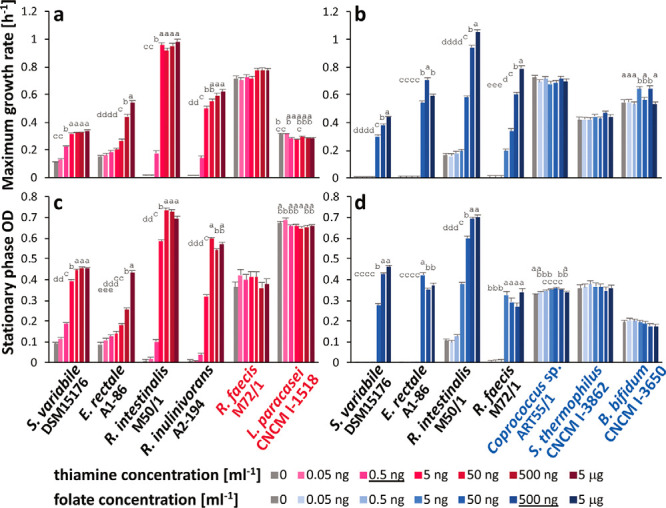
Pure culture growth parameters of strains grown in the presence of increasing concentrations of thiamine (red) or folate (blue). (a to d) Graphs show maximum growth rate achieved in exponential phase (a and b) and show the optical density reached in stationary phase (c and d). Auxotrophic strains are in black font, and thiamine and folate prototrophic strains are in red and blue font, respectively. The corresponding growth curves are shown in Fig. S3d. The concentrations closest to the estimated in vivo concentrations (34) are underlined in the legend. Letters refer to analysis of variance test; treatments with different letters are significantly different (P value of <0.05; no letters implies no significant difference).
FIG 5
FIG 5
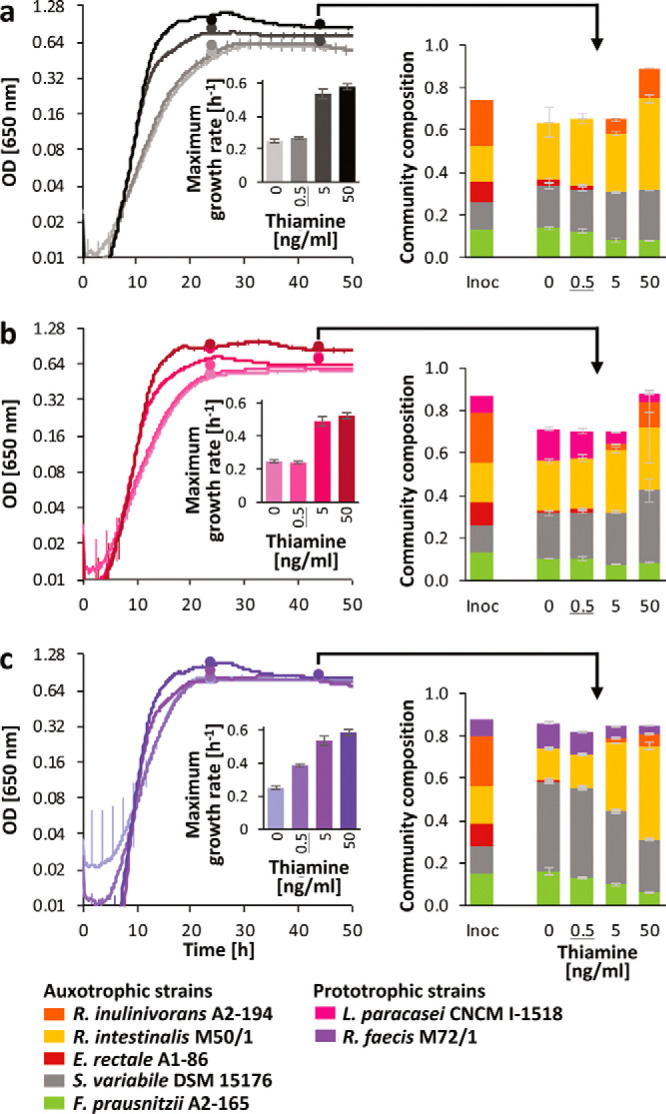
Coculture growth in 96-well plates in the presence of increasing thiamine concentrations. (a to c) Growth curves and their corresponding maximum growth rates are shown for a five-membered auxotrophic community (a) or the same community with a thiamine prototrophic strain (L. paracasei CNCM I-1518 [b] or R. faecis M72/1 [c]). Error bars are means of 12 individual time points to facilitate visibility of the curves. Colored stacked bar graphs show the relative community composition of the inoculum (Inoc) (scaled to 100× relative to grown cultures for visibility) and after 44 h of community growth in a replicate plate set up for sampling as indicated by the arrows (individual data points on the growth curves show optical density of the replicate plate after 24 and 44 h of incubation). The sum of the percentage of all strains is scaled to the OD of the original sample. The thiamine concentration closest to the estimated in vivo concentrations (34) is underlined.
FIG 6
FIG 6
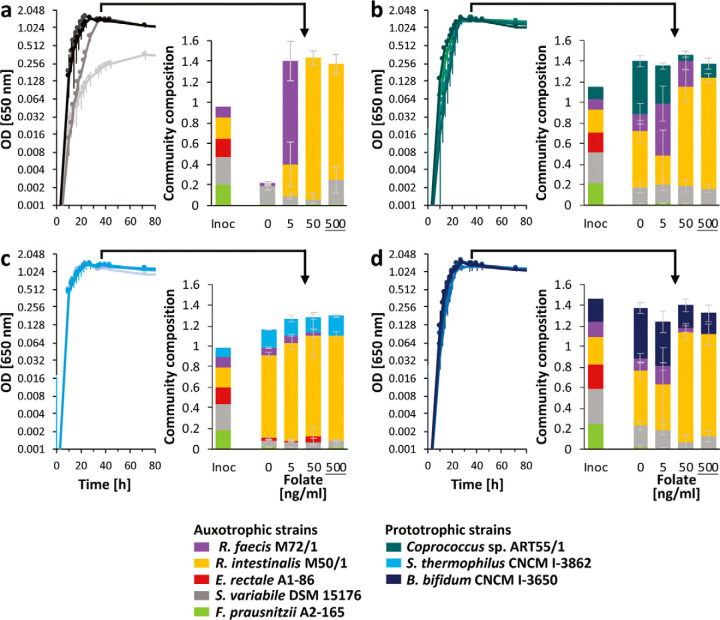
Coculture growth in Hungate tubes in the presence of increasing folate concentrations. (a to d) Growth curves (increasing darkness with increasing folate concentrations) are shown for a five-membered auxotrophic community (a) or the same community with a folate prototrophic strain (Coprococcus sp. ART55/1 [b], S. thermophilus CNCM I-3862 [c], or B. bifidum CNCM I-3650 [d]). Colored stacked bar graphs show the relative community composition of the inoculum (Inoc) (scaled to 300× relative to grown cultures for visibility) and after 36 h of growth in stationary phase as indicated by the arrows. The sum of the percentage of all strains is scaled to the OD of the original sample. The folate concentration closest to the estimated in vivo concentrations (34) is underlined.

References

    1. Louis P, Hold GL, Flint HJ. 2014. The gut microbiota, bacterial metabolites and colorectal cancer. Nat Rev Microbiol 12:661–672. doi: 10.1038/nrmicro3344. - DOI - PubMed
    1. Louis P, Flint HJ. 2009. Diversity, metabolism and microbial ecology of butyrate-producing bacteria from the human large intestine. FEMS Microbiol Lett 294:1–8. doi: 10.1111/j.1574-6968.2009.01514.x. - DOI - PubMed
    1. Louis P, Flint HJ. 2017. Formation of propionate and butyrate by the human colonic microbiota. Environ Microbiol 19:29–41. doi: 10.1111/1462-2920.13589. - DOI - PubMed
    1. Sheridan PO, Martin JC, Lawley TD, Browne HP, Harris HM, Bernalier-Donadille A, Duncan SH, O’Toole PW, Scott KP, Flint HJ. 2016. Polysaccharide utilization loci and nutritional specialization in a dominant group of butyrate-producing human colonic Firmicutes Microb Genom 2:e000043. doi: 10.1099/mgen.0.000043. - DOI - PMC - PubMed
    1. Reichardt N, Vollmer M, Holtrop G, Farquharson FM, Wefers D, Bunzel M, Duncan SH, Drew JE, Williams LM, Milligan G, Preston T, Morrison D, Flint HJ, Louis P. 2018. Specific substrate-driven changes in human faecal microbiota composition contrast with functional redundancy in short-chain fatty acid production. ISME J 12:610–622. doi: 10.1038/ismej.2017.196. - DOI - PMC - PubMed

Publication types

Supplementary concepts

LinkOut - more resources