Renal hyperfiltration is independently associated with increased all-cause mortality in individuals with type 2 diabetes: a prospective cohort study
- PMID: 32665314
- PMCID: PMC7365485
- DOI: 10.1136/bmjdrc-2020-001481
Renal hyperfiltration is independently associated with increased all-cause mortality in individuals with type 2 diabetes: a prospective cohort study
Abstract
Introduction: In addition to favoring renal disease progression, renal 'hyperfiltration' has been associated with an increased risk of death, though it is unclear whether and how excess mortality is related to increased renal function. We investigated whether renal hyperfiltration is an independent predictor of death in patients with type 2 diabetes from the Renal Insufficiency And Cardiovascular Events Italian multicenter study.
Research design and methods: This observational, prospective cohort study enrolled 15 773 patients with type 2 diabetes consecutively attending 19 Italian diabetes clinics in 2006-2008. Serum creatinine, albuminuria, cardiovascular risk factors, and complications/comorbidities were assessed at baseline. Vital status on 31 October 2015 was retrieved for 15 656 patients (99.26%). Patients were stratified (A) by absolute estimated glomerular filtration rate (eGFR) values in eGFR deciles or Kidney Disease: Improving Global Outcomes (KDIGO) categories and (B) based on age-corrected thresholds or age and gender-specific 95th and 5th percentiles in hyperfiltration, hypofiltration, and normofiltration groups.
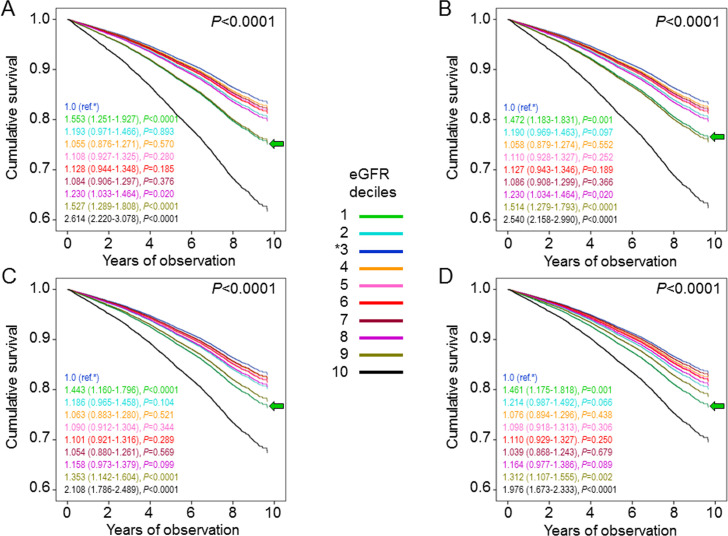
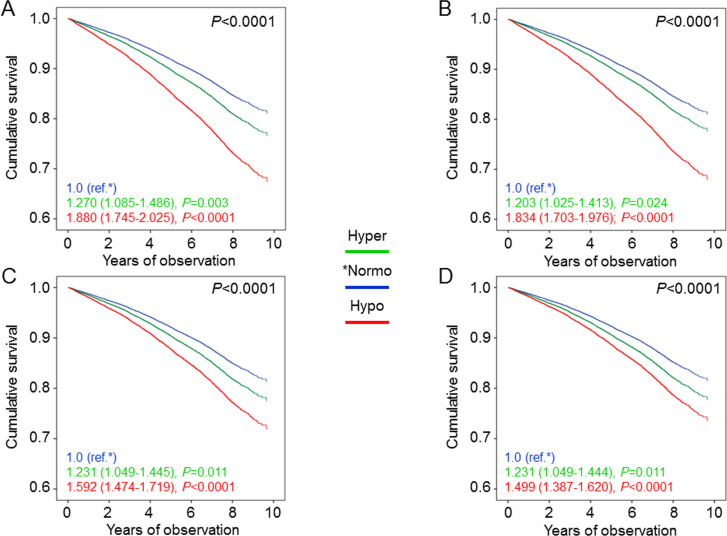
Results: The highest eGFR decile/category and the hyperfiltration group included (partly) different individuals with similar clinical features. Age and gender-adjusted death rates were significantly higher in deciles 1, 9, and 10 (≥103.9, 50.9-62.7, and <50.9 mL/min/1.73 m2, respectively) versus the reference decile 3 (92.9-97.5 mL/min/1.73 m2). Mortality risk, adjusted for multiple confounders, was also increased in deciles 1 (HR 1.461 (95% CI 1.175 to 1.818), p=0.001), 9 (1.312 (95% CI 1.107 to 1.555), p=0.002), and 10 (1.976 (95% CI 1.673 to 2.333), p<0.0001) versus decile 3. Similar results were obtained by stratifying patients by KDIGO categories. Death rates and adjusted mortality risks were significantly higher in hyperfiltering and particularly hypofiltering versus normofiltering individuals.
Conclusions: In type 2 diabetes, both high-normal eGFR and hyperfiltration are associated with an increased risk of death from any cause, independent of confounders that may directly impact on mortality and/or affect GFR estimation. Further studies are required to clarify the nature of this relationship.
Trial registration number: NCT00715481.
Keywords: diabetes mellitus, type 2; kidney diseases; mortality.
© Author(s) (or their employer(s)) 2020. Re-use permitted under CC BY-NC. No commercial re-use. See rights and permissions. Published by BMJ.
Conflict of interest statement
Competing interests: GPe: lecture fees from AstraZeneca, Boehringer Ingelheim, Eli Lilly, Merck Sharp & Dohme, Novo Nordisk, Sigma-Tau, and Takeda, and travel grants from AstraZeneca, Novo Nordisk, and Takeda. EO: consultant fees from Eli Lilly and Novo Nordisk. AS: consultant fees from AstraZeneca, Boehringer Ingelheim, and Sanofi-Aventis, and lecture fees from AstraZeneca, Boehringer Ingelheim, Eli Lilly, and Mundipharma. EB: consultant fees from Abbott, AstraZeneca, Boehringer Ingelheim, Bristol-Myers Squibb, Bruno Farmaceutici, Eli Lilly, Janssen, Johnson & Johnson, Merck Sharp & Dohme, Mundipharma, Novartis, Novo Nordisk, Roche, Sanofi-Aventis, Servier, and Takeda, and research grants from AstraZeneca, Genzyme, Menarini Diagnostics, Novo Nordisk, Roche, and Takeda. CF: lecture fees from AstraZeneca, Boehringer Ingelheim, Eli Lilly, and Novo Nordisk and travel grants from AstraZeneca, Boehringer Ingelheim, Eli Lilly, Merck Sharp & Dohme, Sanofi-Aventis, and Takeda. RT: consultant fees from AstraZeneca, Boehringer Ingelheim, Eli Lilly, Merck Sharp & Dohme, Novo Nordisk, and Sanofi-Aventis, and lecture fees from AstraZeneca, Boehringer Ingelheim, Eli Lilly, and Novo Nordisk. MV: lecture fees from LifeScan and Novo Nordisk. FC: lecture fees from AstraZeneca, Sanofi-Aventis, and Takeda. GG: lecture fees from Boehringer Ingelheim and Mundipharma. LL: consultant fees from Abbott, AstraZeneca, Boehringer Ingelheim, Eli Lilly, Medtronic, Movi, Novo Nordisk, Roche, Sanofi-Aventis, and Takeda, and lecture fees from Abbott, AstraZeneca, Boehringer Ingelheim, Eli Lilly, Medtronic, Menarini, Merck Sharp & Dohme, Movi, Mundipharma, Novo Nordisk, Roche, Sanofi-Aventis, and Takeda. AN: consultant fees from AstraZeneca, Pikdare, Roche, lecture fees from AstraZeneca, Boehringer Ingelheim, Medtronic, and Novo Nordisk, and research grants from Aboca, AstraZeneca, Eli Lilly, Novo Nordisk, Sanofi-Aventis, and Theras. GPu: consultant fees from AstraZeneca, Boehringer Ingelheim, and Eli Lilly, lecture fees from AstraZeneca, Boehringer Ingelheim, Eli Lilly, Merck Sharp & Dohme, Mundipharma, Novartis, Novo Nordisk, Sigma-Tau, Takeda, and travel grants from AstraZeneca, Laboratori Guidotti, Sanofi-Aventis, and Takeda.
Figures
References
Publication types
MeSH terms
Associated data
LinkOut - more resources
Full Text Sources
Medical
Research Materials
Miscellaneous