


BMI and future risk for COVID-19 infection and death across sex, age and ethnicity: Preliminary findings from UK biobank
- PMID: 32668401
- PMCID: PMC7326434
- DOI: 10.1016/j.dsx.2020.06.060
BMI and future risk for COVID-19 infection and death across sex, age and ethnicity: Preliminary findings from UK biobank
Abstract
Aims: We examined the link between BMI and risk of a positive test for SARS-CoV-2 and risk of COVID-19-related death among UK Biobank participants.
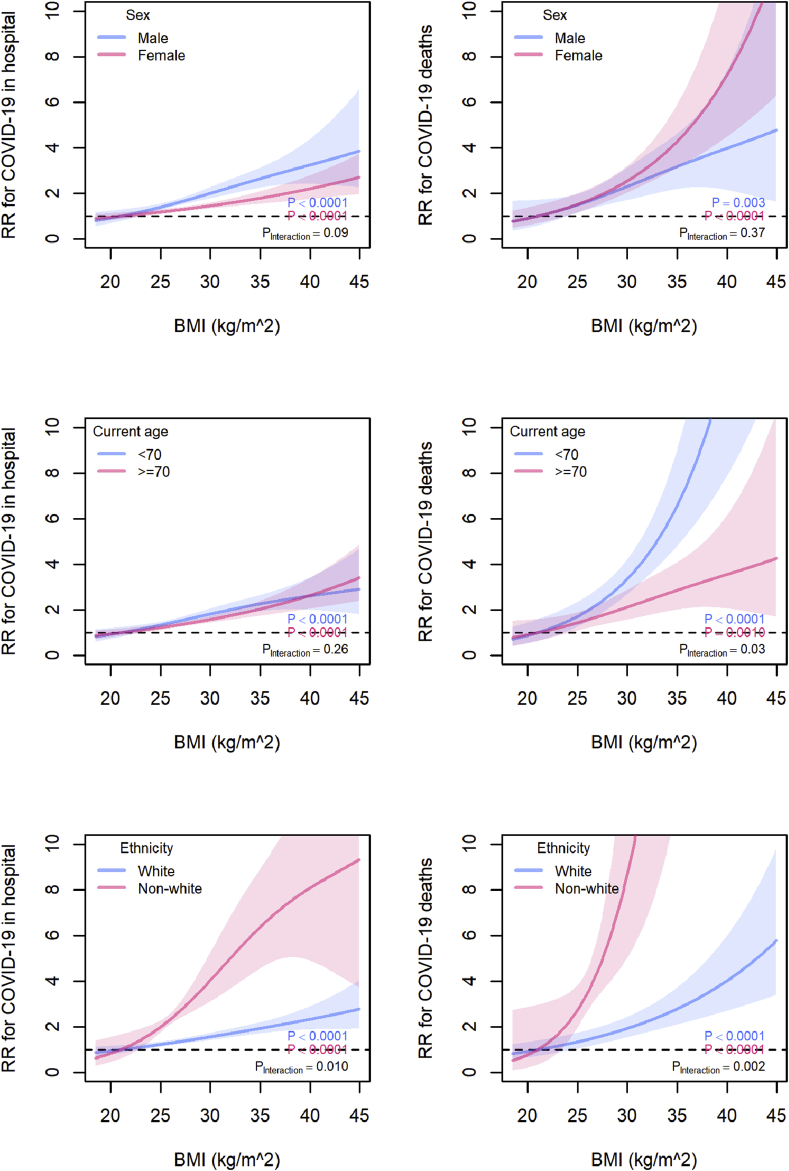
Methods: Among 4855 participants tested for SARS-CoV-2 in hospital, 839 were positive and of these 189 died from COVID-19. Poisson models with penalised thin plate splines were run relating exposures of interest to test positivity and case-fatality, adjusting for confounding factors.
Results: BMI was associated strongly with positive test, and risk of death related to COVID-19. The gradient of risk in relation to BMI was steeper in those under 70, compared with those aged 70 years or older for COVID-19 related death (Pinteraction = 0.03). BMI was more strongly related to test positivity (Pinteraction = 0.010) and death (Pinteraction = 0.002) in non-whites (predominantly South Asians and Afro-Caribbeans), compared with whites.
Conclusions: These data add support for adiposity being more strongly linked to COVID-19-related deaths in younger people and non-white ethnicities. If future studies confirm causality, lifestyle interventions to improve adiposity status may be important to reduce the risk of COVID-19 in all, but perhaps particularly, non-white communities.
Keywords: Body mass index; COVID-19; Obesity.
Copyright © 2020 The Authors. Published by Elsevier Ltd.. All rights reserved.
Conflict of interest statement
Declaration of competing interest NS reports personal fees from Amgen, AstraZeneca, Eli Lilly, Novo Nordisk, Pfizer, and Sanofi, and grants and personal fees from Boehringer Ingelheim, outside the submitted work. PW reports grant from Boehringer Ingelheim outside submitted work. All other authors declare no competing interests.
Figures
References
-
- Petrilli C.M., Jones S.A., Yang J. medRxiv; 2020. Factors associated with hospitalization and critical illness among 4,103 patients with COVID-19 disease in New York City. 2020.04.08.20057794.
-
- Ntuk U.E., Gill J.M.R., Mackay D.F., Sattar N., Pell J.P. Ethnic-specific obesity cutoffs for diabetes risk: cross-sectional study of 490,288 UK Biobank participants. Diabetes Care. 2014;37:2500–2507. - PubMed
-
- Williamson E., Walker A.J., Bhaskaran K.J. medRxiv; 2020. OpenSAFELY: factors associated with COVID-19-related hospital death in the linked electronic health records of 17 million adult NHS patients. 2020.05.06.20092999.
MeSH terms
Grants and funding
LinkOut - more resources
Full Text Sources
Miscellaneous
