Review
. 2020 Jun 16:11:699.
doi: 10.3389/fphys.2020.00699. eCollection 2020.

The Modulation of Mucosal Antiviral Immunity by Immunobiotics: Could They Offer Any Benefit in the SARS-CoV-2 Pandemic?

Affiliations
Review

The Modulation of Mucosal Antiviral Immunity by Immunobiotics: Could They Offer Any Benefit in the SARS-CoV-2 Pandemic?

Julio Villena et al. Front Physiol. .

Abstract

Viral respiratory infections are of major importance because of their capacity to cause of a high degree of morbidity and mortality in high-risk populations, and to rapidly spread between countries. Perhaps the best example of this global threat is the infectious disease caused by the new SARS-CoV-2 virus, which has infected more than 4 million people worldwide, causing the death of 287,000 persons according to the WHO's situation report on May 13, 2020. The availability of therapeutic tools that would be used massively to prevent or mitigate the detrimental effects of emerging respiratory viruses on human health is therefore mandatory. In this regard, research from the last decade has reported the impact of the intestinal microbiota on the respiratory immunity. It was conclusively demonstrated how the variations in the intestinal microbiota affect the responses of respiratory epithelial cells and antigen presenting cells against respiratory virus attack. Moreover, the selection of specific microbial strains (immunobiotics) with the ability to modulate immunity in distal mucosal sites made possible the generation of nutritional interventions to strengthen respiratory antiviral defenses. In this article, the most important characteristics of the limited information available regarding the immune response against SARS-CoV-2 virus are revised briefly. In addition, this review summarizes the knowledge on the cellular and molecular mechanisms involved in the improvement of respiratory antiviral defenses by beneficial immunobiotic microorganisms such as Lactobacillus rhamnosus CRL1505. The ability of beneficial microorganisms to enhance type I interferons and antiviral factors in the respiratory tract, stimulate Th1 response and antibodies production, and regulate inflammation and coagulation activation during the course of viral infections reducing tissue damage and preserving lung functionally, clearly indicate the potential of immunobiotics to favorably influence the immune response against SARS-CoV-2 virus.

Keywords: beneficial microbes; coronavirus; immunobiotics; inflammation; respiratory viral infections.


Figures

Figure 1
Figure 1
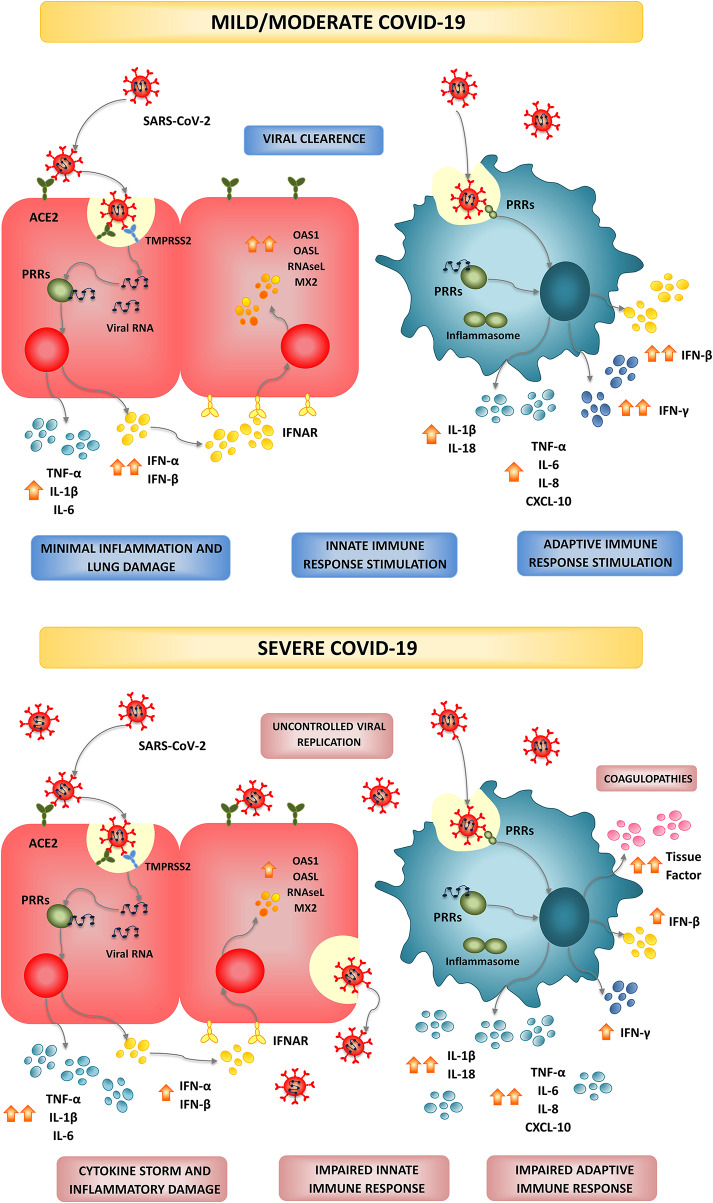
Infection and modulation of the immune system by SARS-CoV-2. In most individuals, SARS-CoV-2 infection triggers and efficient and timely production of type I IFNs and inflammatory cytokines by epithelial cells and immune cells creating an antiviral state and inducing the recruitment of additional immune cells that collaborate to clear the infection in the lung, with minimal inflammation and damage. This type of immune response is associated to mild or moderate forms of COVID-19 and patients finally recover. In high-risk populations such as the elderly and persons with comorbidities, a dysfunctional immune response is triggered by SARS-CoV-2 infection. A severe type of COVID-19 characterized by a cytokine storm that mediates widespread lung inflammation, coagulopathies, organ failure, and death occurs in some patients.
Figure 2
Figure 2
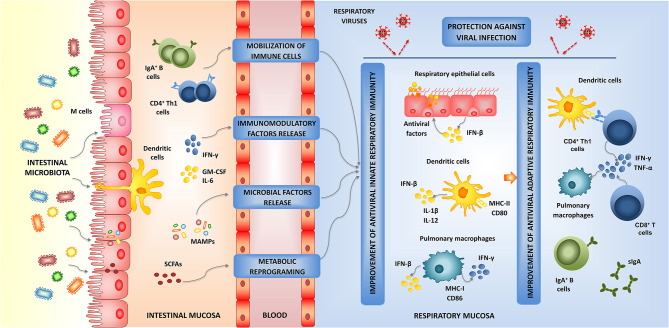
Modulation of respiratory antiviral immunity by intestinal microbiota. Proposed mechanism for the distal immunomodulation induced by the intestinal microbiota and the enhancement of the resistance against viral infections through the improvement of the respiratory innate and adaptive antiviral immune responses.
Figure 3
Figure 3
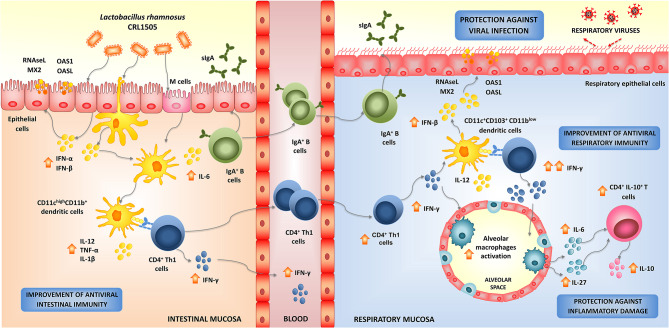
Modulation of respiratory antiviral immunity by Lactobacillus rhamnosus CRL1505. Proposed mechanism for the distal immunomodulation induced by the immunobiotic strain L. rhamnosus CRL1505 and the enhancement of the resistance against viral infections through the improvement of the respiratory innate and adaptive antiviral immune responses.
Figure 4
Figure 4
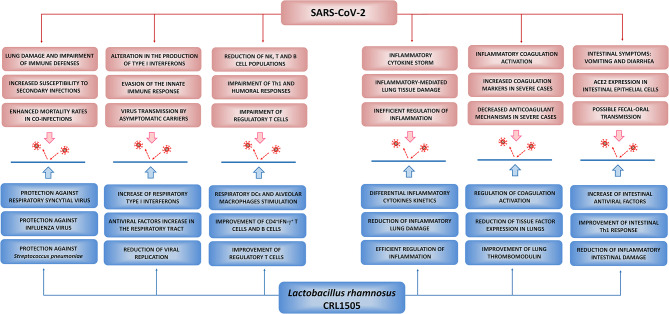
Potential beneficial effects of Lactobacillus rhamnosus CRL1505 against SARS-CoV-2 infection. Proposed potential benefits in the reduction of the incidence and severity of COVID-19 induced by nutritional interventions with the immunobiotic strain L. rhamnosus CRL1505. The principal pathological and immunological alterations during SARS-CoV-2 infection were summarized from Jamilloux et al. (2020), Tay et al. (2020), Merad and Martin (2020), and Chen N. et al. (2020). The beneficial effects of L. rhamnosus CRL1505 in the respiratory tract were summarized from Villena et al. (2012a), Chiba et al. (2013), and Zelaya et al. (2014). The beneficial effects of L. rhamnosus CRL1505 in the intestinal tract were summarized from Villena et al. (2014), Tada et al. (2016), and Albarracin et al. (2017, 2020).
Figure 5
Figure 5
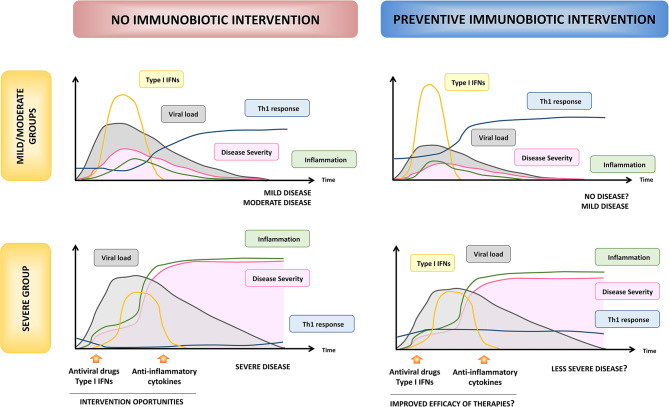
Hypothesis of the beneficial effects of preventive immunobiotic intervention on SARS-CoV-2 infection. The kinetics and intensity of immune actors involved in the response to SARS-CoV-2, viral load and COVID-19 severity are shown according to Jamilloux et al. (2020) in both “mild/moderate” and “severe” susceptible hosts. Optimal times for therapeutic interventions proposed to ameliorate disease severity are also shown (left panels). The potential modulation of the kinetics and intensity of immune response, viral load, and disease severity by preventive nutritional immunobiotic interventions for low and high susceptible hosts are shown in the right panels.

References

    1. Abt M. C., Osborne L. C., Monticelli L. A., Doering T. A., Alenghat T., Sonnenberg G. F., et al. (2012). Commensal bacteria calibrate the activation threshold of innate antiviral immunity. Immunity 37, 158–170. 10.1016/j.immuni.2012.04.011 - DOI - PMC - PubMed
    1. Addie D., Curran S., Bellini F., Crowe B., Sheehan E., Ukrainchuk L., et al. (2020). Oral Mutian®X stopped faecal feline coronavirus shedding by naturally infected cats. Res. Vet. Sci. 130:222–229. 10.1016/j.rvsc.2020.02.012 - DOI - PMC - PubMed
    1. Aeffner F., Traylor Z. P., Yu E. N. Z., Davis I. C. (2011). Double-stranded RNA induces similar pulmonary dysfunction to respiratory syncytial virus in BALB/c mice. Am. J. Physiol. Lung Cell. Mol. Physiol. 301, 99–109. 10.1152/ajplung.00398.2010 - DOI - PubMed
    1. Ahanchian H., Jafari S. A., Ansari E., Ganji T., Kiani M. A., Khalesi M., et al. (2016). A multi-strain synbiotic may reduce viral respiratory infections in asthmatic children: a randomized controlled trial. Electr. Phys. 8, 2833–2839. 10.19082/2833 - DOI - PMC - PubMed
    1. Albarracin L., García-Castillo V., Masumizu Y., Indo Y., Islam M. A., Suda Y., et al. (2020). Efficient selection of new immunobiotic strains with antiviral effects in local and distal mucosal sites by using porcine intestinal epitheliocytes. Front. Immunol. 11:543. 10.3389/fimmu.2020.00543 - DOI - PMC - PubMed