


Study Protocol of Brief Daily Body-Mind-Spirit Practice for Sustainable Emotional Capacity and Work Engagement for Community Mental Health Workers: A Multi-Site Randomized Controlled Trial
- PMID: 32670170
- PMCID: PMC7332841
- DOI: 10.3389/fpsyg.2020.01482
Study Protocol of Brief Daily Body-Mind-Spirit Practice for Sustainable Emotional Capacity and Work Engagement for Community Mental Health Workers: A Multi-Site Randomized Controlled Trial
Abstract
Background: Given the emotional demanding nature of social services, we developed a brief daily body-mind-spirit (BMS) program and successfully piloted it with workers at elderly services. The proposed study focuses on community mental health workers who are often under chronic stress and vulnerable to burnout.
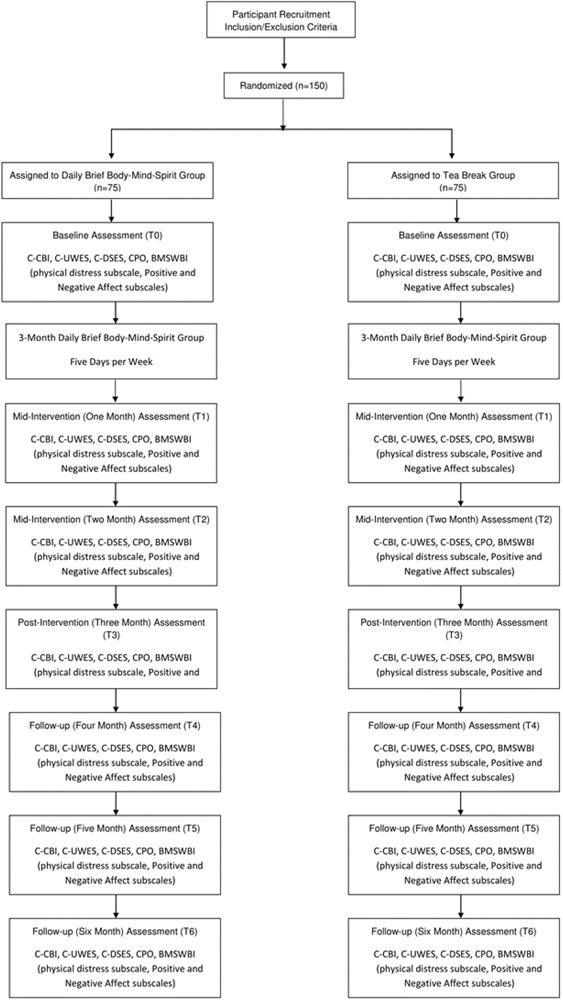
Methods: The study aims to evaluate the program for fostering sustainable emotional capacity and work engagement for community mental health workers. A multi-site randomized controlled trial design is adopted. All the 24 the Integrated Community Centre for Mental Wellness (ICCMW of Hong Kong will be approached to join this program. Assuming conservatively, 60% ICCWM (14 centers) will respond and participate. At each site, a pair of intervention and control groups will be run. The targeted total sample size is 224. To investigate the course of changes in burnout and engagement, each group will last 6 months, including 3-month intervention and 3-month follow-up. Measures will be taken at monthly intervals.
Discussion: In light of literature and the pilot trial's findings, participants in the Brief Daily BMS intervention group are expected to have a reduced burnout level and a narrowing of range in work engagement during the 3 months intervention. And within the 3 months post-intervention period, a rebound of burnout level and a widening of range in work engagement are expected to be observed in the same group of participants. Hopefully, this study will contribute to the deeper understanding of burnout and work engagement, and shed light on sustainable intervention for emotionally demanding workplaces.
Clinical trial registration: The trial has been registered in the Clinical Trials Centre of the University of Hong Kong. HKUCTR-2763 Registered 27 December 2019 - Retrospectively registered, http://www.hkuctr.com/Study/Show/eb930d24e2c647afb7a922055163f24b.
Keywords: body-mind-spirit (BMS) practice; burnout; community mental health workers; randomized controlled trial (RCT); work engagement.
Copyright © 2020 Ng, Lo, Yeung, Young, Fung and Wang.
Figures
References
-
- Bailey C., Madden A., Alfes K., Fletcher L. (2017). The meaning, antecedents and outcomes of employee engagement: a narrative synthesis. Int. J. Manag. Rev. 19 31–53. 10.1111/ijmr.12077 - DOI
-
- Bakker A. B., Albrecht S. L., Leiter M. P. (2011). Key questions regarding work engagement. Eur. J. Work Organ. Psychol. 20 4–28. 10.1080/1359432x.2010.485352 - DOI
-
- Barattucci M., Padovan A., Vitale E., Rapisarda V., Ramaci T., De Giorgio A. (2019). Mindfulness-based IARA Model® proves effective to reduce stress and anxiety in health care professionals. a six-month follow-up study. Int. J. Environ. Res. Public Health 16:4421. 10.3390/ijerph16224421 - DOI - PMC - PubMed
-
- Beckers D. G., van der Linden D., Smulders P. G., Kompier M. A., van Veldhoven M. J., van Yperen N. W. (2004). Working overtime hours: relations with fatigue, work motivation, and the quality of work. J. Occup. Environ. Med. 46 1282–1289. - PubMed
LinkOut - more resources
Full Text Sources
