Review
. 2020 Jun 26:11:1297.
doi: 10.3389/fmicb.2020.01297. eCollection 2020.

Chikungunya Virus: An Emergent Arbovirus to the South American Continent and a Continuous Threat to the World

Affiliations
Review

Chikungunya Virus: An Emergent Arbovirus to the South American Continent and a Continuous Threat to the World

Marcela S Cunha et al. Front Microbiol. .

Abstract

Chikungunya virus (CHIKV) is an arthropod-borne virus (arbovirus) of epidemic concern, transmitted by Aedes ssp. mosquitoes, and is the etiologic agent of a febrile and incapacitating arthritogenic illness responsible for millions of human cases worldwide. After major outbreaks starting in 2004, CHIKV spread to subtropical areas and western hemisphere coming from sub-Saharan Africa, South East Asia, and the Indian subcontinent. Even though CHIKV disease is self-limiting and non-lethal, more than 30% of the infected individuals will develop chronic disease with persistent severe joint pain, tenosynovitis, and incapacitating polyarthralgia that can last for months to years, negatively impacting an individual's quality of life and socioeconomic productivity. The lack of specific drugs or licensed vaccines to treat or prevent CHIKV disease associated with the global presence of the mosquito vector in tropical and temperate areas, representing a possibility for CHIKV to continually spread to different territories, make this virus an agent of public health burden. In South America, where Dengue virus is endemic and Zika virus was recently introduced, the impact of the expansion of CHIKV infections, and co-infection with other arboviruses, still needs to be estimated. In Brazil, the recent spread of the East/Central/South Africa (ECSA) and Asian genotypes of CHIKV was accompanied by a high morbidity rate and acute cases of abnormal disease presentation and severe neuropathies, which is an atypical outcome for this infection. In this review, we will discuss what is currently known about CHIKV epidemics, clinical manifestations of the human disease, the basic concepts and recent findings in the mechanisms underlying virus-host interaction, and CHIKV-induced chronic disease for both in vitro and in vivo models of infection. We aim to stimulate scientific debate on how the characterization of replication, host-cell interactions, and the pathogenic potential of the new epidemic viral strains can contribute as potential developments in the virology field and shed light on strategies for disease control.

Keywords: Chikungunya virus; emergent arbovirus; epidemiology; pathogenesis; virus–cell interaction.


Figures

FIGURE 1
FIGURE 1
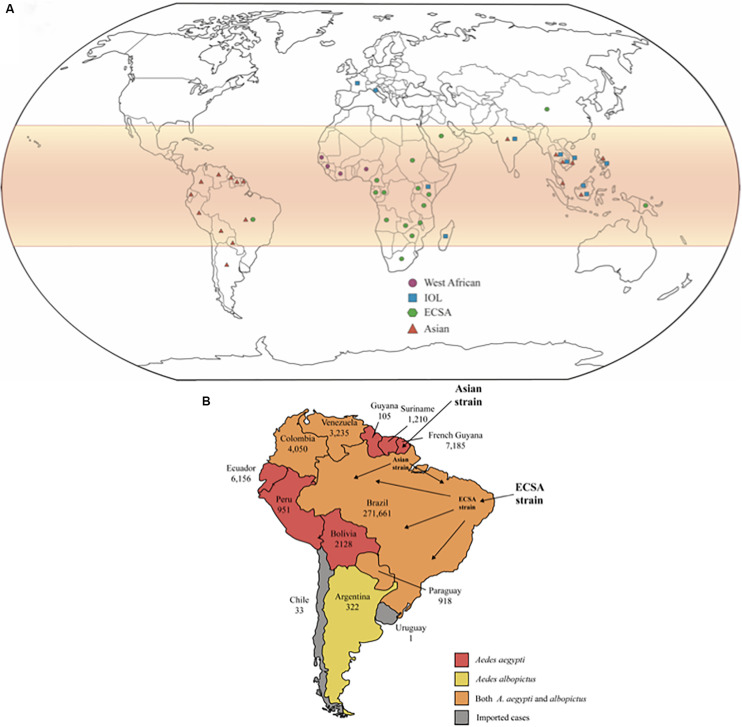
(A) Global distribution of CHIKV lineages. CHIKV infections are more likely to occur in tropical and sub-tropical regions of the globe, highlighted in red on the map. The geometric forms represent the different lineages of CHIKV that are currently in circulation. (B) The number of confirmed cases is shown for each country individually. There is not autochthonous transmission reported in Chile and Uruguay, only imported cases. The Asian strain first reached South America by French Guyana, but ECSA strain has arrived by northeast Brazil and got predominated in Brazil. The colors represent the circulation of Aedes aegypti and albopictus in each country, as indicated in the subtitle.
FIGURE 2
FIGURE 2
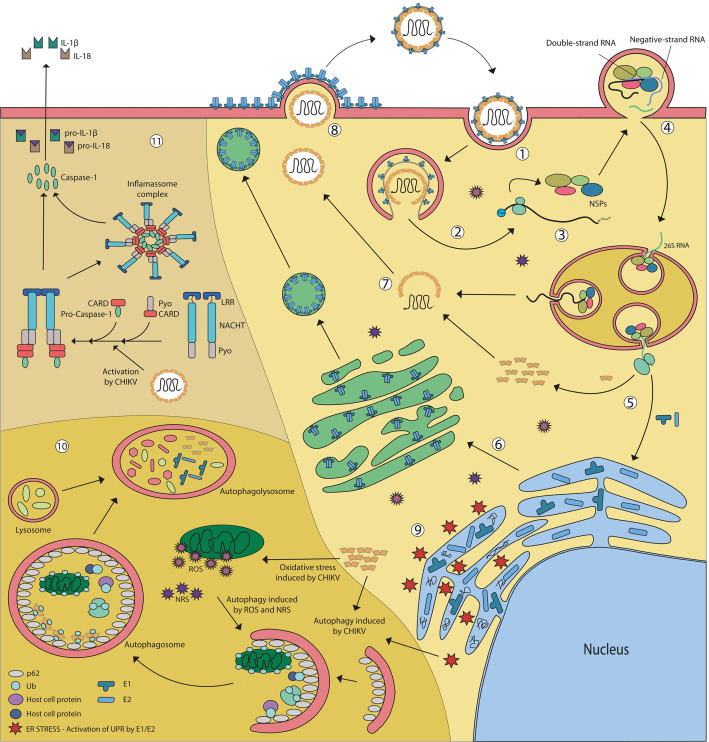
CHIKV life cycle in mammalian infected cells. (1) CHIKV cell binding occurs through the interaction of virus E2 protein and a still unknown cellular receptor. Like other alphaviruses, it can enter the cell by clathrin-dependent and independent endocytosis. (2) Once inside the endosome, the acidic environment leads to conformational rearrangement of glycoproteins followed by dissociation of E2-E1 heterodimers and E1 rearrangement into fusogenic homotrimers that induce fusion of viral and endosomal membrane, allowing the release of nucleocapsid into the cytosol. (3) Following uncoating and genomic RNA release, the non-structural proteins are translated as polyproteins denominated P123 and P1234. (4) A replicative complex (RC) formed by uncleaved P123 plus nsP4, the genomic RNA, and several host factors is targeted and anchored at the plasma membrane inducing bulb-shaped invaginations, known as spherules, where RNA synthesis will occur. dsRNA indicates the viral replicative intermediate. nsP1-3 associates with nsP4 in a specific quaternary structure converts the RC into a positive-strand RNA replicase, which synthesizes the viral genomic and subgenomic RNAs. Spherules are internalizate and shape functional large cytopathic vacuoles that bear multiple spherules. (5) Subgenomic RNA (26S) is translated, producing the structural polyprotein (6) E1and E2-E3 (pE2) are translocated into the ER and go through the post-translational process of maturation and glycosylation. (7) Capsid autoproteolysis releases free capsid into the cytoplasm that interacts with genomic RNA, giving origin to the nucleocapsid. (8) The viruses bud out of infected cells through the cell membrane in a pH and temperature-dependent process. (9) CHIKV replication induces ER stress and activates the Unfolded Protein Response (UPR). By non-elucidated mechanisms CHIKV infection also results in oxidative stress, generating Reactive Oxygen Species (ROS) and Reactive Nitrogen Species (NRS). (10) Both ER and oxidative stress can trigger autophagy, a pro-survival signal, in an attempt to preserve cell viability. When CHIKV capsid is produced in the cytoplasm, it can be ubiquitinated and sequestered by adaptor protein SQMT1/p62 into the autophagosomes, leading to capsid degradation in the autophagolisosome. (11) CHIKV is able to trigger NLRP3 inflammasome, starting a signaling cascade that culminates in the activation of the caspase 1, that turns able to cleaves of pro IL-1β and pro IL-18, generating mature cytokines, that will elicit adaptive responses, but also can contribute to pathological inflammatory events such as edema and arthritic disease symptoms.

References

    1. Agarwal A., Sharma A. K., Sukumaran D., Parida M., Dash P. K. (2016). Two novel epistatic mutations (E1:K211E and E2:V264A) in structural proteins of Chikungunya virus enhance fitness in Aedes aegypti. Virology 497 59–68. 10.1016/j.virol.2016.06.025 - DOI - PubMed
    1. Akhrymuk I., Lukash T., Frolov I., Frolova E. I. (2019). Novel mutations in nsP2 abolish chikungunya virus-induced transcriptional shutoff and make the virus less cytopathic without affecting its replication rates. J. Virol. 93:e02062-18 10.1128/JVI.02062-2018 - DOI - PMC - PubMed
    1. Aliperti G., Schlesinger M. J. (1978). Evidence for an autoprotease activity of sindbis virus capsid protein. Virology 90 366–369. 10.1016/0042-6822(78)90321-5 - DOI - PubMed
    1. Alva-Urcia C., Aguilar-Luis M. A., Palomares-Reyes C., Silva-Caso W., Suarez-Ognio L., Weilg P., et al. (2017). Emerging and reemerging arboviruses: a new threat in eastern peru. PLoS One 12:e0187897 10.1371/journal.pone.0187897 - DOI - PMC - PubMed
    1. Ambrose R. L., Mackenzie J. M. (2011). West Nile virus differentially modulates the unfolded protein response to facilitate replication and immune evasion. J. Virol. 85 2723–2732. 10.1128/JVI.02050-2010 - DOI - PMC - PubMed

LinkOut - more resources