


Artificial Intelligence in Skin Cancer Diagnostics: The Patients' Perspective
- PMID: 32671078
- PMCID: PMC7326111
- DOI: 10.3389/fmed.2020.00233
Artificial Intelligence in Skin Cancer Diagnostics: The Patients' Perspective
Abstract
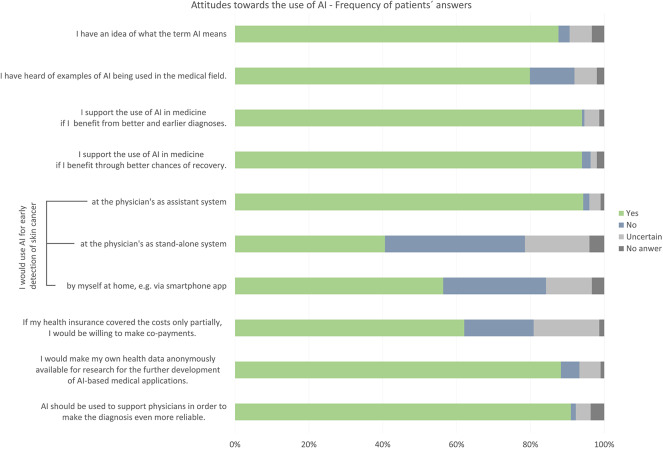
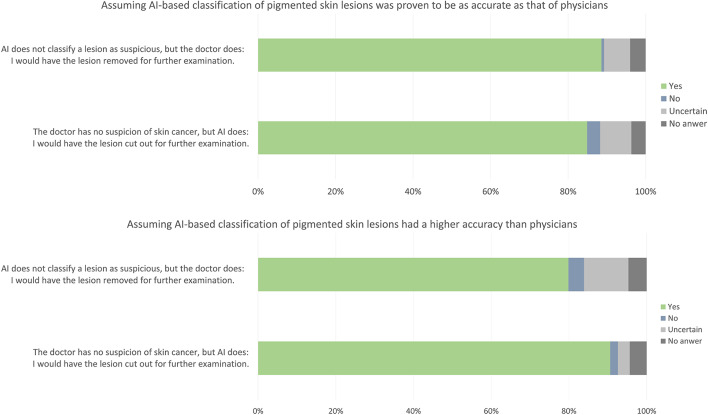
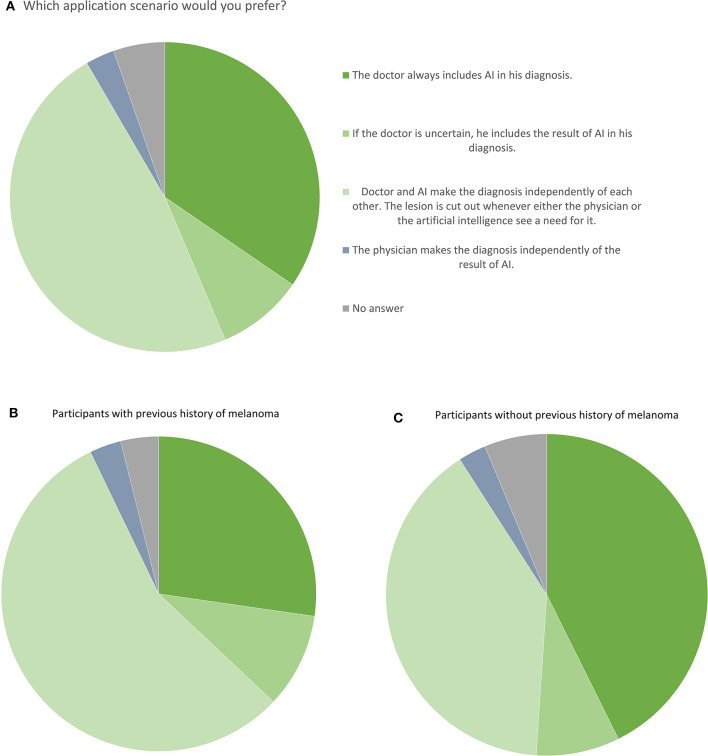
Background: Artificial intelligence (AI) has shown promise in numerous experimental studies, particularly in skin cancer diagnostics. Translation of these findings into the clinic is the logical next step. This translation can only be successful if patients' concerns and questions are addressed suitably. We therefore conducted a survey to evaluate the patients' view of artificial intelligence in melanoma diagnostics in Germany, with a particular focus on patients with a history of melanoma. Participants and Methods: A web-based questionnaire was designed using LimeSurvey, sent by e-mail to university hospitals and melanoma support groups and advertised on social media. The anonymous questionnaire evaluated patients' expectations and concerns toward artificial intelligence in general as well as their attitudes toward different application scenarios. Descriptive analysis was performed with expression of categorical variables as percentages and 95% confidence intervals. Statistical tests were performed to investigate associations between sociodemographic data and selected items of the questionnaire. Results: 298 individuals (154 with a melanoma diagnosis, 143 without) responded to the questionnaire. About 94% [95% CI = 0.91-0.97] of respondents supported the use of artificial intelligence in medical approaches. 88% [95% CI = 0.85-0.92] would even make their own health data anonymously available for the further development of AI-based applications in medicine. Only 41% [95% CI = 0.35-0.46] of respondents were amenable to the use of artificial intelligence as stand-alone system, 94% [95% CI = 0.92-0.97] to its use as assistance system for physicians. In sub-group analyses, only minor differences were detectable. Respondents with a previous history of melanoma were more amenable to the use of AI applications for early detection even at home. They would prefer an application scenario where physician and AI classify the lesions independently. With respect to AI-based applications in medicine, patients were concerned about insufficient data protection, impersonality and susceptibility to errors, but expected faster, more precise and unbiased diagnostics, less diagnostic errors and support for physicians. Conclusions: The vast majority of participants exhibited a positive attitude toward the use of artificial intelligence in melanoma diagnostics, especially as an assistance system.
Keywords: acceptance; artificial intelligence; diagnostics; melanoma; online survey; patients view; skin cancer.
Copyright © 2020 Jutzi, Krieghoff-Henning, Holland-Letz, Utikal, Hauschild, Schadendorf, Sondermann, Fröhling, Hekler, Schmitt, Maron and Brinker.
Figures
References
LinkOut - more resources
Full Text Sources
